CLASS 2 MATHS • THE EQUAL SHARING PLAYGROUND
Division Worksheets for Class 2
with Online Activities and Quiz
Share fairly, pack equal groups and hop back to zero. Explore division with counters, pictures, listening and small thinking challenges.
Share and Group
Move counters into baskets and build equal packs.
See Hear and Do
Build arrays, deal one at a time and explore leftovers.
Think and Explain
Repair unfair shares and check division with multiplication.
Division Class 2 Online Quiz
Question 1 / 20 • Easy
Share 6 counters equally between 2 children. How many does each get?
Tap an answer to continue.
Quiz and listening guide
There are 10 easy, five average and five thinking questions. The 20-minute timer starts with the first answer or question-navigation action. Read-aloud alone does not start it. Answers advance except at the last question. Revisit any question before submitting. Submission or timeout shows the score and all explanations. Restart clears answers and pauses the timer. Reading depends on browser speech; all text remains visible.
Five Clickable Division Games
Choose a game from the raised selector. Each game has five challenges.
Fair Share Baskets
Choose a basket, then tap a counter to move it. Use every counter and keep baskets equal.
Share 8 counters equally between 2 baskets.
Deal one to each basket in turn. Check all baskets have the same number.
Highlighted counters are assigned. Choose another basket and tap a counter to move it.
Five Hands-On Division Activities
Choose an activity and keep the model, task and controls together.
Leftover tasks are an extension for children ready to explore whole objects that cannot all be packed evenly.
Division Stories and Reasoning Practice
Little Division Stories
Read what the answer needs to count, then type a whole-number answer.
21 beads are shared equally among 3 children. How many beads does each receive?
Identify the total and what the divisor means. Count groups or objects per group.
How the activity sets work
Five games, five activities and five extra-practice sets provide 75 tasks, separate from the quiz. Games and activities share one active main workspace. Extra practice is independent. Switching sets keeps progress while the page stays open. Reset options clear one task or its whole set. Try a few tasks at a time. These general worksheets are not presented as a named textbook chapter.
Eight Division Tips for Children
- Count the total objects first.
- Ask whether the question gives the number of groups or the size of each group.
- Share one at a time to keep groups equal.
- Count every complete group when packing.
- Count jumps, not the starting number.
- Check a division fact using multiplication.
- For whole-object grouping, leftovers must be fewer than one full group.
- Explain what your answer counts: objects in each group or number of groups.
Five Tips for Parents and Teachers
- Use counters or buttons before asking for symbolic answers.
- Compare sharing and grouping stories with the same total.
- Offer optional read-aloud, visible text and tap controls together.
- Ask children to show why a share is fair and repair an unfair one.
- Introduce leftovers only when the child is ready, keeping the whole-object context clear.
Division Worksheets for Class 2 Guide Examples and Thinking Questions
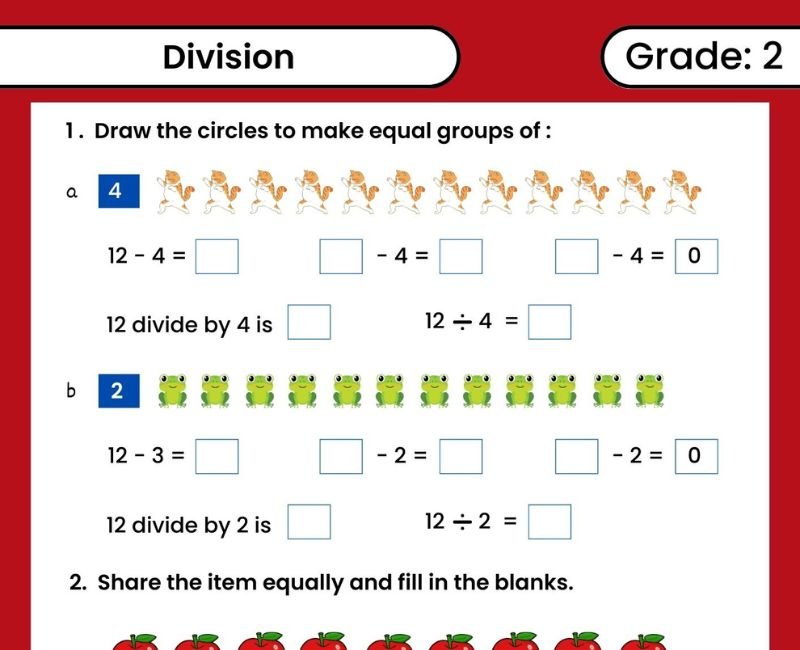
How can twelve counters be shared fairly? How many packs of three can we make? These division worksheets for Class 2 connect pictures, equal sharing and equal grouping. Use the printable worksheets offered on this page for written practice, then use the online activities to move objects, test ideas and explain an answer.
This general topic resource covers division with pictures, equal sharing worksheets, grouping, arrays, repeated subtraction, division on a number line, missing numbers and word problems. Simple leftover tasks are included as an extension. Select the activities that suit the child's current school sequence.
What Is Division for Class 2?
Division can help us share a total equally or find how many equal-sized groups fit into a total. The symbol ÷ means divided by. In 12 ÷ 3 = 4, the meaning of the answer depends on the story: four objects in each of three groups, or four groups containing three objects each.
Equal Sharing and Equal Grouping Explained
| Story | What is known? | What do we find? |
|---|---|---|
| Share 12 crayons equally among 3 children. | Total 12; number of groups 3. | 4 crayons for each child. |
| Put 12 crayons into packs of 3. | Total 12; group size 3. | 4 packs. |
Both stories use 12 ÷ 3 = 4, but the answer has a different unit. Ask children to say the full answer rather than only “four”. This makes the distinction easier to understand.
Division with Pictures and Objects
For equal sharing, set out the required baskets and deal one counter to each basket in turn. Continue until every counter is shared. Count one basket and check that every basket has the same number.
For grouping, select a fixed number of counters to make one pack. Repeat until no further complete pack can be formed. Count the packs. The Pack Builder game lets children choose the actual counters in each pack, so different valid selections work.
Division as Repeated Subtraction
To find 15 ÷ 3, remove groups of three. The sequence is 15 − 3 = 12, 12 − 3 = 9, 9 − 3 = 6, 6 − 3 = 3 and 3 − 3 = 0. Five groups were removed, so 15 ÷ 3 = 5.
The answer is the number of subtractions, not the final zero. Repeated subtraction is a useful model for small whole-number grouping questions. Children can use multiplication facts once they understand the model.
Division on a Number Line
Start at the total and make equal backward jumps of the group size. For 12 ÷ 3, start at twelve and land on nine, six, three and zero. There are four jumps, so the answer is four.
The same scale must be used for every jump. The Backward Hop Trail displays the distance and number of jumps separately, helping children avoid counting the starting point as a jump.
Arrays for Multiplication and Division
An array arranges objects in equal rows and columns. Twenty counters arranged in four rows of five show 4 × 5 = 20. The same picture supports 20 ÷ 4 = 5 and 20 ÷ 5 = 4.
State which quantity represents the rows and which represents the objects in each row. In an activity asking for four rows, a different orientation with the same total is useful to discuss, but it does not yet meet that particular instruction.
Checking Division with Multiplication
If 18 ÷ 3 = 6, then 3 × 6 = 18. This multiplication check reconnects the number of equal groups, objects in each group and the total. It also helps explain a fact family.
4 × 6 = 24
6 × 4 = 24
24 ÷ 4 = 6
24 ÷ 6 = 4
Do not swap the numbers in a division sentence as if division behaved like addition or multiplication. The total and the divisor have different roles.
Division by 2 and Finding Half
Sharing an even collection equally between two groups finds half of that collection. For example, 14 ÷ 2 = 7. Each group contains seven objects. Counting pairs or dealing into two baskets gives a concrete way to check.
For division by five or ten, children can make packs of five or ten and count the complete packs. Use totals that fit the child's counting confidence.
Division with Remainders as a Leftover Extension
Suppose thirteen whole counters are packed in groups of four. Three complete packs use twelve counters, and one counter remains. We describe this as three full groups with one left over.
13 = (4 × 3) + 1.
Three groups of four account for twelve counters, and the one leftover accounts for the thirteenth.
The leftover must be smaller than the group size when all possible complete groups have been formed. If six counters remain while making groups of four, one more group can still be made. The robot-repair tasks focus on this reasoning.
These activities keep counters whole. Sharing divisible food or continuous materials can lead to fractional shares instead; that is a different task. The context determines whether cutting is allowed.
Division Word Problems for Class 2 with Answers
- Sixteen stickers are shared equally among four children. How many does each receive?
16 ÷ 4 = 4. Each child receives four stickers.
- Twenty-five beads are packed five in each bag. How many bags are filled?
25 ÷ 5 = 5. Five bags are filled.
- Eighteen pencils are shared equally between two pots. How many go in each pot?
18 ÷ 2 = 9. Each pot receives nine pencils.
- Twenty-four counters are arranged in six equal rows. How many are in each row?
24 ÷ 6 = 4. There are four counters in each row.
- Seventeen whole counters are packed in groups of five. What is the result?
Three complete groups use fifteen counters, leaving two. Check 17 = (5 × 3) + 2.
Reasoning Questions and Common Mistakes
Does the same total always give the same answer? No. The group size or number of recipients matters. With twelve counters, two equal baskets receive six each, while four equal baskets receive three each.
Does division always make a number smaller? No. Dividing by one leaves the number unchanged. For example, 8 ÷ 1 = 8. Dividing zero by a positive number gives zero. Division by zero is not allowed.
Can equal groups still leave unused counters? Yes. Equal groups alone do not prove that all the objects were used. Check both the equality of group sizes and the total used when a task asks for a complete fair share.
Can a total have several equal-group arrangements? Yes. Twelve can be arranged as two groups of six, three groups of four, four groups of three or six groups of two. The open puzzle accepts any arrangement meeting its stated conditions.
Visual Listening and Hands-On Division Practice
Use baskets and counters for a visual model, optional read-aloud for spoken instructions, and tapping or real objects for active participation. A partner can describe a grouping while another child builds it. A teacher can ask learners to explain why a leftover cannot make another full group.
For an offline activity, use large counters or paper tokens and drawn circles as baskets. For movement, place number cards on the floor and step backward in equal jumps. These are flexible ways to explore division, not fixed labels for different children.
Using Printable Division Worksheets and Online Activities Together
Begin with a small collection. Ask what the total is, what the divisor means in the story and what the answer will count. Build the model, write the division sentence and check it. Use hints to support reasoning rather than racing through tasks.
This page is general Class 2 division practice. It is not tied to a named textbook chapter, and the leftover extension can be left until the teacher or parent considers it appropriate.
More Class 2 Maths Practice
Frequently Asked Questions
What is division in Class 2 Maths?
Division can describe equal sharing or finding how many equal-sized groups fit into a total.
What does the ÷ symbol mean?
It means divided by. For example, 10 ÷ 2 = 5 is read as ten divided by two equals five.
How are sharing and grouping different?
Sharing gives the number of groups and asks how many go in each. Grouping gives the size of each group and asks how many groups can be made.
How do pictures help children learn division?
Counters and baskets show the total, group size and number of groups. Children can move the objects and check equality directly.
How does repeated subtraction show division?
Remove equal groups from a whole-number total and count how many groups are removed. For exact division, the process reaches zero.
How do number-line division activities work?
Start at the total and make equal backward jumps. Count the jumps, not the starting point.
How can multiplication check a division answer?
Multiply the number of groups by the number in each group. For an exact division, this gives the total. Add any leftover when checking a whole-object remainder task.
What does a remainder mean here?
It means whole counters left after all possible complete groups of the stated size are made. It must be smaller than that group size.
Is the divisor the number of groups or objects in each group?
It depends on the story. In sharing it can represent the number of recipients; in grouping it can represent the size of each pack.
Can children listen to the instructions?
Yes, when browser speech is available. Every task also has visible text, a stop-reading button and a hint.
Are these worksheets based on a named textbook chapter?
No. This is a general topic resource for Class 2 division practice.
Do children need to drag objects?
No. All activities use tap buttons, sliders, number fields or native selectors. The tasks also work without read-aloud.
 Download