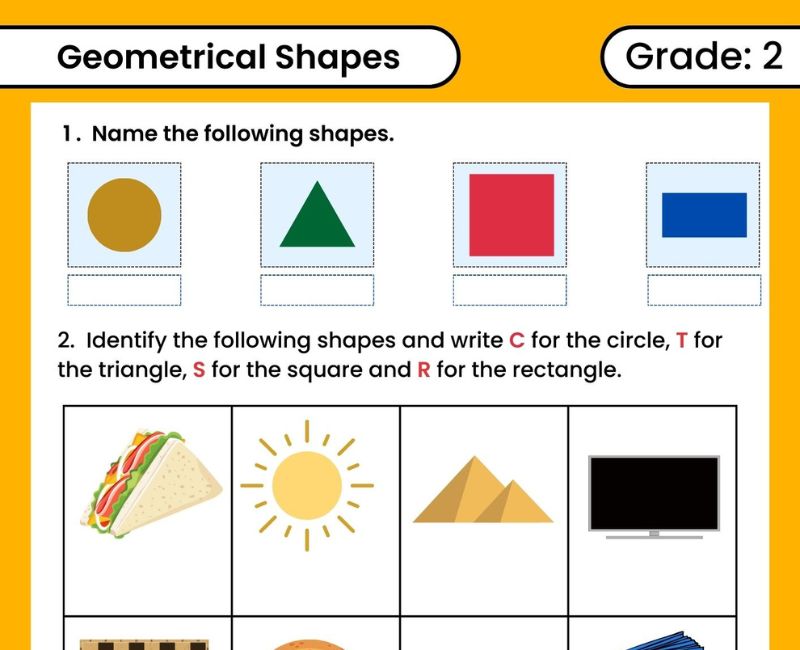
CLASS 2 MATHS • THE SHAPE DISCOVERY STUDIO
2D and 3D Shapes Worksheets for Class 2
with Online Activities and Quiz
Turn a triangle, build a picture and explore solid shapes. Discover sides, corners, flat faces and curved surfaces with colourful models and thinking challenges.
Build and Explore
Find shapes, mark corners and compose new pictures.
See Hear and Do
Turn shapes, explore surfaces and build on a dot board.
Think It Through
Match properties, repair mistakes and explain your discoveries.
2D and 3D Shapes Class 2 Online Quiz
Question 1 / 20 • Easy
Name this 2D shape.
Tap an answer to continue.
Quiz and listening guide
Try 10 easy, five average and five thinking questions. The 20-minute timer starts with the first answer or question-navigation action. Read-aloud alone does not start it. Answers advance except at the final question. Review using the question numbers. Submission or timeout shows every explanation. Restart clears answers and pauses the timer. Speech depends on the browser and available voices; all questions and instructions remain visible.
Five Shape Adventure Games
Tap the raised selector to choose a game. Each one has five challenges.
Shape Property Hunt
Select every card meeting the property, including turned examples.
Find every shape with three straight sides.
Count properties, not colours or orientation.
Look at every card. Select all shapes satisfying the property.
Five Hands-On Online Shape Activities
Use a model, listen if you wish and explain which properties stay the same.
Shapes Reasoning and Extra Practice
Solid Property Profiles
Count flat faces, curved surfaces and vertices separately.
Complete the property profile for this cube.
Count the whole solid. A face means a flat face; curved surfaces are separate.
How the activity sets work
Five games, five activities and five extra-practice sets provide 75 tasks, separate from the quiz. Games and activities share one active main workspace. Extra practice is independent. Switching sets keeps progress while this page stays open. Use Reset options for one task or its whole set. Work in short sessions. Read-aloud, diagrams and practical suggestions are optional ways to explore the same idea.
Eight Shape Tips for Children
- Describe a 2D shape by its outline, straight sides and corners.
- A 3D solid has depth as well as length and height.
- Count every side or corner once.
- Turning a shape does not change its name or number of sides.
- Use flat face and curved surface carefully.
- A cube has six square faces, twelve straight edges and eight vertices.
- A drawing of a solid is a flat picture representing a 3D shape.
- Explain your answer with a drawing, model or example.
Five Tips for Parents and Teachers
- Show shapes in different colours, sizes and orientations.
- Use safe boxes, balls and cans as approximate real-life models.
- Distinguish the whole solid from the shape of one flat face.
- Let children build, turn, trace, listen and discuss without assigning fixed learner types.
- Use flat faces and curved surfaces consistently; some textbooks use different counting conventions.
2D and 3D Shapes Worksheets for Class 2 Guide Examples and Reasoning
Is a square still a square when it is turned? Why is a coin a thin solid rather than a perfect flat circle? These 2D and 3D shapes worksheets for Class 2 connect pictures, properties, everyday objects and practical construction. Use the printable worksheets offered on this page with the online activities to name, sort, build and explain shapes.
This is a general geometry resource rather than a named NCERT chapter. It focuses on familiar plane shapes and solids. Shape composition, rotation, patterns and dot-board puzzles extend recognition into reasoning. Choose tasks that match the child’s classroom sequence.
Difference between 2D and 3D Shapes
A 2D shape is a flat mathematical figure with length and width, such as a triangle or circle. A 3D solid also has depth, such as a cube or sphere. A screen drawing of a cube is flat, but it represents a solid that would occupy space.
Real paper, coins and other objects have some thickness. For early shape work, we may study the outline of a sheet as a rectangle or one circular face of a coin. Distinguish the flat face or outline from the whole physical object.
2D Shapes Names Sides and Corners
A triangle has three straight sides and three corners. A square has four equal straight sides and four right-angle corners. A rectangle has four straight sides and four right-angle corners, with opposite sides equal. A pentagon has five sides and five corners; a hexagon has six of each.
A circle has a curved boundary, no straight sides and no corners. This page explicitly counts straight sides to avoid confusing a curved boundary with a polygon side.
| 2D shape | Straight sides | Corners |
|---|---|---|
| Triangle | 3 | 3 |
| Square | 4 | 4 |
| Rectangle | 4 | 4 |
| Pentagon | 5 | 5 |
| Hexagon | 6 | 6 |
| Circle | 0 | 0 |
Is a Square a Rectangle?
Yes. A rectangle has four right angles, and a square meets that rule. A square is a special rectangle whose four sides are equal. Not every rectangle is a square. When a matching task offers separate labels for a square and a longer rectangle, it asks for the more specific illustrated name.
Turning a square so that a corner points up does not create a new shape. It still has four equal sides and four right angles. Colour and direction are not defining properties.
3D Shapes Names and Everyday Examples
A dice-shaped model suggests a cube. A typical shoebox suggests a cuboid. A ball suggests a sphere, a straight-sided can suggests a cylinder, and a simple pointed party hat suggests a cone. These are approximations: real objects may have rounded edges, lids or extra details.
A cube is also a special cuboid. The cuboid drawings on this page use visibly unequal dimensions when the task contrasts the two names.
Faces Edges and Vertices Explained
A flat face is a flat surface of a solid. A straight edge is where two flat polygon faces meet. A vertex is a corner point; the plural is vertices. A cube has six flat square faces, twelve straight edges and eight vertices. A cuboid has six flat rectangular faces, twelve straight edges and eight vertices.
A drawing may hide some parts of a solid. Dashed lines in the box models suggest hidden edges. Count the whole solid, not only the surfaces or corners visible from one viewing direction.
Flat Faces and Curved Surfaces
In this resource, faces means flat faces, and curved surfaces are counted separately. A cylinder has two flat circular faces and one curved surface. A cone has one flat circular face, one curved surface and one pointed vertex. A sphere has one curved surface and no flat faces or vertices.
| Solid | Flat faces | Curved surfaces | Vertices |
|---|---|---|---|
| Cube | 6 | 0 | 8 |
| Cuboid | 6 | 0 | 8 |
| Cylinder | 2 | 1 | 0 |
| Cone | 1 | 1 | 1 |
| Sphere | 0 | 1 | 0 |
Some primary books use “curved face” or describe circular rims as curved edges. Match the teacher’s vocabulary when discussing those books. These activities avoid mixing those conventions with straight-edge counts.
Rolling Sliding and Stacking Shapes
Curved surfaces help ideal models roll; flat faces provide surfaces on which models can rest or slide. A cylinder can roll on its side and rest on a circular end. A cone can roll around on its curved surface and rest on its base. A sphere has no flat face.
Actual movement also depends on orientation, material and the surface underneath. The Surface Explorer sorts the geometric surfaces rather than making an absolute claim that an object can only ever move one way.
Building New Shapes from Smaller Pieces
Two matching right triangles can form a square when their suitable edges meet. Two equal squares placed side by side form a rectangle. Four small squares arranged in two rows and two columns make a larger square.
Ask children to describe the outside boundary of the finished shape. Internal joining lines do not become extra outside sides. The composition game shows coloured pieces fitted together without gaps or overlaps.
Shape Rotation and Orientation
Rotation means turning a shape. A turned triangle still has three sides and three corners. A turned rectangle still has four right angles. The shape’s position changes, but its defining properties stay the same.
Use different-looking examples so children do not assume that every triangle must point upwards or every rectangle must have horizontal long sides.
Dot-Board Shape Activities
Choose three non-collinear points to make a triangle. Three points lying on one straight line do not enclose a triangle. To build a rectangle, choose four points whose joined boundary has four right angles. A square also qualifies as a rectangle.
The open dot-board tasks join selected points around their boundary automatically. They check the geometry and accept different valid constructions, including a triangle using the centre dot when that extra condition is requested.
Shape Patterns for Class 2
Look for the repeating unit rather than guessing from the last picture. In triangle, circle, triangle, circle, the unit is triangle followed by circle. The next two shapes are triangle and circle. In square, square, circle repeated, the next cycle begins with two squares.
Say, point to or clap the repeating unit before choosing the next pieces. Pattern-building uses the same familiar shapes in a different reasoning context.
Shapes Questions with Solutions
A square is turned so a corner points up. Is it still a square? Yes. Its four equal sides and four right angles are unchanged.
What shape is the flat end of an ideal cylinder? A circle. The whole solid is a cylinder, not a circle.
A cube picture shows three shaded faces. Does the whole cube have only three faces? No. A cube has six faces, including those not visible in that view.
Can six square tiles form different rectangles? Yes. One row of six and two rows of three are examples. In the online lab, follow the stated limits on rows and columns.
Common Shape Mistakes
Check for counting only visible cube edges, calling a sphere a circle, treating a rotated square as a different shape, counting internal tile joins as outer sides, or assuming every rectangle must be longer than it is wide. Ask for a property or a model to support the answer.
Learning with Pictures Listening and Construction
Children can view diagrams, hear a question, mark corners, compose pieces, build on a dot board or handle safe solid models. These are flexible participation choices rather than fixed learner categories. All instructions remain visible if browser speech is unavailable.
For practical work, trace a flat face of a safe box, turn paper shapes, or arrange square tiles. An adult can help prepare paper pieces. Discuss which properties stay the same after a turn.
Using Printable Shape Worksheets with Online Activities
Name and describe a model, test an idea in an untimed activity, then record a drawing or explanation on paper. Use the quiz review to discuss reasoning. Choose tasks according to readiness rather than assuming a fixed textbook chapter sequence.
More Class 2 Maths Practice
Frequently Asked Questions
What do 2D and 3D shapes worksheets for Class 2 cover?
Naming and sorting shapes, straight sides, corners, flat faces, curved surfaces, vertices, real-object models, composition, rotation and patterns.
What is the difference between a 2D shape and a 3D solid?
A 2D mathematical shape is flat. A 3D solid has depth as well. A flat picture can represent a solid such as a cube.
How many straight sides and corners does a circle have?
A circle has no straight sides and no corners. Its boundary is curved.
Is a turned square still a square?
Yes. Turning changes its orientation, not its four equal sides or four right angles.
Is a square a rectangle?
Yes. It is a special rectangle with all four sides equal. A rectangle need not have all four sides equal.
How many faces edges and vertices does a cube have?
A cube has six flat square faces, twelve straight edges and eight vertices. Include hidden parts when counting from a drawing.
How many flat faces does a cylinder have?
Two flat circular faces, plus one curved surface. This page counts flat faces separately from curved surfaces.
Does a sphere have a flat face?
No. An ideal sphere has one curved surface, no flat faces and no vertices.
Is a coin a circle or a cylinder?
A real coin is approximately a thin cylinder. Its flat face has a circular shape. The whole object and its face are different ideas.
Can different answers work in the building puzzles?
Yes. The dot-board and tile-rectangle puzzles accept every construction that meets their stated geometric rules and limits.
Can children listen and play without dragging?
Yes, when browser speech is available. Text stays visible, and activities use tapping, clicking, typing and buttons without requiring dragging.
Is this a particular NCERT chapter worksheet?
No. It is a general shapes resource. Choose activities to match the child’s classroom sequence.
 Download