CLASS 2 MATHS • THE CARRYING AND BORROWING STUDIO
Carrying and Borrowing Worksheets for Class 2
Two-Digit Practice with Online Activities and Quiz
Bundle ten ones, open a ten and repair a column calculation. Explore two-digit addition with carrying and subtraction with borrowing through colourful place-value models.
Build and Explore
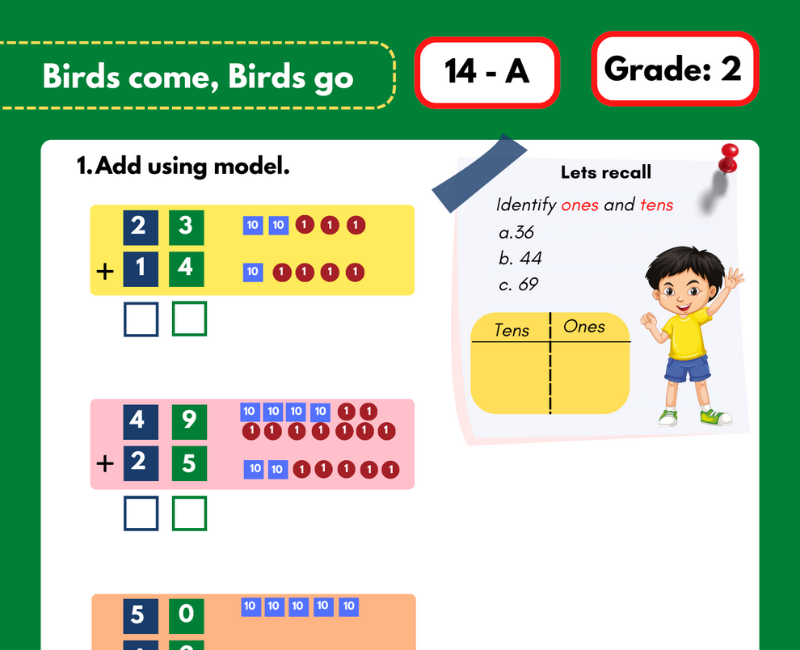
Build answers with blocks, collect carry tokens and complete column steps.
See Hear and Do
Rescue zero ones, exchange equal values and complete number walls.
Think It Through
Find missing digits, diagnose errors and justify regrouping choices.
Carrying and Borrowing Class 2 Online Quiz
Question 1 / 20 • Easy
What does a carried 1 in the tens column represent?
Choose a model. Explain the whole, the parts and the change.
Tap an answer to continue.
Quiz and listening guide
Try 10 easy, five average and five thinking questions. The 20-minute timer starts with the first answer or question-navigation action. Read-aloud alone does not start it. Answers advance except at the final question. Review using the question numbers. Submission or timeout shows every explanation. Restart clears answers and pauses the timer. Speech depends on the browser and available voices; all questions and instructions remain visible.
Five Regrouping Discovery Games
Tap the raised selector to choose a game. Each one has five challenges.
Build the Place-Value Answer
Solve the calculation, then build its answer with tens and ones.
Model 28 + 15 and find the result.
Exchange ten ones for one ten. Include the new ten in the tens column.
Five Place-Value Exploration Labs
Use a model, listen if you wish and explain what changes and what stays equal.
Carrying and Borrowing Reasoning Practice
Regrouping Story Studio
Use a number sentence to explain a story before entering the answer.
A shelf holds 35 books. Another 18 arrive. How many books are there?
Write each change in order and check the ones column for an exchange.
Choose a model. Explain the whole, the parts and the change.
How the activity sets work
Five games, five activities and five extra-practice sets provide 75 tasks, separate from the quiz. Games and activities share one active main workspace. Extra practice is independent. Switching sets keeps progress while this page stays open. Use Reset options for one task or its whole set. Work in short sessions. Read-aloud, diagrams, counters and physical suggestions are optional ways to explore the same idea.
Eight Number-Adventure Tips for Children
- Read which amount is known and which is missing.
- Track arrivals and departures in order.
- Keep tens aligned with tens and ones with ones.
- Exchange ten ones for one ten when adding if needed.
- Exchange one ten for ten ones before subtracting if needed.
- Use addition to check subtraction and subtraction to check addition.
- In a number wall, the upper brick is the sum of the two below.
- Explain a different route or model for the same answer.
Five Tips for Parents and Teachers
- Let the child model a problem before writing column calculations.
- Use a bundle of ten sticks to show an equal-value exchange.
- Ask why a chosen operation matches the situation.
- Combine visible instructions, optional listening, movement and discussion without fixed learner labels.
- Keep practice short and revisit a model when an error needs explaining.
Carrying and Borrowing Worked Examples Common Mistakes and Practice Tips
Why does a small 1 appear above the tens column? What should a child do when a subtraction starts with zero ones? These carrying and borrowing worksheets for Class 2 connect each written step to tens-and-ones models. Practise two-digit addition with carrying, subtraction with borrowing, missing digits and reasoning about equal values.
Two-Digit Addition with Carrying
Begin with the ones. In 28 + 15, eight ones and five ones make thirteen ones. Put ten of those ones into a bundle and exchange that bundle for one ten. Three loose ones remain. The tens are now two original tens, one more ten and the exchanged ten. Four tens and three ones give 43.
The small carried 1 represents a ten. It belongs with the other tens when that column is added. The Carry Token Workshop lets children mark ten ones before trading them, so the written digit has a visible meaning.
How to Show Borrowing with Tens and Ones
For 54 − 28, begin with five tens and four ones. Four ones cannot supply the eight ones being removed. Exchange one ten for ten loose ones. The new representation is four tens and fourteen ones. It still equals 54.
Now remove eight ones, leaving six. Remove two tens from the four tens, leaving two. The remaining blocks show 26. In a written calculation, changing the tens digit is essential because one of those tens has become ones.
Subtraction with Borrowing from Zero Ones
Ninety is nine tens and zero ones. Exchange one ten to show eight tens and ten ones. Subtract seven ones to leave three. Subtract four tens to leave four. Therefore 90 − 47 = 43.
A zero ones digit does not mean subtraction is impossible. It signals that an exchange is needed before removing the ones. The Zero Ones Rescue Lab guides children through preparing the ones, removing them and then removing the required tens.
Place-Value Blocks and Equal Representations
Sixty-three can be shown as six tens and three ones or five tens and thirteen ones. The second model contains more loose pieces, but its total is unchanged. Count each long rod as ten and each small cube as one.
The Same Value Two Models activity asks learners to save two distinct representations of one number. An incorrect model is not saved. This encourages children to test an exchange rather than assume that moving blocks always changes the amount.
Checking Carrying with a Number Line
For 48 + 17, start at 48, move forward ten to 58 and then seven more to 65. The final steps cross from the fifties into the sixties. This gives a second way to check the column answer.
A ten-jump covers ten equal units, while a one-jump covers one. Use the line to explain a result after working with blocks. Children can also mark the same jumps on paper.
Missing Digit Questions with Answers
Subtract eighteen from sixty-five to recover forty-seven. The blank stands for 7. Check by adding 47 + 18 and including the carried ten.
Add the difference and the amount removed. Since 35 + 28 = 63, the blank is 3. Substituting gives 63 − 28 = 35.
Read the position of the box carefully. A missing tens digit and a missing ones digit represent different values. Enter the digit requested, rather than the entire two-digit number.
Regrouping Word Problems with Solutions
Books arriving A shelf holds 35 books and receives 18. Join the quantities using 35 + 18 = 53 books. The thirteen ones include one exchanged ten.
Counters removed A box holds 61 counters and 27 are taken out. Represent sixty-one as five tens and eleven ones, then remove two tens and seven ones. There are 34 counters left.
Two changes A tree has 47 birds. Sixteen arrive and twenty-eight leave. Find the intermediate total 63, then calculate 63 − 28 = 35. Record both stages so the second change acts on the updated amount.
Number Walls and Regrouping Puzzles
In these puzzles, the upper brick equals the sum of the two lower bricks. Lower bricks of 24 and 18 make a top brick of 42. If the top is 43 and a lower brick is 17, the other lower brick is 26. Check the completed wall by adding its two lower values.
Common Carrying and Borrowing Mistakes
Forgetting the carried ten A robot writes 38 + 27 = 55. Its five ones are correct, but it omitted the exchanged ten. The corrected sum is 65.
Keeping the original tens after borrowing In 70 − 26, the starting model becomes six tens and ten ones. Keeping seven tens as well as the ten ones would incorrectly change the starting value to eighty.
Reversing just the ones subtraction For 56 − 28, subtracting six from eight does not solve the ones column. Exchange a ten to obtain sixteen ones, then remove eight. The correct result is 28.
Reasoning Questions about Place Value
Does carrying create extra value? No. Ten loose ones and one bundled ten are equal. Only the representation changes.
Can a subtraction check require carrying? Yes. To check 63 − 28 = 35, calculate 35 + 28. The thirteen ones require an exchange before the result returns to 63.
How can a child decide whether regrouping is needed? In these additions, inspect whether the ones total reaches ten. In these subtractions, compare the starting ones with the ones to be removed.
Using the Worksheet and Online Activities
Begin with one model, explain the exchange aloud and write the matching column steps. Then try a missing-digit or error-repair task. Use bundles of ten sticks and loose sticks for a practical version. Optional read-aloud supports listening while every question remains visible. Short sessions with discussion help children connect the written algorithm to quantities.
More Class 2 Maths Practice
Frequently Asked Questions
What do these carrying and borrowing worksheets practise?
Two-digit addition with carrying, subtraction with borrowing, zero-ones exchanges, missing digits, column steps, number walls and place-value error diagnosis.
How do bird-arrival and bird-departure stories help?
Arrivals can increase a group and departures can decrease it. Track each event and identify whether the starting, changing or final amount is unknown.
How is carrying shown using blocks?
Ten ones are exchanged for one ten. A carried 1 in the tens column represents that exchanged ten.
What happens when borrowing in subtraction?
One ten is represented as ten ones so that more ones are available to remove. The starting quantity stays equal during the exchange.
How do children find a missing starting number?
Reverse the stated change. If adding nine gives twenty-eight, subtract nine to find nineteen.
What is a number wall?
Here the upper brick is the sum of the two bricks directly below. A missing lower brick is a missing part of that total.
Can one number have different tens-and-ones representations?
Yes. For example, 43 is four tens and three ones or three tens and thirteen ones. The equal-value lab checks two distinct representations within its limits.
How are two-step word problems solved?
Find the intermediate amount after the first event, then apply the next event to that amount.
How do children decide whether a column needs regrouping?
For addition, check whether the ones total reaches ten. For subtraction, check whether the starting ones are fewer than the ones to be removed.
When are the timer and End Quiz visible?
They stay in the quiz section and scroll out of view when the quiz ends or the learner leaves that area. The countdown continues while an attempt is running.
Can a child listen to the questions?
Read Task Aloud and Read Question use browser speech when available. Every instruction also stays visible, and Stop Reading cancels playback.
Does this reproduce a complete textbook chapter?
No. It provides focused two-digit carrying and borrowing practice with original activities and examples. It does not reproduce a complete textbook exercise.
 Download