NCERT JOYFUL MATHEMATICS • CLASS 2 • CHAPTER 7
Rani’s Gift Class 2 Worksheet
Measure Compare and Discover
Explore lengths with equal blocks, compare paths and build a toy-height tower. Read a balance, fill a model jug and discover why the measuring unit matters.
Measure Fairly
Use equal units, a common starting point and touching blocks.
Compare the Loads
Watch the heavier pan go down and build an equal balance.
Count Equal Cups
Fill containers, compare capacities and repeat a stated recipe.
Rani’s Gift Class 2 Online Quiz
20 questions • 10 easy • 5 average • 5 thinking • 20 minutes
The clock starts with your first answer or navigation action. Choose an answer to continue and review before submitting.
Question 1 / 20 • Easy • Answered 0/20
How should equal blocks be placed to measure a length?
Five Rani’s Gift Measurement Games
Tap the raised selector. Each game has five original tasks with the model and answer together.
Measure with Equal Blocks
Every block has the same length. Stop at the ribbon’s end.
Ribbon begins at the left-hand start line.
Blocks placed 0
Reset options
Five Interactive Measurement Activities
Balance equal counters, order parcel weights, fill a jug, compare capacities and prepare recipe quantities.
Chapter 7 Questions and Thinking Practice
Measurement Story Problems
Keep the measuring unit the same before comparing or combining counts.
Reset options
Using this measurement studio
Five games and five exploration sets provide 50 tasks. Five thinking sets add 25 more, alongside a separate 20-question quiz. Build, tap, pour or answer in the compact blanks. Optional Read and Stop controls remain above the question frame.
These are original chapter-based models. Blocks within a measurement have equal size. The balances are ideal equal-arm models; the heavier side moves down. Model weight units are not grams, and illustrated parcel values do not claim fixed weights for real objects. Capacity comparisons use the same full cup.
Progress stays while this page remains open. Reset options clear one task or set. Real classroom measurements of desks, hands or bottles can vary; use the unit and object actually chosen.
Rani’s Gift Notes Objectives Examples and Solutions • Tap to Read
Rani’s Gift Class 2 NCERT Worksheet and Measurement Guide
This Rani’s Gift Class 2 worksheet supports Chapter 7 of NCERT Joyful Mathematics. It connects measuring length and height with comparing weight and capacity. Children use equal blocks, handspan models, paths, an equal-arm balance, full cups and recipe quantities to explain what they measure.
What Does Rani’s Gift Teach?
The chapter begins with a bed-making story in which different handspan measurements cause confusion. It develops non-standard measurement through textbook lengths, blocks and other familiar tools, then explores heavier and lighter objects, balances, quantities of water and nimbu pani ingredients.
The learning objectives are to estimate and measure with a chosen uniform unit, compare complete lengths and heights, use a common start or baseline, interpret a balance and compare capacities using the same cup. Children also explain why different unit sizes can lead to different counts.
Why Did the Handspan Measurements Differ?
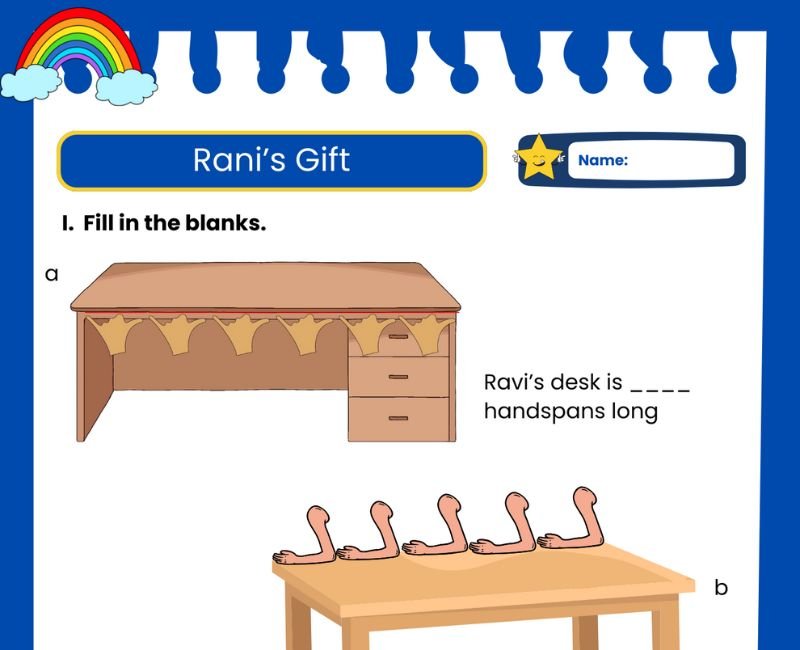
A handspan depends on the person’s hand size. Counting ten small handspans does not necessarily produce the same length as ten large handspans. To avoid confusion, agree on a common measuring unit or clearly identify the unit used.
The span activity uses two fixed illustrative sizes. The larger model span is twice as long, so the same object needs half as many larger spans. Real people’s handspans do not have to follow that exact ratio.
Non-Standard Units of Length for Class 2
Blocks, an eraser, a pencil or a textbook length can be used as informal measuring units. Use the same size and orientation each time. Begin at one end of the object and place the units end to end without gaps or overlaps.
If seven equal touching blocks exactly cover a ribbon from its start to its end, the ribbon measures seven of those block units. State the unit rather than recording only the number seven.
A gap leaves part of the length unmeasured by the blocks. An overlap counts some length more than once. Mixing different block sizes makes the recorded unit count unclear.
Estimation and Actual Measurement
An estimate is a sensible guess made before measuring. A measured result comes from using the chosen tool and counting carefully. Compare the two to improve later estimates.
There is no single universal answer to the length of a real classroom desk in textbook units. The desk, textbook size, orientation and placement affect the count. The online questions use exact illustrative models so their answers can be checked consistently.
Measuring Height with Equal Blocks
Start the block tower and the object at the same baseline. Stack equal blocks with no gaps and compare their top with the object’s height. Do not start the blocks on a raised surface while the object starts lower.
The height tower game uses a coloured toy-height marker and a stack of equal blocks. Add or remove blocks until the two tops match. Count the full stack from the baseline, including its bottom block.
Shortest and Longest Paths
Two routes can have the same start and end but different lengths. Follow each complete route. A thread placed along the path can help compare bends and detours using the same measuring method.
The number of bends alone is not enough to decide which route is longer. A route with several small bends can be shorter than one with a large detour. In a clear open space, the straight connection gives the shortest distance between two points; a real route may have obstacles or other conditions.
Heavier Lighter and Equal Weight
Weight comparison asks which load is heavier, lighter or equal. On an ideal equal-arm balance, the heavier pan moves down and the lighter pan moves up. Level pans indicate equal loads in the model.
Outside size is not enough to decide weight. Two bags of the same size may have different contents. Actual fruits and vegetables also vary, so a pictured pumpkin or watermelon should not be assigned a universal fixed weight.
Reading and Building a Balance
The balance activity makes the actual pans clickable. Read their positions rather than choosing by the parcel’s colour. If the pans are level, choose Equal Weight.
A parcel representing twelve model units can balance four counters representing three units each. Both sides total twelve model units.
The counter activity uses stated model values, not grams. Every counter in a task has the same weight. It illustrates how a number of equal smaller loads can balance one larger load.
Ordering Objects by Weight
Combine comparison clues. If Parcel A is lighter than B and B is lighter than C, the order from lightest to heaviest is A, B, C. A child can show this with labelled cards before explaining it aloud.
The parcel ordering game uses equal-looking labelled cards and relational clues. It does not encourage judging weight from the picture’s size.
Capacity Worksheets for Class 2
Capacity describes how much a container can hold. A partly filled jug’s current amount is different from its full capacity. Adding more water changes the amount inside, while the capacity of a fixed rigid jug stays the same.
Use the same full cup or glass for each pour when comparing containers. If one container takes five of those cups and another takes eight, the second has greater capacity. If different-sized cups are used, the counts cannot be compared directly without knowing how the cups relate.
What Happens When the Measuring Cup Is Larger?
A larger cup needs fewer pours to fill the same bottle. For example, if a bottle takes eight small cups and one large cup holds two small cups, four large cups fill the bottle.
The bottle has not changed capacity. Only the measuring unit changed. This is the same general idea as using larger handspans to measure an unchanged length.
Nimbu Pani Measurement Activity
The chapter’s one-glass recipe uses one glass of water, one spoon of sugar, two spoons of lemon juice and one pinch of salt. Repeating the recipe means repeating each stated quantity for every glass.
Four glasses use four glasses of water, four spoons of sugar, eight spoons of lemon juice and four pinches of salt under the stated practice recipe.
Use the same glass and spoon sizes within the activity. The counts describe the given recipe; they do not establish standard amounts for every household’s drink.
Rani’s Gift Class 2 Questions and Answers
Why use equal blocks? They provide a consistent unit. Which balance pan is heavier? The lower pan in the equal-arm model. Does a bigger handspan always need more repeats? No; the same length usually needs fewer larger spans. Can two full bottles be compared using different cups without further information? No; the measuring unit must be consistent or its relationship must be known.
Hands-On Measurement and Sound Exploration
Estimate a safe object’s length and then measure it with equal blocks or the same textbook edge. Compare selected objects on a simple balance and record how many full glasses fill a bottle. Use the same tools consistently and discuss any difference from the estimate.
The chapter also suggests exploring jal tarang using similar glasses or bowls with different water levels. This gives an opportunity to notice different sounds and discuss water use. The online studio provides optional question reading; real objects add touch, pouring and sound experiences that a screen cannot fully reproduce.
Chapter reference NCERT Joyful Mathematics Chapter 7 Rani’s Gift. The digital diagrams and numbers are original practice examples.
Related Class 2 Maths Worksheets
Frequently Asked Questions
Which NCERT chapter does this worksheet support?
NCERT Joyful Mathematics Class 2 Chapter 7 Rani’s Gift, covering measurement of length and height, comparison of weight, balances and capacity.
Why are different handspan counts possible for the same object?
People’s handspans can differ in size. A larger unit covers more length per repeat, so it can give a smaller count.
How should blocks be placed when measuring length?
Use equal blocks, start at one end and place them end to end without gaps or overlaps. State the block unit with the count.
How do children measure a toy’s height with blocks?
Start the toy and stack at the same baseline, stack equal touching blocks and count until the tops match.
Which pan goes down on an equal-arm balance?
The pan carrying the heavier load. Level pans indicate equal loads in the ideal model.
Is a bigger object always heavier?
No. Material, contents and other features matter. Compare the actual loads rather than relying only on outside size.
What is capacity?
How much a container can hold. It differs from the amount of water currently inside a partly filled container.
Why use the same cup to compare capacities?
The same full cup gives a consistent unit. Counts from different cup sizes need additional information before they can be compared.
What happens if a larger cup is used?
The same container generally needs fewer pours. Its capacity stays unchanged; the measuring unit changes.
Are model weight units the same as grams?
No. They are stated illustrative values for the balance activities. They do not describe fixed real-world fruit or parcel weights.
Can students answer directly inside the activities?
Yes. They build block models, tap balance pans, add counters, pour cups and complete recipe quantities in the question frame.
Are the online answers exact textbook picture answers?
The models use original numbers and diagrams based on the chapter. Real classroom measurements may vary. Use the values and rules shown in each online task.
 Download