NCERT JOYFUL MATHEMATICS • CLASS 2 • CHAPTER 2
Shapes Around Us Class 2 Worksheet
Discover Solid Shapes with Online Activities
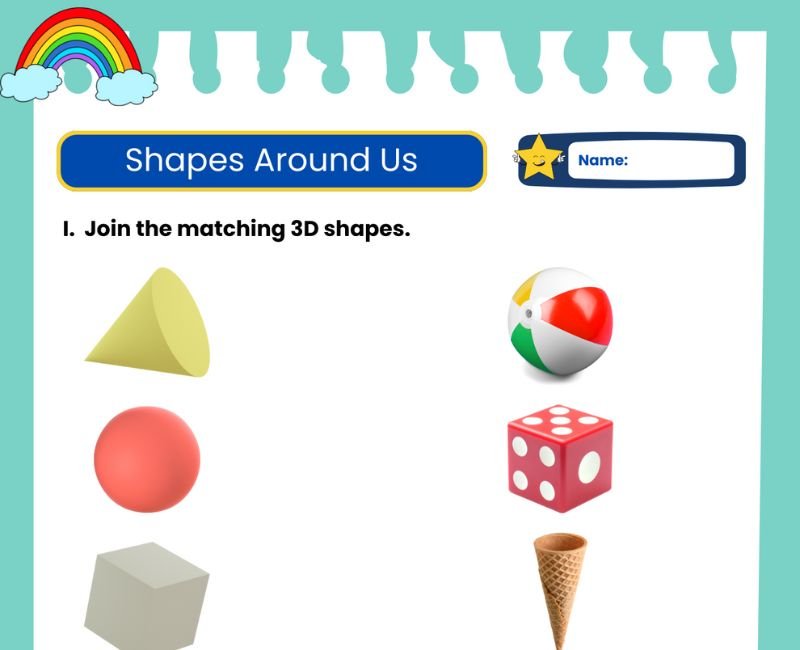
Find the shape in a ball, a box and a drum. Tap corners, trace edges and decorate faces in a colourful shape studio where every answer belongs with its question.
Look and Discover
Recognise cube, cuboid, cone, cylinder and sphere models in different colours.
Touch and Explore
Mark corners and edges, colour face tiles and build a two-piece shape tower.
Think and Explain
Connect familiar objects with shape clues and repair common counting mistakes.
We name flat faces and curved surfaces separately. A cylinder has two flat faces and one curved surface. Circular rims count as edges here, and a cone’s tip counts as one corner. Some books call a curved surface a “curved face”; read the heading before comparing totals.
Shapes Around Us Class 2 Quiz
Question 1 / 20 • Easy • Answered 0/20
Optional audio controls
Which solid shape is shown?
Tap an answer to continue.
Quiz and listening guide
Try 10 easy, five average and five thinking questions. The 20-minute timer starts with the first answer or question-navigation action. Read-aloud alone does not start it. Answers advance except at the final question. Review using the question numbers. Submission or timeout shows every explanation. Restart clears answers and pauses the timer. Speech depends on the browser and available voices; all questions and instructions remain visible.
Five Shapes Around Us Games
Tap the raised game selector to switch challenges. Each game has five tasks, with controls inside the question frame.
Solid Shape Treasure Hunt
Tap every model in the named shape family.
Tap all three cube models. Look at shape rather than colour.
One shape family can be shown in different colours.
Five Interactive Solid Shape Activities
Paint face tiles, complete a solid passport, solve a riddle, build a tower and investigate flat or curved surfaces.
Chapter 2 Questions and Thinking Practice
Shape Story Questions
Enter the requested total in the question blank.
A cuboid gift box gets one star on every face. How many stars are needed?
Find the property of one solid, then count for all the solids named.
How this shape studio works
There are 75 tasks across five games, five exploration sets and five thinking sets, plus a separate 20-question quiz. Optional read-aloud and Stop Reading controls sit above the activity frame. Tap diagrams and choices or use the compact number blanks. Previous and Next move between tasks. Progress stays while this page remains open; reset options clear the selected task or set.
The quiz allows 20 minutes, starts timing on the first answer or navigation action, and provides explanations after submission. The timer and End Quiz button stay within the quiz section while scrolling. The activities use original simplified models and questions based on the chapter, rather than reproducing its illustrated answer key.
Shapes Around Us Notes Objectives Examples and Solutions • Tap to Read
Shapes Around Us Class 2 NCERT Worksheet
This Shapes Around Us Class 2 worksheet supports Chapter 2 of NCERT Joyful Mathematics. Children investigate the solid shapes found in familiar objects, compare their surfaces and connect a face, an edge and a corner with something they can see or touch. The online activities add original practice to the chapter’s observation, matching and gift-box decoration ideas.
What Does Shapes Around Us Teach?
The chapter introduces cube, cuboid, cone, cylinder and sphere through objects and musical instruments. It asks children to compare shapes, find an odd object, match objects to solids, investigate box faces, edges and corners, and solve touch-and-tell clues. It also encourages making and discussing shapes with cardboard, clay or dough.
The learning objectives are to name the five solid families, recognise approximate examples, distinguish surfaces from their boundaries, count features of the whole object and explain a choice using a property. Children should be able to point to a face or corner rather than memorising only a list of numbers.
3D Shapes for Class 2 with Everyday Examples
A cube has six equal square faces. An ideal closed dice or equal-sided block resembles a cube. A cuboid is a rectangular box shape, such as a rectangular book or brick. Its length, width and height do not all have to match.
A cylinder has two flat circular ends and a curved side, like a simple straight-sided tin. A cone has a circular base, a curved surface and a pointed tip. A party-hat outline suggests a cone, although an actual paper hat is open. A sphere is round all around, like an ideal ball or marble.
Real objects are approximate examples. Handles, openings, seams and decorations can change the details without making a comparison unhelpful. Match the main part named in the question.
Musical Instruments and Their Shapes
A straight-sided drum body resembles a cylinder. A rectangular harmonium body suggests a cuboid. The flared bell of a shehnai can suggest a cone. These comparisons describe selected parts of real instruments, rather than claiming that every instrument is an exact geometric solid.
The textbook also invites children to compare instruments with a matka and discuss how instruments are played. A matka has a rounded body and a neck, so it should not be treated as a perfect sphere. Ask what is similar and what is different.
Faces Edges and Corners Explained
A flat face is a flat part of a solid’s surface. An edge is a boundary where surfaces meet. A corner is a meeting point of edges on a box. In these early-years activities, a cone’s pointed tip is also counted as a corner.
A curved surface bends instead of staying flat. We list it separately from flat faces. For a cone and cylinder, the circular rims are included as curved edges. This explicit convention helps children understand why two resources might display different totals under a general heading such as “faces”.
Faces Edges and Corners of 3D Shapes
| Solid | Flat faces | Curved surfaces | Edges including rims | Corners or tips |
|---|---|---|---|---|
| Cube | 6 | 0 | 12 | 8 |
| Cuboid | 6 | 0 | 12 | 8 |
| Cone | 1 | 1 | 1 | 1 |
| Cylinder | 2 | 1 | 2 | 0 |
| Sphere | 0 | 1 | 0 | 0 |
Cube and Cuboid Difference
Both have six flat faces, twelve edges and eight corners. A cube has equal square faces and all its edges have the same length. A cuboid can have rectangular faces and different edge lengths. A cube is a special cuboid, but the worksheet uses the familiar labels “cube” for equal-sided models and “cuboid” for the longer rectangular box models.
Counting Hidden Faces Edges and Corners
A drawing may show only three faces of a cube. The whole solid still has six. Turn a real box to find its back, bottom and other hidden parts. Marking each feature once can prevent double counting.
The transparent box activities use dashed lines for hidden back edges. These edges still belong to the solid. Corner dots and edge lines are directly tappable, and selected features change appearance. The tasks explore the front, back, top and connecting parts before counting everything.
Gift Box Decoration Questions with Solutions
A cuboid gift box has six faces. It needs six stars when each face receives one star.
A cube has twelve edges. It needs twelve ribbon strips when each strip covers exactly one edge. This counts strips, not the total ribbon length.
A cube has eight corners. One box needs eight pompoms, and two such boxes need sixteen.
Shapes Around Us Class 2 Questions and Answers
Which shape has no flat faces? A sphere has a curved surface and no flat faces. Which shape has one tip? A cone. Which shape has two flat circular ends? A cylinder. Can a cube change its shape when turned? Turning changes the view, while its faces, edges and corners remain the same.
For an odd-one-out question, read the stated rule. A cone is different from a sphere and cylinder when the rule is “no corners”. A sphere is different from several cylinders when the rule is “two flat circular ends”. More than one answer may be defensible in an open discussion, so the online questions state a specific property.
Flat Shapes and Solid Shapes
A circle is flat; a sphere is solid. A square is flat; a cube has square faces. A cylinder’s flat end is circular, but the whole cylinder is not a circle. This chapter focuses on solid shapes; tracing and exploring their flat faces helps connect the two ideas.
Shape Activities for Home and Classroom
Collect safe blocks, empty closed boxes and a soft ball. Ask children to find a flat face, point to an edge and count corners while turning a box. Match a familiar object to a model and discuss where the comparison is only approximate. A child can explain aloud, listen to a question, tap a visual model or handle a real object.
For a creative extension, build a four-faced triangular pyramid with paper or modelling dough and compare it with a box. Adult help is appropriate for cardboard cutting. Keep this as exploration; it is not necessary to introduce volume formulae or formal nets for the five core solids.
Chapter reference NCERT Joyful Mathematics Chapter 2 Shapes Around Us. The digital questions and diagrams here are original practice based on the chapter’s concepts.
Related Class 2 Maths Worksheets
Frequently Asked Questions
Which textbook and chapter does this worksheet support?
NCERT Joyful Mathematics Class 2 Chapter 2 Shapes Around Us. The online tasks use original examples based on its solid-shape objectives.
Which 3D shapes should Class 2 children recognise?
Cube, cuboid, cone, cylinder and sphere, with familiar approximate examples such as blocks, boxes, hats, tins and balls.
How many faces edges and corners does a cube have?
A cube has six flat faces, twelve edges and eight corners. Hidden parts still count.
How is a cube different from a cuboid?
A cube has equal square faces and equal edge lengths. A cuboid can have different edge lengths. Both have six faces, twelve edges and eight corners.
Does a sphere have one face or no faces?
This page counts flat faces separately from curved surfaces. A sphere has zero flat faces and one curved surface. A resource using “curved face” may call its curved surface one face.
How many flat faces does a cylinder have?
Two circular flat faces. Its curved side is listed separately. Under our convention, the two circular rims are edges and it has no corners.
How many corners does a cone have?
One pointed tip, counted as one corner in this early-years practice. It also has one flat circular base and one curved surface.
Is a ball a circle or a sphere?
A ball is approximately a sphere, a solid shape. A circle is flat.
What shape is a drum or harmonium?
A simple straight-sided drum body resembles a cylinder. A rectangular harmonium body resembles a cuboid. Real instruments can have additional parts.
Are the faces behind a box included?
Yes. Count the whole object. The transparent diagram marks hidden back edges with dashed lines.
Can children answer directly inside the activity?
Yes. They tap models, corner dots, edge lines, face tiles and tower positions. Numeric blanks and classification choices stay within the question frame.
Do these activities replace handling real shapes?
They add visual, listening and touch-based screen practice. Turning and feeling safe real objects remains useful for exploring depth and hidden surfaces.
 Download