NCERT JOYFUL MATHEMATICS • CLASS 2 • CHAPTER 4
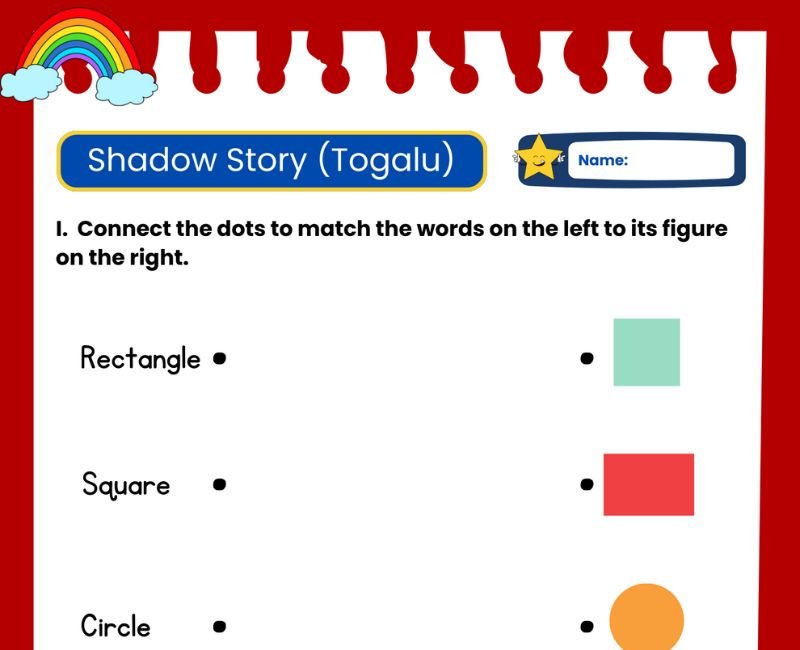
Shadow Story Class 2 Worksheet
A Colourful Shape and Pattern Studio
Step into shadow play, trace flat shapes and discover corners. Paint a carpet, explore paper folds and build patterns with activities that keep the question and answer together.
Observe and Trace
Match outlines and trace boundaries directly on a large shape.
Make and Explore
Mark corners, paint shapes and investigate a simple torch model.
Find the Repeat
Extend shape units and number trails, then explain the rule.
Shadow Story Class 2 Online Quiz
20 questions • 10 easy • 5 average • 5 thinking • 20 minutes
Timing starts with your first answer or navigation action. Choose an answer to continue, then review before submitting.
Question 17 / 20 • Thinking • Answered 0/20
A child says every shape with a curved part has no corners. Which example challenges this?
Five Shadow Story Shape Games
Tap the raised selector. Each game contains five original challenges.
Match the Shadow Outline
Use the boundary and corners. Turning a square does not make it a different shape.
Shadow of a flat card facing the screen
Reset options
Five Interactive Creative Activities
Explore torch positions, fold a square, complete patterns, stamp a wall hanging and follow tile trails.
Chapter 4 Questions and Thinking Practice
Shape Sides and Corners Passport
Count the whole outline. A circle has no straight sides and no corners.
Reset options
Using the shadow and shape studio
Five games and five exploration sets provide 50 tasks. Five thinking sets add 25 more. The separate quiz has 20 questions with explanations after submission. Your progress stays while this page remains open; use reset options to clear a task or set.
Tap diagrams, colour tiles, choose fold lines or type in compact answer blanks. Optional Read and Stop controls sit above the question frame. Guided tracing is a tap-to-trace activity, so children can use a mouse, touch or keyboard without needing precise dragging. Try pencil tracing and safe real-object exploration alongside it.
Shadow Story Notes Objectives Examples and Solutions • Tap to Read
Shadow Story Class 2 NCERT Worksheet and Chapter Guide
This Shadow Story Class 2 worksheet supports Chapter 4 Shadow Story (Togalu) in NCERT Joyful Mathematics. Children connect shadow play with flat shapes, trace outlines, identify straight and curved boundaries, count corners and extend patterns. The online questions use original models based on these ideas.
What Does Shadow Story Teach?
The chapter begins with a shadow-puppet performance and invites children to explore familiar objects and hand shadows. It then develops flat-shape recognition through tracing, shape hide-and-seek, carpet colouring, a corner game, paper folding, stamping and patterns. Number patterns appear towards the end, so this studio includes both visual repeats and equal-step tile trails.
The learning objectives are to name a circle, triangle, square and rectangle; connect a flat outline with an object face; distinguish straight boundary parts from curved ones; identify corners; follow a colouring rule; and continue a stated pattern. Children also practise describing what changes when a shape is turned or a light position changes.
What Is Togalu Gombeyaata?
Togalu Gombeyaata is a shadow-puppetry tradition associated with Karnataka. It provides the story setting for the chapter. A light, a puppet and a viewing surface create an opportunity to observe outlines and tell stories. Children can explore the idea with paper cutouts or hand shapes while describing what they notice.
How Are Shadows Formed?
An opaque object blocks light from reaching part of a surface, producing a shadow. The shadow shows an outline rather than the object’s surface colours. Its shape and size depend on the arrangement of the light, object and surface.
A shadow is not a guaranteed label for one object. Different objects can produce similar outlines, and turning an object can change the outline it produces. In the matching game, the question explicitly describes a flat card facing the screen so that the intended comparison is clear.
Does Moving the Torch Change a Shadow?
It can. Our digital model keeps a small upright card and the screen fixed while a point light moves along a straight line towards the card. In this arrangement, a nearer light produces a larger shadow, while a farther light produces a smaller one.
The coloured diagram identifies the light, card and screen. This is a simplified model, not a claim that every possible torch movement produces the same result. Moving the object or screen, turning the object or using a broad light source can change what is observed.
With sunlight, shadows are generally longer when the Sun is low in the sky and shorter when it is higher. Observe the actual conditions rather than assuming one fixed clock time always gives the shortest shadow.
Tracing Objects and Naming Flat Shapes
Place a suitable flat face on paper and draw around its boundary. A round bottle-cap base can give a circle. A rectangular eraser face or book cover can give a rectangle. A square tile face can give a square, and a triangular paper cutout can give a triangle.
The face being traced matters. A solid object can have more than one face shape. A trace is also different from a shadow: tracing follows the contact outline on paper, whereas a shadow depends on the light and viewing arrangement.
Circle Triangle Square and Rectangle
A triangle has three straight sides and three corners. A square has four equal straight sides and four square corners. A rectangle has four straight sides and four square corners; its opposite sides are equal. A square is a special rectangle, although the activity uses the familiar separate labels for the pictured square and longer rectangle.
A circle has no straight sides and no corners. Its boundary curves continuously. Some early-years books describe this as one curved edge. Here, questions asking for sides specify straight sides so children do not confuse a curved boundary with a straight segment.
Sides and Corners of 2D Shapes
Triangle — 3 straight sides and 3 corners.
Square — 4 straight sides and 4 corners.
Rectangle — 4 straight sides and 4 corners.
Circle — 0 straight sides and 0 corners.
A corner is a meeting point of sides in the core polygon shapes. A dot drawn in the middle of a side is not a corner. The corner game deliberately includes extra dots so children must inspect the boundary instead of selecting every dot.
Can a Curved Shape Have Corners?
A circle has no corners, but that does not mean every shape containing a curved part has no corners. A semicircle is an additional comparison example: its straight diameter meets the curved arc at two corners. It has one straight boundary part and one curved part.
This mixed-boundary example helps children test a rule using evidence. It is presented as an extension alongside the chapter’s four main shapes, rather than replacing them.
Shape Hide and Seek and Colour the Carpet
To find a hiding place for a flat shape, look for a matching face or outline in a familiar object. A circle can match a round coaster face; a rectangle can match a rectangular photo frame. The object description matters because not every frame, clock or tile has the same shape.
The carpet activity uses a stated colour key: triangles red, circles green, squares blue and rectangles yellow. Children choose a colour and paint the actual tile. A square remains square when turned, so its colour rule stays the same.
Paper Folding Questions with Answers
Fold a square along a diagonal joining opposite corners. The two triangular halves overlap, making a triangular outline with three corners.
Fold a square through the midpoints of two opposite sides. The two rectangular halves overlap, making a rectangular outline with four corners.
“Fold a square in half” is not enough to identify the result without knowing the fold line. The digital workshop shows both fold lines and the resulting outline. Children can try the same folds using real paper.
Repeating Shape Patterns for Class 2
A repeating pattern uses a unit again in the same order. Circle, triangle, circle, triangle repeats a two-shape unit. Square, square, circle repeats an AAB unit, so both squares must be included before the circle.
The pattern builder displays the unit and places answer slots within the actual sequence. Tap a slot and choose its shape. Checking the whole repeated unit is more reliable than guessing from the last shape alone.
Number Patterns in Shadow Story
The chapter also explores numbered tile trails. Read the difference between landing numbers. In 2, 6, 10, the difference is four, so the next landing is fourteen. In 3, 10, 17, the repeated increase is seven, so twenty-four comes next.
The rabbit activity states its starting values and the size of each increase. Children select three successive landings in order and can undo a move. This avoids confusing a tile’s printed number with the number of gaps crossed.
Shadow Story Class 2 Questions and Answers
Can a circle play a game that requires standing at corners? A circular outline has no corners, so the rule needs changing. Does a turned square gain corners? No. Does every object make only one possible shadow outline? No; orientation and lighting matter. What should be counted when tracing a triangle? All three sides and all three corners.
Creative Shape Activities at Home and School
Trace safe object faces, stamp with suitable objects, fold paper and make a wall hanging from shape cutouts. Ask children to explain a choice by pointing to a side, curve, corner or repeated unit. Optional listening and large tap targets provide different ways to participate; paper, objects and movement add useful hands-on experiences.
Chapter reference NCERT Joyful Mathematics Chapter 4 Shadow Story (Togalu). Practice diagrams and questions here are original, so answer from the model displayed.
Related Class 2 Maths Worksheets
Frequently Asked Questions
Which NCERT textbook chapter does this worksheet support?
Joyful Mathematics Class 2 Chapter 4 Shadow Story (Togalu), covering shadows, tracing, flat shapes, corners, folding and patterns.
What is Togalu in Shadow Story?
The story introduces Togalu Gombeyaata, a shadow-puppetry tradition associated with Karnataka.
What are the four main flat shapes in this chapter?
Circle, triangle, square and rectangle. The activities also include a semicircle as a clearly labelled extension for comparing mixed boundaries.
How many sides and corners does a circle have?
A circle has zero straight sides and zero corners. It has a continuous curved boundary, sometimes called one curved edge in early-years resources.
Is every dot on a shape a corner?
No. A dot can be drawn on a straight side or curved boundary. Look at where boundary parts meet rather than counting every marker.
Does a square become a different shape when turned?
No. The same square keeps its equal sides and four corners even when it looks like a diamond.
What shape do we get by folding a square in half?
It depends on the fold. A diagonal fold gives a triangular outline; a fold through opposite side midpoints gives a rectangular outline.
What is the difference between tracing and a shadow?
Tracing follows the contact outline of a face or cutout on paper. A shadow is formed when an object blocks light, and its outline depends on the arrangement.
Will moving a torch always make a shadow bigger?
No. The result depends on what moves and in which direction. Our model fixes the card and screen; bringing its point light closer to the card makes the shadow larger.
Are the activities directly clickable inside the question?
Yes. Tap boundaries, corners, carpet tiles, fold lines, shape slots and numbered tiles. Optional audio controls remain in a separate box above the question.
Are number patterns included in Shadow Story?
Yes. The chapter finishes with numbered tile trails and number patterns, so this page includes them alongside repeating shape patterns.
Are these exact textbook picture answers?
No. The online practice uses original models based on the chapter. Use the displayed instructions and diagrams. Explanations appear in activity feedback and quiz review.
 Download