NCERT JOYFUL MATHEMATICS • CLASS 2 • CHAPTER 6
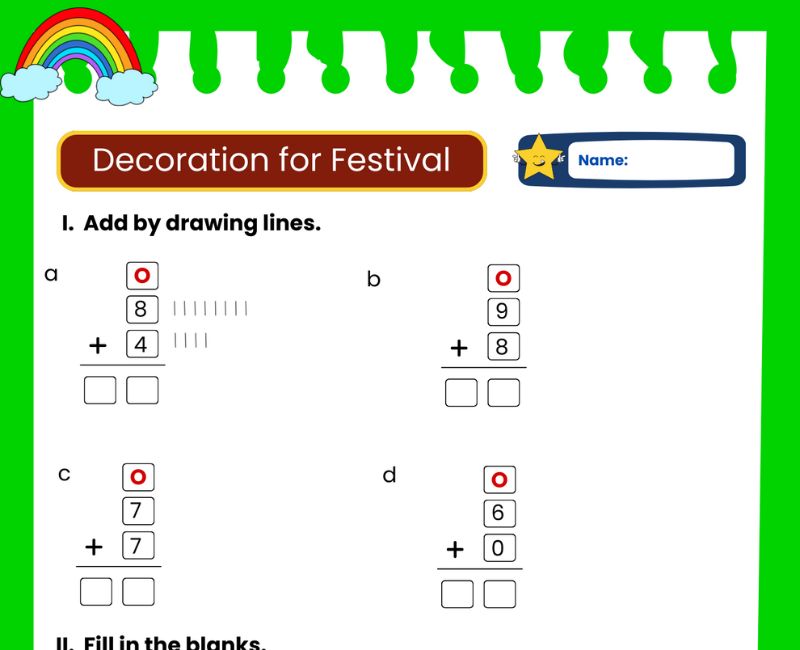
Decoration for Festival Class 2 Worksheet
Add Subtract and Plan a Celebration
Join flower collections, tie ten flowers into a garland and find how many diyas remain. Explore regrouping, number jumps, fact families and puzzle frames with answers built into each activity.
Join and Regroup
Combine collections and exchange ten loose flowers for a complete garland.
Take Away and Compare
Mark diyas given away and open a garland when more ones are needed.
Solve and Explain
Build fact families, complete number puzzles and plan a two-purchase gift budget.
Decoration for Festival Class 2 Online Quiz
20 questions • 10 easy • 5 average • 5 thinking • 20 minutes
Timing starts with your first answer or navigation action. Choose an answer to continue and review before submitting.
Question 1 / 20 • Easy • Answered 0/20
Three garlands and seven loose flowers represent how many flowers?
3 garlands and 7 loose flowers
Five Festival Number Games
Tap the raised selector. Each game has five original tasks using flower collections, diyas, exchanges or jumps.
Join the Flower Collections
Each garland is ten; each loose flower is one.
2 garlands and 1 loose flowers
3 garlands and 4 loose flowers
Each garland contains exactly ten flowers.
Reset options
Five Addition and Subtraction Activities
Complete fact families, build two kinds of pyramids, solve side sums and plan a gift budget.
Chapter 6 Questions and Thinking Practice
Festival Story Problems
Identify the whole and the parts before choosing an operation.
Reset options
How to use the festival maths studio
Five games and five exploration sets provide 50 tasks. Five thinking sets add 25 more, plus a separate 20-question quiz. Tap flowers and diyas, make exchanges, build jump trails and answer inside the equation or diagram. Optional audio controls are separate from the question frame.
A garland always contains ten flowers in these models. Opening or tying a garland keeps the total unchanged. The addition pyramid uses sums; the subtraction pyramid uses the bigger minus the smaller of each pair below. Follow the stated rule.
Progress stays while this page remains open. Reset controls clear one task or set. These questions and pictures are original practice based on the chapter, so use the values displayed here.
Decoration for Festival Notes Objectives Examples and Solutions • Tap to Read
Decoration for Festival Class 2 NCERT Worksheet
This Decoration for Festival Class 2 worksheet supports Chapter 6 of NCERT Joyful Mathematics. The chapter develops addition and subtraction through flower garlands, diyas, blocks, a ginladi, number lines, stories and number puzzles. The online activities use original examples to make these number relationships visible.
Decoration for Festival Learning Objectives
Children combine two quantities, find a remaining quantity and solve for a missing part. They represent two-digit numbers with tens and ones, exchange ten ones for one ten, open a ten when more ones are needed and connect a picture with a calculation.
They also use forward and backward jumps, related addition and subtraction facts, number pyramids and two-step gift-budget problems. Some addition examples cross one hundred, so reading the complete result matters.
Garlands of Ten and Loose Flowers
In these models, each complete garland has exactly ten flowers. Three garlands and four loose flowers represent thirty-four, not seven. Count the value of each complete group before adding the loose flowers.
Two collections can be combined by joining their tens and their ones. For example, twenty-four flowers and thirty-three flowers give five garlands and seven loose flowers, or fifty-seven altogether.
Two-Digit Addition without Regrouping
When the ones add to fewer than ten, add the tens and ones in their places. In 42 + 25, four tens and two tens make six tens; two ones and five ones make seven ones. The total is sixty-seven.
Children can explain this using garlands, blocks or a number trail. The representation should agree with the written equation, whichever method is chosen.
Addition with Regrouping or Carrying
If the combined loose flowers reach ten or more, tie exactly ten into a new garland. For 28 + 37, the ones give fifteen. Exchange ten of those ones for a ten, leaving five loose ones. The tens then total six, giving sixty-five.
The extra one recorded with the tens represents one ten, not one single flower. Regrouping changes the form of the collection while preserving its total value.
The regrouping game asks children to select the actual ten loose flowers before tying them. This makes the exchange visible rather than treating carrying as an unexplained written rule.
Subtraction without Regrouping
Subtraction can describe giving away or using part of a collection. If there are forty-eight flowers and twenty-three are used, remove two tens and three ones. Two tens and five ones remain, so 48 − 23 = 25.
The diya activity shows a smaller collection so children can mark each diya given away and then count the unmarked ones. A selected diya still represents one diya; the mark records that it belongs to the given-away part.
Subtraction with Regrouping or Borrowing
If there are not enough loose ones to give away, open a complete garland. One garland becomes ten loose flowers. For 63 − 27, six tens and three ones can be represented as five tens and thirteen ones.
From five tens and thirteen ones, remove two tens and seven ones. Three tens and six ones remain. Therefore 63 − 27 = 36.
The exchange does not add ten new flowers. It changes one ten into ten equivalent ones. The game keeps all flowers visible before marking which garlands and loose flowers are given away.
Addition and Subtraction on a Ginladi or Number Line
A ginladi is a counting string. Its positions can be connected with numbered landings. To add, move forward; to subtract, move backward. Splitting a two-digit change into tens and ones makes the movement easier to organise.
For example, 44 + 23 can be modelled as two jumps of ten and three jumps of one. Starting at forty-four, the final landing is sixty-seven. For 72 − 16, move back ten and then six ones to reach fifty-six.
The jump-trail activity records every chosen landing. It checks the requested number of tens and ones jumps as well as the final answer. Count movements from the starting position, rather than counting the start as the first jump.
Missing Numbers and How Many More Questions
A missing part can be found by subtraction even when the story uses the word “more”. If a display needs sixty flowers and already has thirty-eight, the extra flowers needed are 60 − 38 = 22.
If the remaining part and given-away part are known but the starting whole is missing, add the parts. A collection with twenty-nine left after seventeen are used originally contained forty-six.
Addition and Subtraction Fact Families
A fact family connects a whole and its two parts. If the parts are eighteen and twenty-seven, their whole is forty-five. The related equations are 18 + 27 = 45, 27 + 18 = 45, 45 − 18 = 27 and 45 − 27 = 18.
Swapping the addends keeps the sum. Subtraction is different: the whole and the subtracted part have different jobs, so reversing them is not a general shortcut.
Addition Pyramids with Solutions
In an addition pyramid, each box is the sum of the two directly below. With a base row of five, eight and three, the middle boxes are thirteen and eleven. The top is twenty-four.
Complete one level at a time. The middle base number contributes to both adjacent sums, so adding only the three base numbers does not usually give the top.
Subtraction Pyramids with Solutions
Our subtraction pyramid uses the bigger number minus the smaller of each adjacent pair below. With a base row of thirty, fourteen and nine, the middle differences are sixteen and five. Their difference is eleven at the top.
Read the rule before beginning. Addition and subtraction pyramids can look similar but use different operations. Apply the chosen rule at every level.
Four-Corner Addition Puzzles
Each side blank in the sum frame equals the two corner numbers at its ends. A top side joining nine and twelve has sum twenty-one. A side next to twelve and seven has sum nineteen.
Follow the visible side to its two endpoints. Do not accidentally add opposite corners or reuse a sum from a different side. The answer blanks sit in their actual positions on the frame.
Festival Money Problems and Gift Budgets
When buying two items, first add their costs to find total spending. Subtract that spending from the starting amount to find money left. If a purse has ₹96, ribbons cost ₹28 and paper costs ₹39, the spending is ₹67 and the money left is ₹29.
All prices in the activities are made-up practice amounts. Keep the two stages separate, name the amount each answer represents and check that spending plus money left equals the original budget.
Zero and Self-Subtraction
Adding zero leaves the original quantity unchanged. Subtracting zero also leaves it unchanged. Subtracting a whole quantity from itself leaves zero. These rules can be shown by adding nothing, giving away nothing or giving away everything.
Decoration for Festival Class 2 Questions and Answers
How many flowers make one garland here? Ten. Does opening a garland change the total? No. What happens to twelve ones? They can be represented as one ten and two ones. How do we check a subtraction answer? Add the remaining part and removed part to recover the starting whole.
Practice with Objects and Explanations
Use counters, bundles of ten sticks or paper flowers to model the exchanges. Ask children to explain why an exchange preserves value, which quantity is the whole and what a missing number represents. They can listen, tap a visual model, handle objects or describe a method aloud.
Chapter reference NCERT Joyful Mathematics Chapter 6 Decoration for Festival. The digital tasks use original practice examples rather than copying textbook picture answers.
Related Class 2 Maths Worksheets
Frequently Asked Questions
Which NCERT chapter does this worksheet support?
NCERT Joyful Mathematics Class 2 Chapter 6 Decoration for Festival, which develops addition and subtraction using groups, models, stories and puzzles.
Is this chapter mainly about decorative patterns?
Its festival setting supports addition and subtraction. The main number work includes tens and ones, regrouping, missing parts, fact families, pyramids and gift-budget problems.
What does one flower garland represent?
Exactly ten flowers in the models used here. One loose flower represents one.
What is regrouping in addition?
Exchanging ten ones for one ten. For example, thirteen loose flowers can become one full garland and three loose flowers.
Why do we open a garland in subtraction?
When more loose ones are needed, one ten can be exchanged for ten ones. The total value remains unchanged before anything is given away.
Does “how many more” always mean addition?
No. When the whole needed and the part already available are known, subtract to find the missing part.
What is a fact family?
A group of related addition and subtraction equations using the same whole and two parts.
How do addition and subtraction pyramids differ?
The addition pyramid adds each adjacent pair below a box. Our subtraction pyramid uses the bigger minus the smaller of each pair. Use the rule printed with the puzzle.
Can the chapter include a total above 100?
Yes. Some two-digit additions can cross one hundred. Record the whole answer rather than omitting its hundreds value.
Can children answer directly inside the models?
Yes. They select flowers and diyas, tie or open garlands, make jumps and fill blanks within equations, pyramids and sum frames.
How do children check a gift-budget answer?
Add the two item costs to find spending, then subtract from the starting money. Spending plus money left should equal the original budget.
Are these exact NCERT picture answers?
These are original chapter-based practice questions. Use the numbers and diagrams displayed here. Explanations appear in activity feedback and quiz review.
 Download