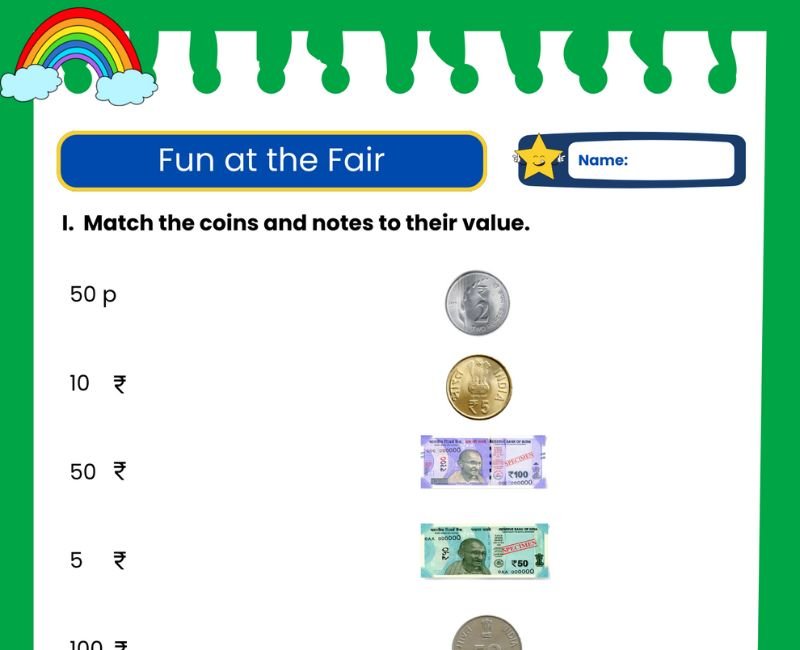
NCERT JOYFUL MATHEMATICS • CLASS 2 • CHAPTER 10
Fun at the Fair Class 2 Worksheet
Count Pay Play and Discover
Build exact amounts, fill a shopping basket, make change and explore colourful balloon sums. Every little purchase is a chance to think with money.
Build the Value
Make the same amount using different money tiles.
Check the Change
Connect the price, amount paid and money returned.
Think in Rupees
Explore value, ticket prices and historical paise models.
Fun at the Fair Online Quiz
20 questions • 10 easy • 5 average • 5 thinking
The 20-minute timer starts with your first answer or quiz navigation. Reading a question aloud does not start it. You can revisit answers before submitting.
Question 1 of 20 • Easy
What is the total value of these money tiles?
Five Interactive Fair Games
Choose a raised selector. Build, shop and tap answers directly inside each activity frame.
Make the Exact Amount • Task 1 of 5
Make exactly ₹17 in your payment tray.
Your tray
Rupee total ₹0
0 of 5 tasks completed
Five More Money Activities
Find the greatest balloon sum, count back to find spending, build tickets, exchange equal values and explore paise.
Find the Biggest Balloon Total • Task 1 of 5
Select three different pretend balloons with the greatest possible total.
0 balloons selected • Total ₹0
Pretend values for addition practice.
0 of 5 tasks completed
Money Word Problems and Thinking Practice
Everyday Money Stories • Task 1 of 5
A notebook costs ₹24 and a pen costs ₹13. What is the combined cost?
0 of 5 tasks completed
How to use this money studio
Ten interactive games and activities contain 50 tasks. Five thinking sets add 25 more tasks. The quiz has 20 separate questions. Optional Read and Stop controls stay above the question frame.
Each activity has Previous Task, Next Task, Reset Task and Reset Set controls. Undo controls reverse a money tile, ticket or counting step. Progress stays while the page is open. The timer and End Quiz button remain inside the quiz section.
All prices, balloons and money tiles are practice examples. The tiles show values and are not replicas of actual banknotes. The paise museum is arithmetic practice: 10p, 20p and 25p coins are historical and are not used in the shopping games.
You can make exact amounts in any valid way using the available tiles. A basket needs exactly two items. Balloon activities need exactly three different balloons. Read whether you are finding a total, change, money spent or extra money needed.
Read about the Fun at the Fair Class 2 worksheet
NCERT Class 2 Maths Chapter 10 Fun at the Fair
This Fun at the Fair Class 2 worksheet supports the money chapter in NCERT Joyful Mathematics. Children count values, combine prices, calculate money spent, find change and make equal amounts in different ways. The original interactive questions turn these ideas into a small practice fair.
Indian money worksheets for Class 2
Read the value printed on each practice tile before adding. A ₹20 value and two ₹5 values make ₹30. The number of pieces alone does not tell the total. One ₹50 value is worth more than three ₹10 values even though it uses fewer pieces.
Counting money and making amounts
The same amount can have different combinations. ₹18 can be made with ₹10 + ₹5 + ₹2 + ₹1, or with ₹10 + ₹2 + ₹2 + ₹2 + ₹2. Children build amounts and undo a tile when they need to change their plan.
Addition of money and shopping bills
Add prices to find a combined bill. A badge costing ₹9 and a card costing ₹14 together cost ₹23. When several identical tickets have the same price, repeated addition or multiplication can find the total. Three tickets costing ₹6 each require ₹18.
Subtraction of money and correct change
Change is the amount paid minus the purchase cost. If an item costs ₹27 and the customer pays ₹50, the correct change is ₹23. Check by adding the purchase cost and change: ₹27 + ₹23 = ₹50. Keep the bill total separate from the amount handed to the seller.
How to find money spent
Subtract the money left from the amount originally available. A child who starts with ₹60 and has ₹14 left has spent ₹46. Another method counts up from ₹14 to ₹60; the added steps total ₹46. The count-back activity makes those steps visible.
Money left and extra money needed
Compare the bill with the available money. If you have ₹35 and the purchase costs ₹29, ₹6 remains. If the purchase costs ₹42, you need ₹7 more. When the bill equals the budget exactly, ₹0 remains. A zero answer can be correct.
Rupees and paise questions
₹1 equals 100 paise. Two 50-paise values make 100 paise. Historical value models also show four 25-paise values or five 20-paise values making 100 paise. These are arithmetic relationships; they do not mean historical small coins can be used for purchases today.
Balloon addition and reasoning
The pretend balloon activities ask children either to make a stated total or to choose three different values giving the greatest total. These are different problems. A target may require a smaller value, while a maximum-total problem uses the three largest available values.
Recognising currency and observing notes
Alongside value practice, an adult can help children observe genuine Indian coins and notes. Look at the printed denomination and compare features using an authentic example or an official currency resource. The studio’s simplified value tiles do not reproduce banknote security features.
Money word problems with explanations
Read what the question asks before choosing an operation. Combined costs need addition. Change, money left and extra money needed usually involve subtraction. Receipt tasks and robot-repair questions encourage children to check an answer with a related calculation.
A practical money activity at home
Set up a pretend shop with price labels and paper value cards. Let a child choose two items, calculate the bill, build an exact payment and check the change from a larger value. Discuss saving some money and comparing prices before deciding what to buy.
More Class 2 Maths Worksheets
Frequently Asked Questions
What does Fun at the Fair teach in Class 2?
NCERT Joyful Mathematics Chapter 10 develops money values, addition and subtraction of money, spending, equal combinations, ticket costs and rupee–paise relationships.
How do you count Indian money in a worksheet?
Read each printed value and add the values. For ₹20, ₹5 and ₹2, the total is ₹27. Counting three pieces does not mean three rupees.
Can the same amount be made in different ways?
Yes. ₹20 can be made with one ₹20 value, two ₹10 values, four ₹5 values or other valid combinations.
How do you calculate change?
Subtract the cost from the amount paid. A ₹34 purchase paid with ₹50 gives ₹16 change. Check that ₹34 + ₹16 = ₹50.
How can children find the amount spent?
Subtract the money left from the starting money. Starting with ₹50 and keeping ₹11 means ₹39 was spent.
How many paise make one rupee?
100 paise make ₹1. Two 50-paise values also make ₹1.
Why are old paise values shown separately?
The chapter includes historical coins. Coins of 25 paise and below were withdrawn from circulation from 30 June 2011. The museum activity uses their values for arithmetic, not shopping.
What if the cost is greater than the money available?
Subtract the available amount from the cost to find the extra money needed. A ₹28 item with ₹20 available needs ₹8 more.
What if the bill exactly equals the budget?
No money remains. For example, a ₹12 item and a ₹18 item use a ₹30 budget exactly.
How do children find the greatest balloon total?
For three different balloons with no other restriction, choose the three largest available values and add them.
Are the money tiles pictures of real currency?
No. They are large simplified practice tiles showing values. Use authentic coins, notes or official resources to study real currency designs.
What online practice is included?
There are 10 interactive games and activities with 50 tasks, 25 additional thinking tasks and a separate 20-question quiz. Optional Read and Stop controls support listening.
 Download