Class 3 Mathematics · NCERT Maths Mela Chapter 2
Toy Joy Class 3 Maths Worksheet NCERT with Quiz and Activities
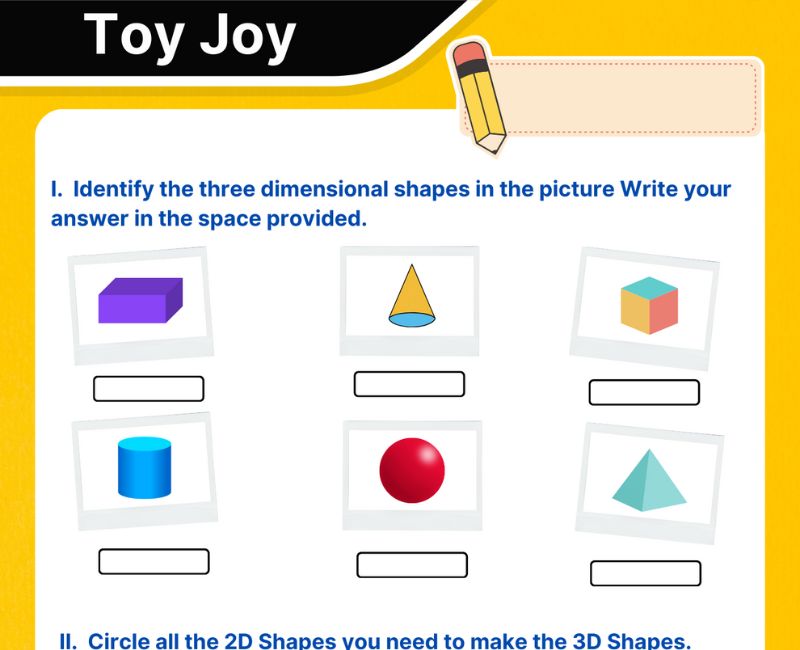
Look at boxes, tins, balls and caps and see the 3D shapes in them. Learn cubes, cuboids, cylinders, cones and spheres with their faces, edges and corners in Class 3 Maths Chapter 2 of the NCERT Maths Mela book, then use the Toy Joy Class 3 worksheet and play the Toy Joy Class 3 quiz and Toy Joy Class 3 activities online.
Toy Joy Class 3 Online Quiz
Toy Joy Class 3 Activities
Explore the Toy Joy Class 3 worksheet for NCERT Maths Mela Chapter 2 with a free online quiz and online activities. Use the Solid Finder to see the faces and corners of every solid, match objects with their shapes, sort solids by flat and curved faces, build towers from position words, count cubes in models and race around a shape board with a die. Every activity is a game you can tap or type.
Practice sheet
Toy Joy Class 3 Complete Guide
Introduction to NCERT Class 3 Maths Chapter 2 Toy Joy
Book: Maths Mela, the NCERT Mathematics textbook for Class 3 (Grade 3). Chapter: 2, Toy Joy. Board: CBSE and other schools that follow NCERT. The chapter is about solid shapes. Children make animal and bird faces on boxes, tins and bottles, look at toys built from different shapes and learn to describe what they see. They name the shapes, talk about their faces, edges and corners, build models and join cubes.
What is there in the chapter?
- Craft with old boxes (cubes and cuboids), bottles and tins (cylinders) and cones, and drawing faces on them
- Naming the shapes used in a rocket, a toy engine, houses and other toys, and counting each shape
- Position words: between, on top, under and on
- Talking about faces and edges, which are straight and which are curved, and the note that a cube is a special type of cuboid
- The Construct and Describe game in groups
- Finding cylinders, spheres, cubes, cuboids and cones in the classroom, filling a table and finding which shape is found most and least
- Sorting shapes: no edges, only flat faces, only curved faces, and both flat and curved faces
- Making shapes with clay and sticks and with cubes, and a board game played with a die
- Comparing shapes: how they are the same and how they are different
- The faces of a die and the pattern of the opposite faces
- Joining a cube and a cuboid, joining 3 cubes in different ways and building with six dice
NCERT Class 3 learning objectives for this chapter
These objectives are written from the content of the chapter. They are not copied from the book.
- To recognise and name a cube, a cuboid, a cylinder, a cone and a sphere in objects around us
- To describe a solid by its faces, edges and corners, and to tell flat faces from curved faces
- To sort solids using a property, such as only flat faces or a curved face
- To understand that a cube is a special type of cuboid
- To use position words such as on top, under and between when building and describing a model
- To build models by joining solids and cubes and to count the cubes in a model
- To observe the opposite faces of a die and find the pattern
- To tell how two solids are the same and how they are different
Learning outcomes
After this chapter and the practice on this page a Class 3 child should be able to:
- name a solid shape from a real object, such as a dice, a brick, a tin, a party cap or a ball
- say how many flat faces, curved faces and corners a cube, a cuboid, a cylinder, a cone and a sphere have
- name the solids that have no edges, only flat faces or a curved face
- explain why a cube is also a cuboid
- build a tower from instructions that use on, under and between, and describe a model in words
- count the cubes in a simple model, including hidden cubes
- say that opposite faces on a die add up to 7
- compare two solids and say one way they are the same and one way they are different
Toy Joy Class 3 resources on this page
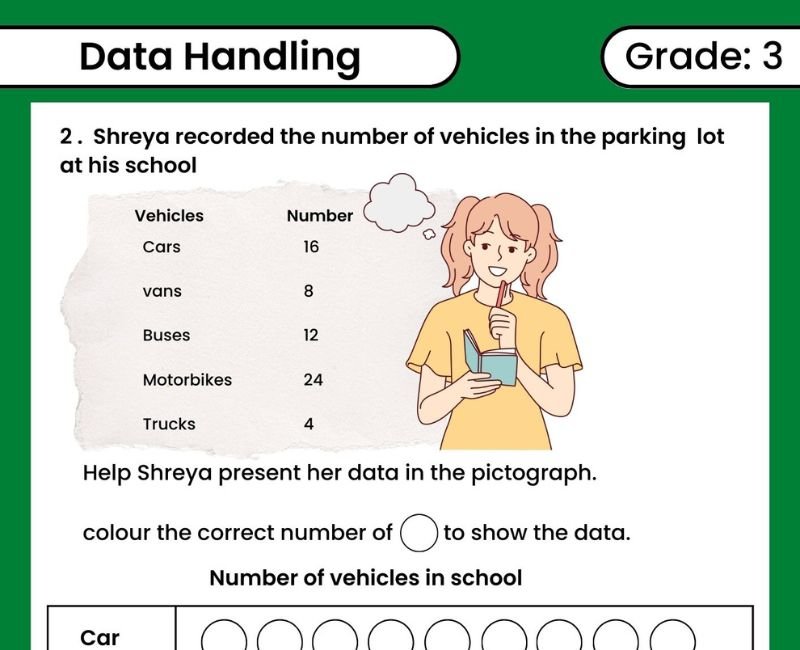
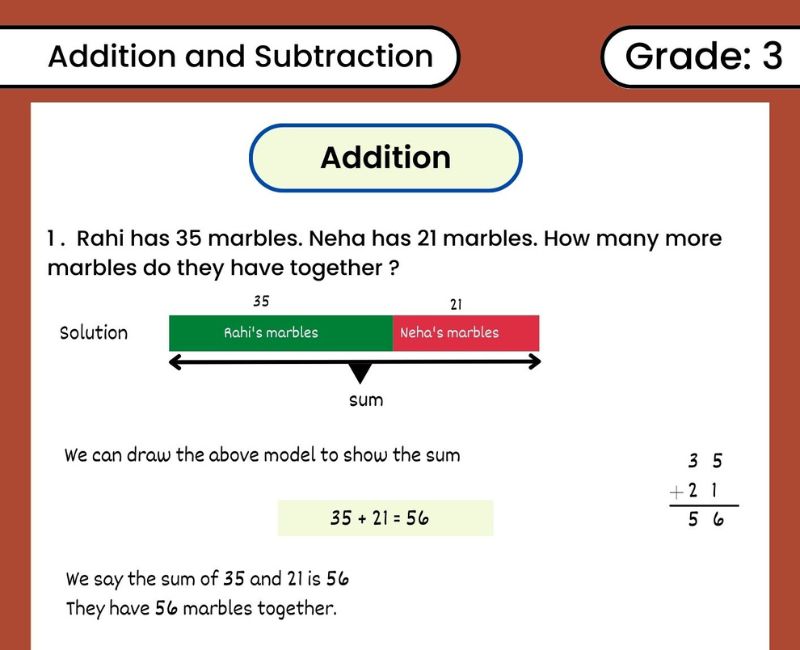
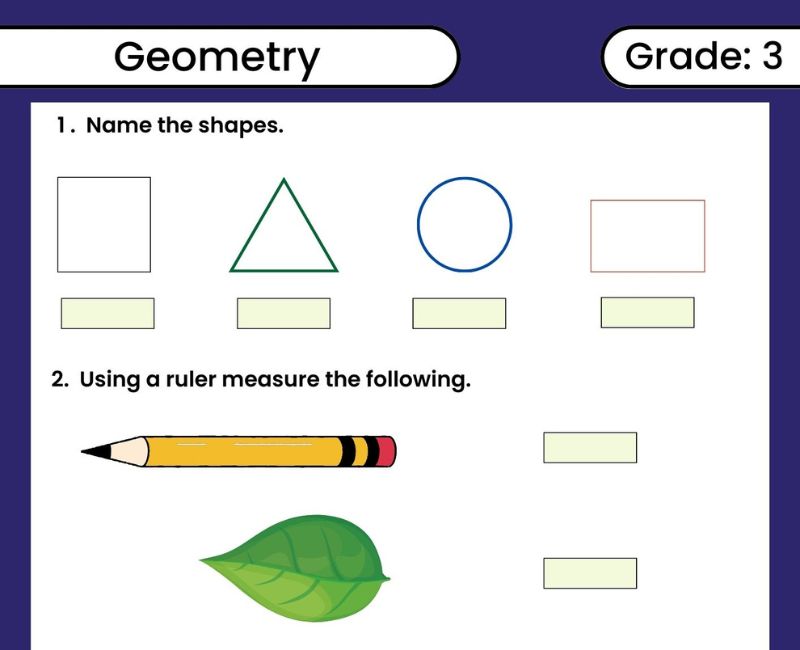
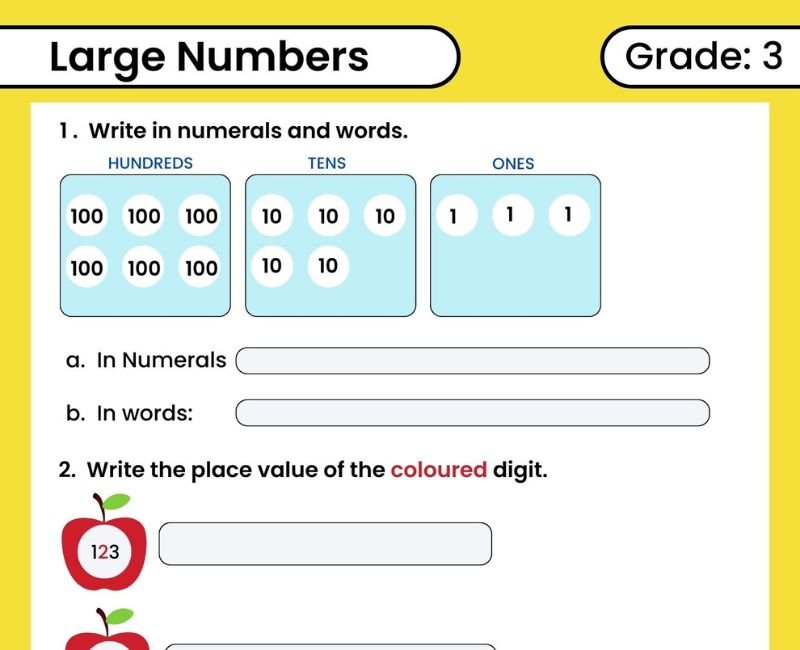
- Toy Joy Class 3 worksheet: a printable NCERT style worksheet on 3D shapes, their faces and building with shapes.
- Toy Joy Class 3 quiz: a free 20-question online quiz with easy, average and thinking questions, solid pictures, dice and instant marks with a reason for every answer.
- Toy Joy Class 3 activities: 15 free online activities, made of 5 games, 5 workshops and 5 challenges, with marks and a comment after the challenges.
- Practice sheet: 16 questions you can type and check, with a Show answers button.
3D shapes around us
A solid shape takes up space. You can hold it and turn it. A dice, a brick, a tin, an ice-cream cone and a ball are all solid shapes. The chapter uses five of them: the cube, the cuboid, the cylinder, the cone and the sphere. Spotting these shapes in everyday things is the first skill.
| Solid | Looks like | Flat faces | Curved faces | Corners |
|---|---|---|---|---|
| Cube | Dice, sugar cube | 6 | 0 | 8 |
| Cuboid | Brick, matchbox, book | 6 | 0 | 8 |
| Cylinder | Tin, pipe, bottle | 2 | 1 | 0 |
| Cone | Ice-cream cone, party cap, funnel | 1 | 1 | 1 |
| Sphere | Ball, marble, globe | 0 | 1 | 0 |
Faces, edges and corners
A face is a surface of a solid. A flat face lies flat on a table. A curved face bends round. An edge is where two faces meet. A corner is a point where edges meet. A cube and a cuboid have 12 straight edges and 8 corners. A sphere has no edges and no corners. The book asks which shapes have no edges, which have only flat faces, which have only curved faces and which have both flat and curved faces.
A cube is a special cuboid
A cuboid has 6 flat faces that are rectangles. A cube is a cuboid whose faces are all squares. So every cube is a cuboid, but a cuboid is not always a cube. A brick is a cuboid. A dice is a cube.
Position words
The words on top, under, between, beside and at the bottom tell where a shape is. The book asks which shape is between two others, which is on top of another and which is under another. It also has a Construct and Describe game. One child joins three shapes and describes how, and the others build the same model without seeing it.
Building with solids and cubes
Children build houses, towers and rockets from solids, and make shapes with clay and sticks. They also use cubes. Count the cubes tower by tower and remember the hidden ones. Two cubes joined in a row make a cuboid. The book asks in how many ways 3 cubes can be joined. Try joining them in a straight row and in a bent shape, and see what you get.
Opposite faces on a die
A die has the numbers 1 to 6. Look at the faces that are opposite each other. 1 is opposite 6, 2 is opposite 5 and 3 is opposite 4. In each pair the numbers add up to 7. That is the pattern the book asks children to find.
Comparing shapes
To compare two solids, ask how many flat faces, curved faces and corners each has and what they look like. A cube and a cuboid are the same because both have 6 flat faces and 8 corners. A cylinder and a cone are the same because both have a curved face and a flat round face. They are different because a cone has a corner and a cylinder does not.
Solved examples
Common mistakes
| Mistake | Correction |
|---|---|
| Calling a cylinder a cone | A cone has a pointed top. A cylinder has two flat round faces. |
| Thinking a cube is not a cuboid | A cube is a special cuboid with all faces squares. |
| Saying a sphere has corners | A sphere is smooth. It has no corners and no edges. |
| Forgetting hidden cubes | Count the cubes behind and below as well as the ones you see. |
| Thinking opposite faces on a die are next to each other | Opposite faces are on opposite sides. They add up to 7. |
| Mixing up on top and under | On top is above. Under is below. |
Shapes in daily life
We see solids everywhere. Houses are cuboids, cricket balls are spheres, water tanks and pipes are cylinders and party caps are cones. Ask your child to find five solids at home and name them. Ask which have a curved face and which have only flat faces.
What your child learns from the Toy Joy worksheet
- Naming cubes, cuboids, cylinders, cones and spheres
- Faces, edges and corners
- Flat faces and curved faces
- A cube as a special cuboid
- Position words on, under and between
- Building models and counting cubes
- Opposite faces on a die
- Comparing shapes
Tips for parents and teachers
Use real things, such as boxes, tins, balls and caps. Let your child hold each solid and turn it. Ask them to run a finger along the edges and point to the corners. Play the Construct and Describe game, where one child describes a model and the other builds it. Praise clear descriptions and careful counting.
Related Maths Worksheets
- Mental Maths Worksheet Class 3
- What’s in a Name Worksheet Class 3
- House of Hundreds II Worksheet Class 3
- Fractions Worksheet Class 3
- Geometry Worksheet Class 3
- Front Top and Side View Worksheet Class 3
- Data Handling Worksheet Class 3
- Place Value Worksheet Class 3
- Play with Patterns Worksheet Class 3
- Multiplication Worksheet Class 3
- Measurement Long and Short Worksheet Class 3
- Measurement of Weight Worksheet Class 3
Frequently Asked Questions
What is Class 3 Maths Chapter 2 Toy Joy?
It is the second chapter of the NCERT Class 3 Maths book Maths Mela. It teaches 3D shapes: the cube, cuboid, cylinder, cone and sphere, their faces, edges and corners, position words, building models and the faces of a die.
What are the five solids in the chapter?
The cube, the cuboid, the cylinder, the cone and the sphere. A dice is a cube, a brick is a cuboid, a tin is a cylinder, a party cap is a cone and a ball is a sphere.
Is a cube a cuboid?
Yes. A cube is a special type of cuboid. A cuboid has 6 flat faces that are rectangles. When all the faces are squares, the cuboid is a cube.
What is the difference between a flat face and a curved face?
A flat face is level, like the top of a box. A curved face bends round, like the side of a tin or a ball.
Which solids have a curved face?
The cylinder, the cone and the sphere. The cube and the cuboid have only flat faces.
Which solid has no edges?
The sphere. A ball is smooth and round with no edges and no corners.
How many faces and corners does a cube have?
A cube has 6 flat faces and 8 corners. A cuboid also has 6 flat faces and 8 corners.
What is the pattern of opposite faces on a die?
The numbers on opposite faces add up to 7. 1 is opposite 6, 2 is opposite 5 and 3 is opposite 4.
How do I tell where a shape is in a model?
Use position words. A shape can be on top, under, between two shapes, at the bottom or beside another shape.
What can I make by joining cubes?
Two cubes joined in a row make a cuboid. You can join 3 cubes in a straight row or bend them into other shapes. Count the cubes tower by tower to find how many are used.
Does this page have Toy Joy Class 3 questions and answers?
Yes. The online quiz shows the right answer and the reason after you finish, and the practice sheet has a Show answers button. The printable worksheet is the PDF download for this chapter.
What is included on this page?
This page has a free 20-question Toy Joy Class 3 online quiz with instant marks, 15 online activities made of 5 games, 5 workshops and 5 challenges, a Solid Finder, a 16-question practice sheet and a complete guide with solved examples.
 Download