Class 3 Mathematics · NCERT Maths Mela Chapter 4
Vacation with My Nani Maa Class 3 Maths Worksheet NCERT with Quiz and Activities
Add and subtract two-digit numbers using tens frames, number lines, number grids and box diagrams. Learn Class 3 Maths Chapter 4 on addition and subtraction from the NCERT Maths Mela book, then use the Vacation with My Nani Maa Class 3 worksheet and play the Vacation with My Nani Maa Class 3 quiz and Vacation with My Nani Maa Class 3 activities online.
Vacation with My Nani Maa Class 3 Online Quiz
There are 15 seeds in all. 12 seeds are on the table and the rest are hidden. How many seeds are hidden? Type the number.
Vacation with My Nani Maa Class 3 Activities
Explore the Vacation with My Nani Maa Class 3 worksheet for NCERT Maths Mela Chapter 4 with a free online quiz and online activities. Use the Add and Subtract Lab to see jumps on a number line and a box diagram, find hidden numbers, fill tens frames, walk on the number grid, build jumps to a target, solve magic sums and play the race to 100. Every activity is a game you can tap or type.
Add and subtract lab
Pick two numbers and add or subtract. See the jumps on the number line, the box diagram and the answer. Jump the tens first and then the ones.
25 + 36 = 61
25 + 30 = 55, then 55 + 6 = 61.
Hidden Number
Game 1 of 5Goal: Find the hidden number from the total and the part you can see.
How to play: Read the total and the seeds on the table. Tap the hidden number.
Round 1 of 6: There are 15 seeds in all. 12 are on the table and the rest are under the cloth. How many are hidden?
Practice sheet
Type your answers. Use jumps on a number line or a box diagram in your notebook if you need them. Press Check when you finish.
A. Hidden numbers
B. Add
C. Subtract
D. Word problems
Vacation with My Nani Maa Class 3 Complete Guide
This guide supports the Vacation with My Nani Maa Class 3 maths worksheet on this page. It covers Class 3 Maths Chapter 4 from the NCERT Maths Mela book, which is part of the latest NCERT syllabus for CBSE schools. Topics include addition and subtraction up to 100 and beyond, making 9, 10 and 20, tens frames, jumps on the number line, the number grid, box diagrams, estimating answers, word problems, magic sums and magic squares. Use it with the printable Vacation with My Nani Maa worksheets for Class 3, the Vacation with My Nani Maa Class 3 quiz and the 15 Vacation with My Nani Maa Class 3 activities above.
Introduction to NCERT Class 3 Maths Chapter 4 Vacation with My Nani Maa
Book: Maths Mela, the NCERT Mathematics textbook for Class 3 (Grade 3). Chapter: 4, Vacation with My Nani Maa. Board: CBSE and other schools that follow NCERT. This is a chapter on addition and subtraction. A visit to a grandmother gives many everyday places to add, take away and compare, such as sweets, books, stamps, radishes, vegetables and apples. The chapter shows children several ways to solve the same problem, so they can pick the way that suits them.
What is there in the chapter?
- A hidden number trick: say the number that is hidden when you know the total and the part you can see
- Number pairs that make 9, 10 and 20
- Adding and taking away with dots and tens frames, such as 6 + 8, 5 + 10, 9 − 6 and 18 − 9
- A card game in which three cards make an addition or subtraction statement
- Adding and subtracting on a bead string (ginladi) and on a number line, with different jumps for the same sum
- Jumps of 10 forward and backward and skip counting tables for jumps of 5, 6 and 9
- The number grid game with two dice and moving forward or backward
- Magic sums puzzles and a magic square with the numbers 1 to 9
- Box diagrams to show word problems and bundles of sticks to add 25 + 36
- Making 100, adding 85 + 67 and finding how many more
- Estimating to say if an answer is more or less than 100
- Word problems with box diagrams and a game of reaching 100
NCERT Class 3 learning objectives for this chapter
These objectives are written from the content of the chapter. They are not copied from the book.
- To add and subtract two-digit numbers using more than one way
- To find the missing part when the total and one part are known
- To use tens frames, number lines, number grids and bundles of sticks to show addition and subtraction
- To jump by 10 and by other numbers, forward and backward
- To draw a box diagram and use it to solve a word problem
- To estimate an answer and say if it is more or less than 100
- To use words such as total, sum, more, difference, less and take away for addition and subtraction
- To notice patterns in puzzles such as magic sums
Learning outcomes
After this chapter and the practice on this page a Class 3 child should be able to:
- say the number that makes a total of 9, 10 or 20 with a given number
- add and subtract two-digit numbers on a number line by jumping the tens first and then the ones
- move on a number grid by adding or subtracting two-digit numbers
- solve word problems on addition, subtraction and how many more using a box diagram
- make an estimate and check it with the exact answer
- explain the answer in more than one way
- complete a magic sums puzzle and a magic square using row and column totals
- make up a word problem with two numbers
Vacation with My Nani Maa Class 3 resources on this page
- Vacation with My Nani Maa Class 3 worksheet: a printable NCERT style worksheet on addition and subtraction, number lines, box diagrams and estimating.
- Vacation with My Nani Maa Class 3 quiz: a free 20-question online quiz with easy, average and thinking questions, picture questions and instant marks with a reason for every answer.
- Vacation with My Nani Maa Class 3 activities: 15 free online activities, made of 5 games, 5 workshops and 5 challenges, with marks and a comment after the challenges.
- Practice sheet: 16 questions you can type and check, with a Show answers button.
What is Class 3 Maths Chapter 4 Vacation with My Nani Maa?
Chapter 4 of the NCERT Class 3 Maths book Maths Mela is called Vacation with My Nani Maa. It builds the skill of adding and subtracting two-digit numbers. The chapter does not push one method. It shows tens frames, bead strings, number lines, number grids, bundles and box diagrams side by side so that children see how each picture shows the same sum.
Hidden numbers and making 9, 10 and 20
The chapter opens with a trick in which some seeds are hidden under a cloth and the total is known. The hidden number is the total take away the seeds on the table. For a total of 15 and 12 seeds on the table, 3 are hidden. The teacher’s note asks children to quickly say the number that makes 9 when a number from 1 to 9 is called, and then to do the same with 10 and 20. Knowing these pairs makes later sums faster.
| Total | Seen | Hidden |
|---|---|---|
| 15 | 12 | 3 |
| 17 | 10 | 7 |
| 19 | 8 | 11 |
| 20 | 9 | 11 |
| 23 | 7 | 16 |
| 27 | 12 | 15 |
Tens frames
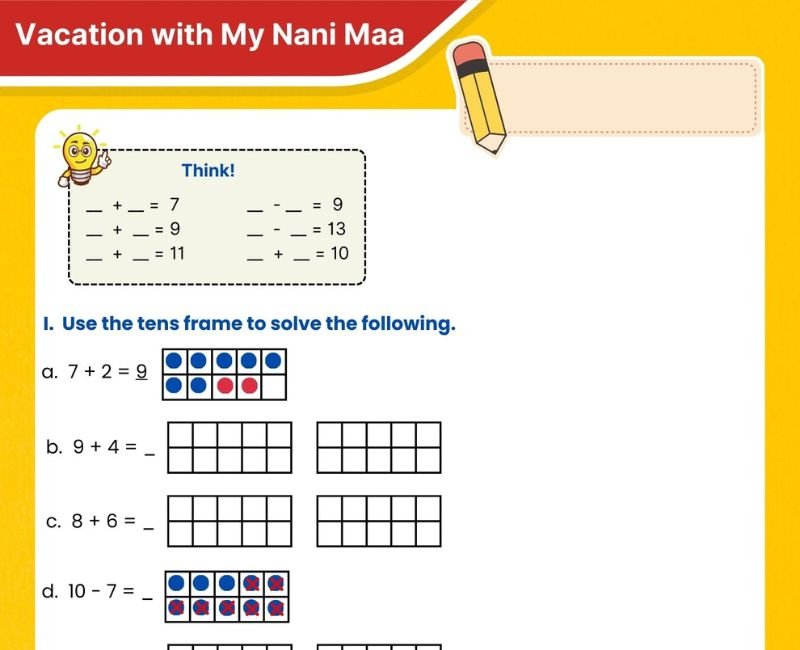
A tens frame holds 10 dots in two rows of 5. To add 6 + 8, fill a frame with 6 dots and move 4 dots from the 8 to complete 10. That leaves 4 more, so the sum is 14. For 5 + 10, a full frame and 5 more dots make 15. For subtraction, take dots away from a frame, such as 9 − 6 = 3 or 18 − 9 = 9.
Adding on the number line and the bead string
The chapter shows 15 stamps and 7 more. One way is to jump 1 seven times. Another is +5 to reach 20 and +2 to reach 22. A third is +10 to reach 25 and then −3 back to 22. All three give 15 + 7 = 22. Adding 30 more stamps to 22 stamps gives 52. Subtraction can be done by jumping back, or by counting up from the smaller number. To find 52 − 37, start at 37, jump 3 to reach 40, jump 10 to reach 50 and jump 2 to reach 52. The jumps are 3 + 10 + 2 = 15.
Number grid and jumps of 10
On the number grid from 1 to 100, adding 10 moves a counter one row and the ones digit stays the same. The frog and grasshopper activities use jumps of 10 forward and backward. Children also fill tables for jumps of 5, 6 and 9 and play the grid game with two dice. They make a two-digit number from the two dice and move forward or backward by that number. If they cannot go forward they move backward.
| Start | Number on the dice | Landing |
|---|---|---|
| 45 | 34 | 79 |
| 75 | 56 | 19 (backward) |
| 30 | 66 | 96 |
| 89 | 63 | 26 (backward) |
Magic sums and the magic square
In a magic sums puzzle, the numbers 1 to 9 are placed in a 3 by 3 grid. The numbers in each row add up to the number on the right and the numbers in each column add up to the number below. Children find what is common when they add the totals in two groups of boxes. In the magic square 2 7 6, 9 5 1 and 4 3 8, every row, column and diagonal adds up to 15. Children fill the blanks of a similar square. These puzzles build number sense and make adding fun.
Box diagrams and word problems
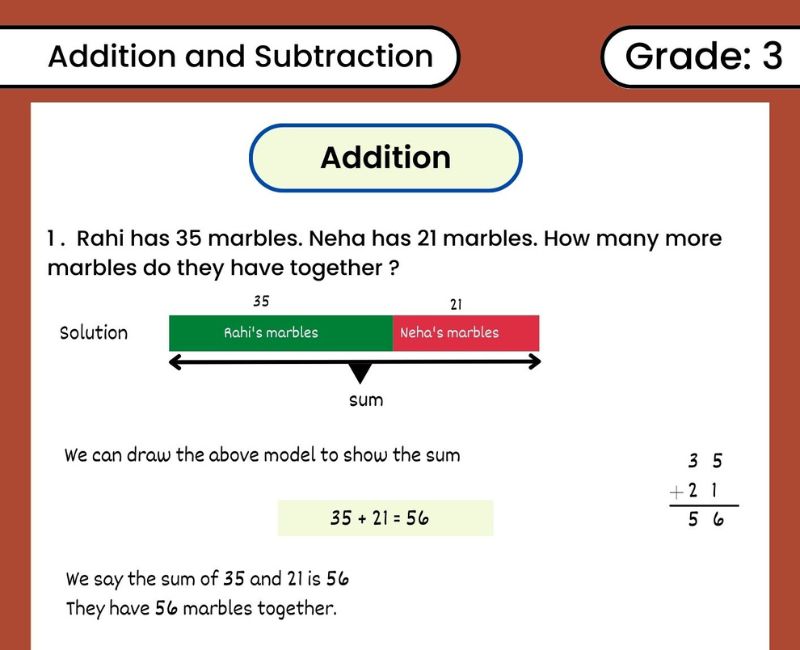
A box diagram shows a story as boxes. The total is one long box on top, and the parts are two boxes below. 25 red radishes and 36 white radishes make 25 + 36 = 61 radishes. When the total is 100 and one part is 65, the other part is 100 − 65 = 35. To find how many more, children compare two bars. 85 apples and 67 apples make 152 apples in all, and the difference is 85 − 67 = 18 apples.
| Problem | Number sentence | Answer |
|---|---|---|
| 25 red and 36 white radishes in all | 25 + 36 | 61 |
| 65 tomatoes in a box of 100 vegetables. How many carrots? | 100 − 65 | 35 |
| 85 apples and 67 apples in all | 85 + 67 | 152 |
| How many more is 85 than 67? | 85 − 67 | 18 |
| 52 stamps, 37 with faces. The rest? | 52 − 37 | 15 |
Estimating more or less than 100
Children estimate first and then solve. They match sums such as 134 − 56, 20 + 41, 150 − 49 and 199 − 90 with the words more than 100 and less than 100. A round number makes this easy. 150 − 50 is 100, so 150 − 49 is a little more than 100. The same answer should then be worked out on a number line, so that the estimate and the exact answer can be compared.
Words for adding and subtracting
The teacher’s note asks teachers to introduce many words. Addition can be spoken as more, added to, total or sum. Subtraction can be spoken as take away, difference, less or reduce. A child who knows these words can read a word problem and pick the right operation.
Types of questions to practise
Questions on this chapter ask children to find a hidden number, make 10 and 20, add and subtract on a tens frame or number line, move on a number grid, complete a magic square, draw a box diagram, solve word problems, estimate if an answer is more or less than 100 and make a word problem of their own. The online quiz on this page mixes choice questions, true or false questions, picture questions and typed answers, and the practice sheet has 16 typed answers.
Solved examples
Common mistakes
| Mistake | Correction |
|---|---|
| Adding the tens and forgetting the ones | Jump the tens first and then jump the ones. |
| Adding when the problem asks for the hidden part | When the total is known, subtract the part you can see. |
| Counting the start number as a jump | The start is where you stand. The first jump lands on the next number. |
| Writing 23 + 12 as 34 | 23 + 10 = 33 and 2 more is 35. |
| Taking a bigger number from a smaller one | Check which is bigger. 52 − 37 is 15, not 25. |
| Mixing up how many more with the total | For how many more, find the difference between the two numbers. |
| Not estimating before solving | Round to the nearest ten and see if the answer should be near it. |
| Using only one method | Try a number line, tens frame or box diagram, and compare the answers. |
Addition and subtraction in daily life
We use these skills when we add the prices of two things at a shop, count how many more pages are left in a book, check how many are still missing from a set of 100 cards or count scores in a game. Ask your child to add the numbers on two bus tickets or to say how many stamps, stickers or coins are in two piles together.
What your child learns from the Vacation with My Nani Maa worksheet
- Finding hidden numbers and making 9, 10 and 20
- Adding and subtracting with tens frames
- Jumping on a number line and a number grid
- Skip counting in jumps of 5, 6, 9 and 10
- Drawing box diagrams for word problems
- Estimating more or less than 100
- Words for addition and subtraction
- Magic sums and magic squares
Tips for parents and teachers
Use real things such as seeds, coins or buttons and a cloth to play the hidden number trick. Draw a number line on paper and let your child jump with a pencil. Ask them to solve the same sum in two ways and explain which is easier. Let them make their own word problems and share them with a friend. Praise careful thinking more than speed.
Related Maths Worksheets
- Mental Maths Worksheet Class 3
- What’s in a Name Worksheet Class 3
- Toy Joy Worksheet Class 3
- Double Century Worksheet Class 3
- House of Hundreds Worksheet Class 3
- Addition and Subtraction Worksheet Class 3
- Addition and Subtraction Word Problems Worksheet Class 3
- Give and Take Worksheet Class 3
- Place Value Worksheet Class 3
- Play with Patterns Worksheet Class 3
- Multiplication Worksheet Class 3
- Data Handling Worksheet Class 3
Frequently Asked Questions
What is Class 3 Maths Chapter 4 Vacation with My Nani Maa?
It is the fourth chapter of the NCERT Class 3 Maths book Maths Mela. It is about adding and subtracting two-digit numbers using tens frames, number lines, number grids, bundles and box diagrams, with word problems and puzzles.
How do I find the hidden number in the trick?
Subtract the part you can see from the total. If there are 20 seeds in all and 9 are on the table, the hidden number is 20 − 9 = 11.
How do I add on a number line?
Start at the first number and jump the tens first and then the ones, or jump to the next ten. 15 + 7 can be +5 to reach 20 and +2 to reach 22.
How do I subtract on a number line?
Count up from the smaller number to the bigger one, or jump back from the bigger one. To find 52 − 37, jump from 37 to 40 (3), then to 50 (10), then to 52 (2). The answer is 3 + 10 + 2 = 15.
How do tens frames help with addition?
A tens frame holds 10 dots. Fill it up and count the rest. For 6 + 8, move 4 dots to the 6 to make 10. Then 10 + 4 = 14.
What is a box diagram?
A box diagram shows a word problem as boxes. The total is a long box on top and the two parts are boxes below. 25 red radishes and 36 white radishes make a total of 25 + 36 = 61.
How do I solve how many more?
Subtract the smaller number from the bigger one. 85 apples and 67 apples: the first child has 85 − 67 = 18 more.
How do I know if an answer is more or less than 100?
Round a number to make a sum easy. 150 − 50 = 100, so 150 − 49 is a little more than 100. 20 + 41 is only 61, so it is less than 100.
What are the jumps of 10 on the number grid?
Adding 10 moves a counter one row and the ones digit stays the same. From 7 a frog lands on 17, 27, 37 and so on. Going backward by 10 from 76 lands on 66, 56 and so on.
What is a magic square?
It is a 3 by 3 square with the numbers 1 to 9 in which every row, column and diagonal adds up to the same total. In the chapter’s square 2 7 6, 9 5 1 and 4 3 8 every line adds up to 15.
Does this page have Vacation with My Nani Maa Class 3 questions and answers?
Yes. The online quiz shows the right answer and the reason after you finish, and the practice sheet has a Show answers button. The printable worksheet is the PDF download for this chapter.
What is included on this page?
This page has a free 20-question Vacation with My Nani Maa Class 3 online quiz with instant marks, 15 online activities made of 5 games, 5 workshops and 5 challenges, an Add and Subtract Lab, a 16-question practice sheet and a complete guide with solved examples.
 Download