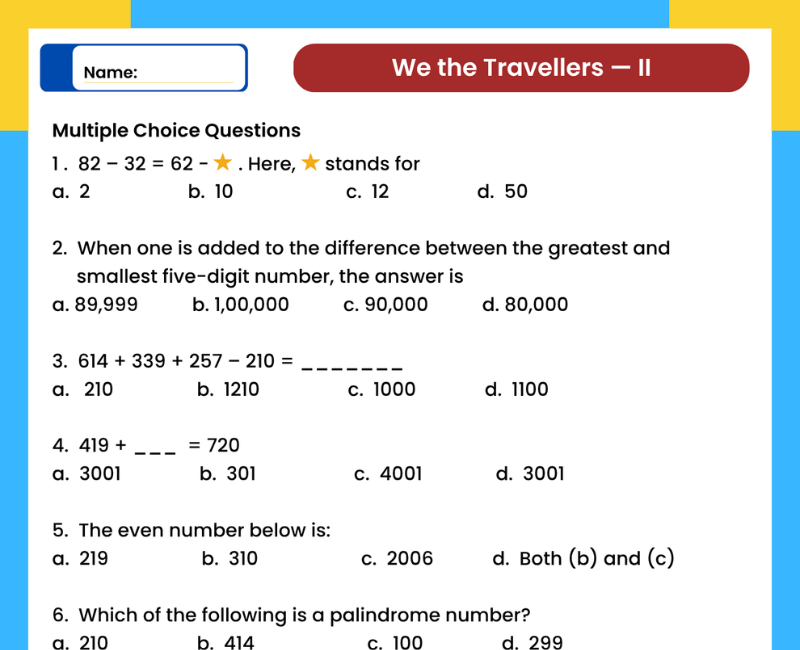
We the Travellers II Class 5 Maths Worksheet with Quiz and Activities
Add and subtract large numbers, use quick tricks, explore consecutive numbers and solve journey case studies. On WitKnowLearn you get the We the Travellers II Class 5 online quiz, online activities and interactive games, a big sums lab, a virtual lab and a worksheet-style practice sheet for NCERT Math Mela Chapter 4.
We the Travellers II Class 5 Online Quiz
20 questions: 10 easy, 5 average and 5 thinking. Tap an answer and the next question comes up.
We the Travellers II Class 5 Activities
👆 Tap a tab to switch: Learn, Games, Labs, Challenges, Virtual Lab and Practice sheet
We the Travellers II: the Great Road Trip Story
A short read for Class 5 before you play. These notes follow Chapter 4 of NCERT Math Mela.
⚖️ Making sums equal
Two groups of numbers have different sums. Swapping just one pair can make them equal.
⛽ Fuel arithmetic
A motorbike needs a few litres and a train needs thousands. Adding the fuel in a tank is addition with regrouping.
🔁 Add and subtract
If 46 + 21 = 67, then 67 - 21 = 46. Subtraction undoes addition, so we can check one with the other.
🗺️ Long routes
The road from Srinagar to Kanniyakumari is 3,717 km. Large numbers are added the same way as small ones.
⚡ Quick tricks
To make 100, make 99 and add 1. To subtract 99, subtract 100 and add 1.
📖 Case studies
Trucks, trains and school funds all need big sums. Estimate first and then calculate.
We the Travellers II Class 5 Activities
Add, subtract and check on the Number Train. Earn up to 3 stars in every activity.
This page follows NCERT Class 5 Maths Math Mela, Chapter 4. Children add and subtract large numbers, use smart tricks, explore consecutive numbers and learn how even and odd numbers behave.
The activities turn each idea into a game. Children sort sums, pop true facts, match words, fill gaps and solve journey stories. Explore more Class 5 maths worksheets on WitKnowLearn after this chapter.
Formulas and facts to know
| Sum of | Result | Example |
|---|---|---|
| Even + even | Even | 12 + 6 = 18 |
| Odd + odd | Even | 13 + 9 = 22 |
| Odd + even | Odd | 7 + 12 = 19 |
How to use this page
- Flip the six cards and try the Big Sums Lab in the Learn tab.
- Play the five games and the five labs to practise each idea.
- Finish the five challenges to collect up to 15 points.
- Take the 20-question online quiz, with assertion and reason and case study questions, and fill in the practice sheet.
Worked examples
Ones 0, tens 2 + 9 = 11 (regroup), hundreds 1 + 8 + 1 = 10 (regroup), thousands 6 + 2 + 1 = 9, ten thousands 4 + 1 = 5, so 59,010.
Regroup as needed. The answer is 4,922.
The middle number is 50 and there are 5 numbers, so 5 × 50 = 250.
This We the Travellers II worksheet for Class 5 maths gives you online activities and interactive games that turn big sums into play. Every activity has a goal, a hint and a short fact, so children learn while they enjoy.
Complete Guide: NCERT Class 5 Maths We the Travellers II Chapter 4
This guide is for Class 5 students, parents and teachers. It covers Chapter 4 of NCERT Math Mela and shows how to use the quiz, labs and games on this page.
Introduction to We the Travellers II
The chapter builds fluency with addition and subtraction of large numbers, through fuel quantities, long routes and travel money. It then adds number puzzles and patterns.
What is there in this chapter
- Making sums equal.
- Fuel arithmetic with 2-digit and 3-digit numbers.
- Relationship between addition and subtraction.
- Sums of consecutive numbers.
- Adding and subtracting large numbers.
- Quick sums and differences.
- Palindrome numbers and number grids.
- Even and odd numbers.
- Word problems and case studies.
Learning objectives
- Add and subtract numbers up to 5 digits with regrouping.
- Use addition to check subtraction.
- Find sums of consecutive numbers with a pattern.
- Use quick tricks for 100, 1,000, 9 and 99.
- Explain even and odd sums.
- Reason about assertions and case studies.
Learning outcomes
- The child can add 1,855 and 1,862 correctly.
- The child can check 2,700 - 1,083 by adding.
- The child can find 67 + 68 + 69 quickly.
- The child can solve a case study on a truck load or a trip budget.
We the Travellers II Class 5 resources on this page
| Resource | What it gives |
|---|---|
| Online quiz | 20 questions: 10 easy, 5 average and 5 thinking, with assertion and reason and case study questions and a full review |
| Flip cards | 6 picture cards with one-line rules |
| Big Sums Lab | A hands-on lab with 3 rounds |
| Games | 5 interactive games |
| Labs | 5 activity labs |
| Virtual Lab | 2 experiments with aim, procedure, observation table and conclusion |
| Challenges | 5 challenges, 15 points in all |
| Practice sheet | A worksheet-style sheet with 16 questions, name and date lines and a live score |
Key facts
| Idea | Rule |
|---|---|
| Regrouping | 10 of one place make 1 of the next. |
| Checking | Add the answer to the smaller number. |
| Consecutive sums | Odd count: middle number times the count. |
| Subtract 99 | Subtract 100, then add 1. |
| Even and odd | Same kind gives even, different kind gives odd. |
Types of questions you may see
- Add and subtract large numbers.
- Fill in the missing number to make 100 or 1,000.
- Find sums of consecutive numbers.
- Assertion and reason questions.
- Case study questions on routes, trucks and money.
Solved examples
878 + 8,789 = 9,667.
The answer is 5,000.
666 + 333 = 999, so the answer is 334.
247 - 100 + 1 = 148.
Yes, it reads the same both ways.
Odd presses switch it ON, so yes.
Common mistakes
| Mistake | Correct idea |
|---|---|
| Forgetting to carry in addition. | Write the carried digit above the next column. |
| Subtracting the smaller digit from the larger in every column. | Always subtract the bottom digit from the top one, regrouping when needed. |
| Misaligning the digits. | Ones must be under ones. |
| Adding 99 when asked to make 100. | Add 1 more after 99. |
We the Travellers II in daily life
Children add and subtract large numbers when they plan trips, count money and compare distances. Estimating first keeps the answers sensible.
Tips for parents and teachers
- Ask the child to add the distances on a road map.
- Practise the 99 trick during shopping.
- Play a palindrome hunt on number plates.
- Practise one assertion and one case study each week.
Related Class 5 Maths Worksheets
- 🚆We the Travellers I Class 5 (NCERT Chapter 1)
- 🍕Fractions Class 5 (NCERT Chapter 2)
- 🔄Angles as Turns Class 5 (NCERT Chapter 3)
- ➕Addition Class 5
- 🔢Large Numbers Class 5
- 💰Money Addition and Subtraction Class 5
- ✖Multiplication Class 5
- ➗Division Class 5
- 🌳Factors and Multiples Class 5
- 📏Measurement Class 5
- 🟩Perimeter and Area Class 5
- 📊Data Handling Class 5
We the Travellers II Class 5 FAQs
What is Chapter 4 of NCERT Class 5 Maths Math Mela?
Chapter 4 is We the Travellers II. It covers adding and subtracting large numbers, the link between addition and subtraction, sums of consecutive numbers, quick sums, palindromes, and even and odd numbers.
How do you add large numbers?
Write the numbers with Ones under Ones, Tens under Tens and so on. Add column by column from the right and regroup when a column makes 10 or more.
How do you subtract large numbers?
Align the digits and subtract from the ones column. If the top digit is smaller, regroup 1 ten as 10 ones, or 1 hundred as 10 tens, and then subtract.
What is regrouping in addition and subtraction?
Regrouping means exchanging 10 of one place for 1 of the next place, such as 10 ones for 1 ten. It is also called carrying and borrowing.
How do you check a subtraction answer?
Add the answer to the smaller number. If 37 + 45 = 82, then 82 - 37 = 45 is correct.
How are addition and subtraction related?
They undo each other. If 46 + 21 = 67, then 67 - 21 = 46 and 67 - 46 = 21.
What are consecutive numbers?
Consecutive numbers follow one another in order without skipping, such as 29, 30, 31 and 32.
What is the shortcut for the sum of consecutive numbers?
For an odd count of numbers, multiply the middle number by how many numbers there are. So 67 + 68 + 69 = 3 x 68 = 204.
How do you find the number to add to get 100 or 1,000?
Find the number that makes 99 or 999 and then add 1 more. So 32 + 67 = 99 and 1 more gives 32 + 68 = 100.
How do you subtract 9 or 99 quickly?
Subtract 10 or 100 and then add 1 back. So 187 - 99 = 187 - 100 + 1 = 88.
What are palindrome numbers and even and odd sums?
A palindrome reads the same from both ends, like 363 and 8,558. The sum of two even numbers or two odd numbers is even, and an even number plus an odd number is odd.
What can children do on this page?
Children can take a 20-question online quiz with assertion and reason and case study questions, play five games, try five online activities, finish five challenges, run the Big Sums Lab and two virtual experiments, and fill in a 16-question practice sheet with a Show answers button.
 Download