Large Numbers Class 5 Maths Worksheet with Quiz and Activities
Read, write, compare and round big numbers with lakhs and crores. On WitKnowLearn you get the Large Numbers Class 5 online quiz, online activities and interactive games, number labs, a virtual lab and a worksheet-style practice sheet, all on one page.
Large Numbers Class 5 Online Quiz
20 questions: 10 easy, 5 average and 5 thinking. Tap an answer and the next question comes up.
Large Numbers Class 5 Activities
👆 Tap a tab to switch: Learn, Games, Labs, Challenges, Virtual Lab and Practice sheet
Large Numbers: the Big Number Story
A short read for Class 5 before you play. These notes are written for this page.
🏙 Why we need big numbers
The people of a city, the pages printed by a press or the money a company earns cannot be counted on fingers. We need names for very big numbers.
📊 The place value chart
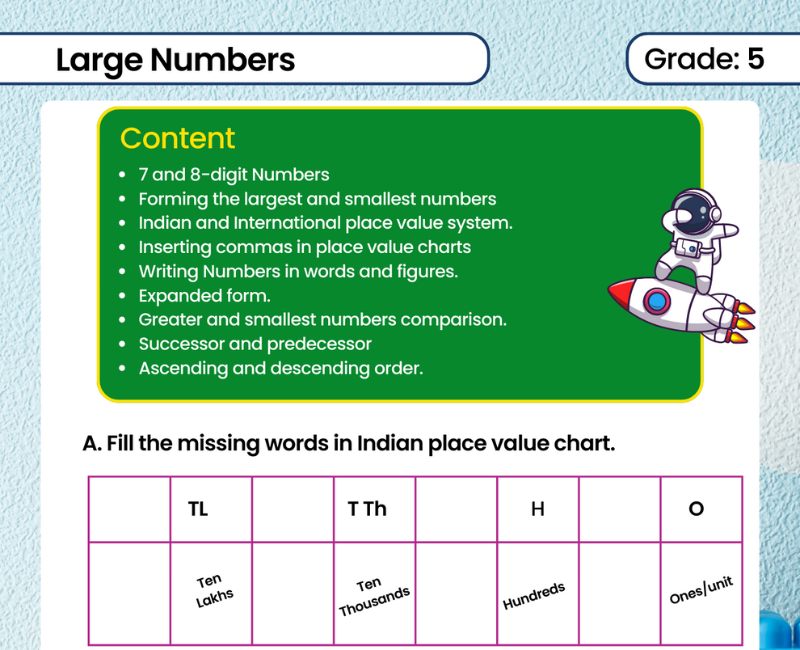
Every digit sits in a place. The places grow ten times bigger as we move left: ones, tens, hundreds, thousands, ten thousands, lakhs, ten lakhs and crores.
📖 Reading and writing
We read a big number in groups. After the hundreds we put a comma after every two digits, and say each group with its name: crore, lakh or thousand.
⚖ Comparing
More digits means a bigger number. When two numbers have equal digits, we compare from the left and stop at the first difference.
➡ One more, one less
The successor is one more and the predecessor is one less. A string of nines is followed by a new place, which is how one lakh and one crore are born.
🎯 Rounding and estimating
Rounding gives an easy number close to the real one, like 9 lakh for a number a little above it. Estimates help us check big sums quickly.
Large Numbers Class 5 Activities
Read, write, compare and round big numbers on the Number Train. Earn up to 3 stars in every activity.
Large numbers are all around us in populations, distances, prices and sales. This page helps children feel at home with lakhs and crores by using charts, number lines and short stories.
The activities turn each idea into a game. Children sort numbers into ranges, pop the bigger bubbles, match maths words, fill gaps and choose the greater number. Explore more Class 5 maths worksheets on WitKnowLearn after this topic.
Words and facts to know
| Word | Meaning | Example |
|---|---|---|
| Lakh | One hundred thousand | 1,00,000 |
| Crore | One hundred lakh | 1,00,00,000 |
| Successor | One more than a number | After 29,999 comes 30,000 |
| Predecessor | One less than a number | Before 30,000 comes 29,999 |
How to use this page
- Flip the six cards and try the Place Value Lab in the Learn tab.
- Play the five games and the five labs to practise each idea.
- Finish the five challenges to collect up to 15 points.
- Take the 20-question online quiz and fill in the practice sheet.
Worked examples
49,99,999 + 1 = 50,00,000.
3 is in the ten thousands place, so it is 30,000.
The lakhs match, then 8 is greater than 1, so 7,81,000 is greater.
This Large Numbers worksheet for Class 5 maths gives you online activities and interactive games that turn big numbers into play. Every activity has a goal, a hint and a short fact, so children learn while they enjoy.
Complete Guide: Maths Large Numbers Class 5
This guide is for Class 5 students, parents and teachers. It explains reading, writing, comparing and rounding large numbers in simple words and shows how to use the quiz, labs and games on this page.
Introduction to Large Numbers
In Class 5 children move from numbers in thousands to numbers in lakhs and crores. They learn that a digit gets its value from the place where it stands, and that the same ideas of comparing, ordering and rounding work for every size of number.
What is there in this topic
- The Indian place value chart up to crores.
- Face value and place value.
- Reading and writing numbers in words and figures.
- Expanded form of a number.
- Comparing and ordering large numbers.
- Successor and predecessor.
- Rounding and estimating.
- The international system with millions.
Learning objectives
- Read and write numbers up to crores.
- Find the face value and place value of a digit.
- Compare and arrange numbers in order.
- Find the successor and predecessor of a number.
- Round a number to a chosen place.
Learning outcomes
- The child can write a number name in figures with correct commas.
- The child can explain why a digit is worth more in a higher place.
- The child can order four numbers from smallest to largest.
- The child can estimate by rounding to the nearest thousand or lakh.
Large Numbers Class 5 resources on this page
| Resource | What it gives |
|---|---|
| Online quiz | 20 questions: 10 easy, 5 average and 5 thinking, with a full review |
| Flip cards | 6 picture cards with one-line rules |
| Place Value Lab | A hands-on lab with 3 rounds |
| Games | 5 interactive games |
| Labs | 5 activity labs |
| Virtual Lab | 2 experiments with aim, procedure, observation table and conclusion |
| Challenges | 5 challenges, 15 points in all |
| Practice sheet | A worksheet-style sheet with 16 questions, name and date lines and a live score |
Key facts
| Topic | Key idea |
|---|---|
| Place | Each place is ten times the one on its right. |
| Face value | The digit itself. |
| Place value | Digit times the value of its place. |
| Compare | More digits is greater, then compare from the left. |
| Round | Look at the digit on the right: 5 or more rounds up. |
Types of questions you may see
- Writing numbers in words and figures.
- Place value and face value.
- Comparing and ordering.
- Successor, predecessor and rounding.
- Word problems on adding and subtracting big numbers.
Solved examples
4,06,00,000.
2.
98,000 has fewer digits, so it is smaller.
The thousands digit is 8, so round up to 7,40,000.
One crore is 100 lakh, and ten million is one crore.
2,05,000.
Common mistakes
| Mistake | Correct idea |
|---|---|
| Putting commas after every three digits. | Use the Indian pattern: three, then two, two. |
| Mixing face value and place value. | Face value is the digit, place value uses the place. |
| Rounding with the wrong digit. | Look at the digit just to the right of the place. |
| Ignoring the number of digits. | Count digits before comparing. |
Large Numbers in daily life
Children meet big numbers in the population of a city, the price of a house, the views of a video and the pages in a library. Reading them aloud at home builds confidence.
Tips for parents and teachers
- Make a place value chart on a wall and hang digit cards in it.
- Ask children to read big numbers from newspapers.
- Play a game of making the greatest and smallest numbers from digit cards.
- Practise rounding with prices in shops.
Related Class 5 Maths Worksheets
Large Numbers Class 5 FAQs
What is Large Numbers in Class 5 maths?
Large Numbers is the study of numbers beyond one lakh, up to crores and beyond. Children learn to read, write, compare, order and round big numbers using the Indian place value system with lakhs and crores.
What are the places in the Indian system?
From the right the places are ones, tens, hundreds, thousands, ten thousands, lakhs, ten lakhs and crores. Commas are put after the hundreds, then after every two digits, so one crore is written 1,00,00,000.
What is the difference between face value and place value?
Face value is the digit itself and never changes. Place value is the digit multiplied by the value of its place, so the same digit is worth more when it moves to the left.
How do we compare two large numbers?
First count the digits, because the number with more digits is greater. If the digits are equal, compare from the left and the first different digit decides which number is greater.
What are a successor and a predecessor?
The successor of a number is the number just after it, which is one more. The predecessor is the number just before it, which is one less. For example, the successor of nine lakh ninety-nine thousand nine hundred ninety-nine is ten lakh.
How do we round a large number?
Look at the digit to the right of the place you are rounding to. If it is 5 or more, round up, otherwise round down, and fill the lower places with zeros.
What is the international system of numbers?
Many countries use thousands, millions and billions instead of lakhs and crores. Ten lakh equals one million and one crore equals ten million.
Why do we learn to estimate large numbers?
Estimating gives a quick idea of a big number, like the people in a city or the books in a library, without doing the exact sum. Rounding to the nearest thousand or lakh makes this easy.
Does this page have Large Numbers Class 5 questions and answers?
Yes. The 20-question online quiz ends with a full review that shows the correct answer and a short reason for every question. The practice sheet has 16 questions and a Show answers button.
Which class is this worksheet for?
This worksheet is for Class 5 maths. All questions are written for this page, so children can practise reading, writing, comparing and rounding large numbers with fresh examples.
What can children do on this page?
Children can take the online quiz, play interactive games, try online activities and number labs, finish challenges, do the hands-on Place Value Lab, run two virtual experiments and solve a worksheet-style practice sheet. They can earn up to 3 stars in every activity.
Can my child use these activities on a phone?
Yes. The page works on phones, tablets and computers. Children can drag cards or simply tap a card and then tap its place, so it is easy on a small screen.
What is included on this page?
This page has a 20-question online quiz, 6 flip cards, the Place Value Lab, 5 games, 5 labs, 5 challenges, a virtual lab with 2 experiments, a 16-question practice sheet, a story of big numbers, a topic description, a complete guide, related Class 5 maths worksheets and 12 FAQs.
 Download