Animal Jumps Class 5 Maths Worksheet with Quiz and Activities
Jump along the number line to find factors, multiples, common factors and prime numbers. On WitKnowLearn you get the Animal Jumps Class 5 online quiz, online activities and interactive games, a factor lab, a virtual lab and a worksheet-style practice sheet for NCERT Math Mela Chapter 13.
Animal Jumps Class 5 Online Quiz
20 questions: 10 easy, 5 average and 5 thinking. Tap an answer and the next question comes up.
Animal Jumps Class 5 Activities
👆 Tap a tab to switch: Learn, Games, Labs, Challenges, Virtual Lab and Practice sheet
Animal Jumps: the Jungle Jump Story
A short read for Class 5 before you play. These notes follow Chapter 13 of NCERT Math Mela.
📦 The hidden multiplier
Numbers go into a box and come out as 28, 36, 48 and 72. A multiplier like 4 divides all of them, so it is a common factor.
🔢 Arrays
12 dots make arrays of 1 × 12, 2 × 6 and 3 × 4. So the factors of 12 are 1, 2, 3, 4, 6 and 12.
🐇 Jumps and multiples
A rabbit jumps 4 each time and a frog jumps 3. Both touch 12, and also 24 and 36. These are the common multiples of 3 and 4.
⭕ Common factors
24 and 36 can both be reached by jumps of 1, 2, 3, 4, 6 and 12. These are their common factors.
⭐ Prime numbers
13 can only make one array, 1 × 13. A number with exactly two factors is prime.
📖 Case studies
Hunting days, jumps and friends on a trail all use factors and multiples. List the numbers before you decide.
Animal Jumps Class 5 Activities
Jump through factors and multiples on the Number Train. Earn up to 3 stars in every activity.
This page follows NCERT Class 5 Maths Math Mela, Chapter 13. Children use arrays to find factors, jump on a number line to find multiples, and discover common factors, common multiples and prime numbers.
The activities turn each idea into a game. Children sort primes, pop true facts, match words, fill gaps and solve jungle stories. Explore more Class 5 maths worksheets on WitKnowLearn after this chapter.
Formulas and facts to know
| Number | Factors | Count |
|---|---|---|
| 12 | 1, 2, 3, 4, 6, 12 | 6 |
| 13 | 1, 13 | 2 |
| 15 | 1, 3, 5, 15 | 4 |
| 16 | 1, 2, 4, 8, 16 | 5 |
How to use this page
- Flip the six cards and try the Factor Lab in the Learn tab.
- Play the five games and the five labs to practise each idea.
- Finish the five challenges to collect up to 15 points.
- Take the 20-question online quiz, with assertion and reason and case study questions, and fill in the practice sheet.
Worked examples
1 × 18, 2 × 9 and 3 × 6, so the factors are 1, 2, 3, 6, 9 and 18.
6, 12, 18 and 9, 18, so the answer is 18.
12 has 1, 2, 3, 4, 6, 12 and 18 has 1, 2, 3, 6, 9, 18, so the common factors are 1, 2, 3 and 6.
This Animal Jumps worksheet for Class 5 maths gives you online activities and interactive games that make factors and multiples fun. Every activity has a goal, a hint and a short fact, so children learn while they enjoy.
Complete Guide: NCERT Class 5 Maths Animal Jumps Chapter 13
This guide is for Class 5 students, parents and teachers. It covers Chapter 13 of NCERT Math Mela and shows how to use the quiz, labs and games on this page.
Introduction to Animal Jumps
The chapter starts with a hidden multiplier game and moves through arrays, factors and multiples, jumps on a number line, common multiples and common factors, and prime numbers.
What is there in this chapter
- The hidden multiplier game.
- Arrays and factors.
- Factors and multiples.
- Prime numbers.
- Common multiples on a number line.
- Common factors from jumps.
- True and false statements about factors and multiples.
- Numbers divisible by 2, 5 and 10.
Learning objectives
- List the factors and multiples of a number.
- Find common factors and common multiples.
- Recognise prime numbers.
- Use jumps to understand multiples.
- Reason about assertions and case studies.
Learning outcomes
- The child can list the factors of 12.
- The child can find that the first common multiple of 4 and 6 is 12.
- The child can say that 13 is prime.
- The child can solve a case study on jumps and hunting days.
Animal Jumps Class 5 resources on this page
| Resource | What it gives |
|---|---|
| Online quiz | 20 questions: 10 easy, 5 average and 5 thinking, with assertion and reason and case study questions and a full review |
| Flip cards | 6 picture cards with one-line rules |
| Factor Lab | A hands-on lab with 3 rounds |
| Games | 5 interactive games |
| Labs | 5 activity labs |
| Virtual Lab | 2 experiments with aim, procedure, observation table and conclusion |
| Challenges | 5 challenges, 15 points in all |
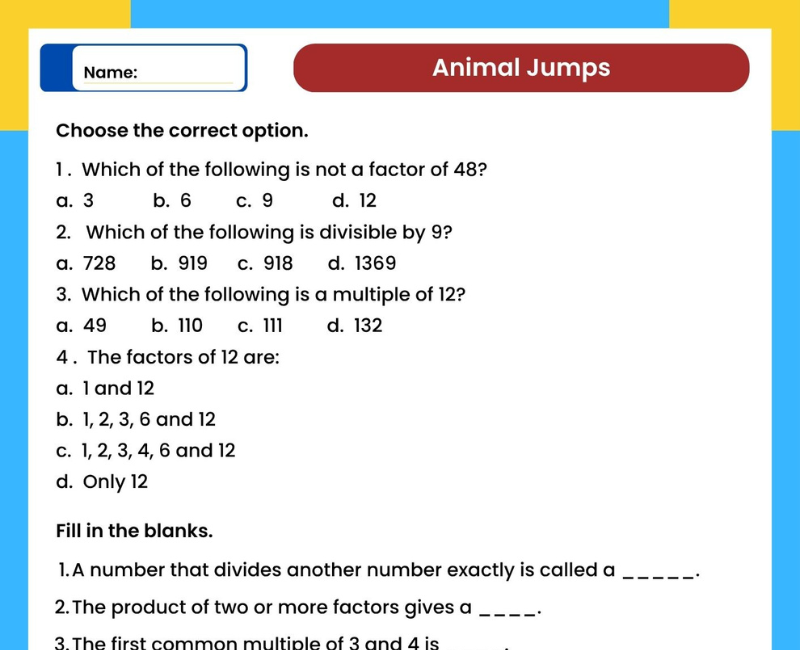
| Practice sheet | A worksheet-style sheet with 16 questions, name and date lines and a live score |
Key facts
| Idea | Rule |
|---|---|
| Factor | Divides a number exactly. |
| Multiple | Comes from multiplying. |
| Prime | Exactly two factors. |
| 1 | A factor of every number. |
| A number | A factor and a multiple of itself. |
Types of questions you may see
- List the factors or multiples of a number.
- Find common factors or common multiples of two numbers.
- Say whether a number is prime.
- Assertion and reason questions.
- Case study questions on jumps and days.
Solved examples
1, 2, 4, 5, 10 and 20.
4, 8, 12, 16, 20 and 10, 20, so the answer is 20.
21 = 3 × 7, so it has more than two factors and is composite.
The factors 1 and 7 divide both, so the greatest is 7.
They meet on day 18.
12, 24, 36, 48 and 60, which is 5.
Common mistakes
| Mistake | Correct idea |
|---|---|
| Leaving out 1 or the number itself as a factor. | Every number has 1 and itself as factors. |
| Calling 1 a prime number. | 1 has only one factor, so it is not prime. |
| Mixing up factors and multiples. | Factors divide the number and multiples are multiplied from it. |
| Calling every odd number prime. | 9 and 15 are odd but not prime. |
Animal Jumps in daily life
Factors and multiples help us group things equally, plan repeating events and share items. Buses that leave every few minutes meet again at a common multiple.
Tips for parents and teachers
- Make arrays with buttons or beans.
- Skip count on a number line with two colours.
- Play the hidden multiplier game with a box.
- Practise one assertion and one case study each week.
Related Class 5 Maths Worksheets
- 📏Far and Near Class 5 (NCERT Chapter 5)
- 🐄The Dairy Farm Class 5 (NCERT Chapter 6)
- 🔷Shapes and Patterns Class 5 (NCERT Chapter 7)
- ⚖Weight and Capacity Class 5 (NCERT Chapter 8)
- 🥥Coconut Farm Class 5 (NCERT Chapter 9)
- 🪞Symmetrical Designs Class 5 (NCERT Chapter 10)
- 🧵Grandmother’s Quilt Class 5 (NCERT Chapter 11)
- ⏱Racing Seconds Class 5 (NCERT Chapter 12)
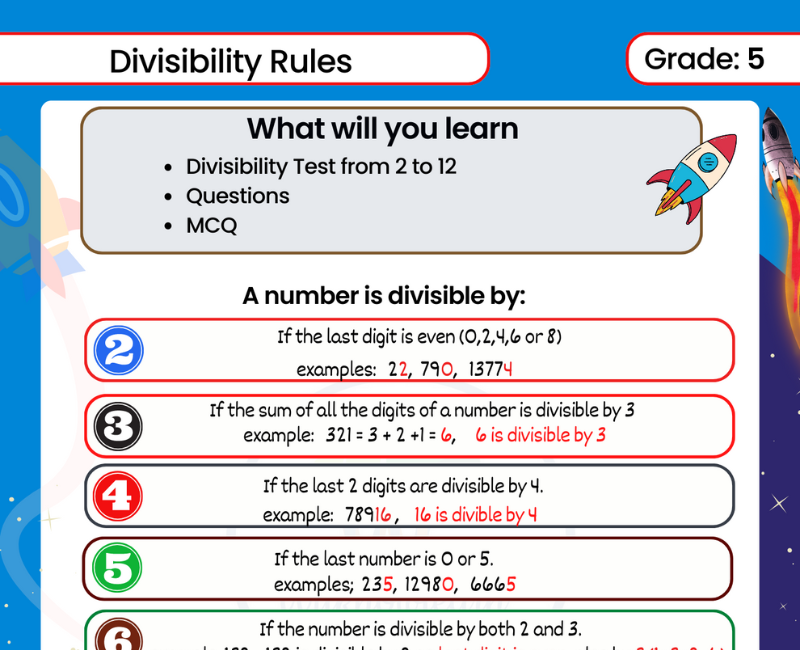
- 🔢Divisibility Rules Class 5
- ✖Multiplication Class 5
- ➗Division Class 5
- 🧮Large Numbers Class 5
Animal Jumps Class 5 FAQs
What is Chapter 13 of NCERT Class 5 Maths Math Mela?
Chapter 13 is Animal Jumps. It covers factors and multiples, arrays, common multiples, common factors, prime numbers, and rules like divisibility by 2, 5 and 10.
What are factors in maths for Class 5?
Factors are numbers that divide a number exactly. The factors of 12 are 1, 2, 3, 4, 6 and 12, because each of them divides 12 with no remainder.
What are multiples in maths for Class 5?
Multiples are the numbers we get by multiplying a number by 1, 2, 3 and so on. The multiples of 4 are 4, 8, 12, 16, 20 and 24. A number is always a multiple of itself.
What is the difference between factors and multiples?
Factors divide a number and are never bigger than it. Multiples are made by multiplying and are never smaller than it. For 12, 3 is a factor and 24 is a multiple.
How do you find the factors of a number using arrays?
Arrange the number in rows and columns of equal size. Each pair of row and column counts is a pair of factors. For 12 the arrays are 1 x 12, 2 x 6 and 3 x 4.
What are common multiples?
Common multiples are numbers that are multiples of two or more numbers. The multiples of 4 and 6 that match are 12, 24, 36 and so on, and 12 is the first common multiple.
What are common factors?
Common factors are numbers that divide each of the given numbers exactly. The common factors of 24 and 36 are 1, 2, 3, 4, 6 and 12. The number 1 is always a common factor.
How do you find the first common multiple of two numbers?
Write the multiples of both numbers and look for the first one in both lists. For 6 and 8, the lists are 6, 12, 18, 24 and 8, 16, 24, so the first common multiple is 24.
What is a prime number?
A prime number has exactly two factors, 1 and itself. Examples are 2, 3, 5, 7, 11 and 13. The number 1 has only one factor, so it is not prime.
What is a composite number?
A composite number has more than two factors. For example 15 has the factors 1, 3, 5 and 15, so it is composite.
Are factors of odd numbers always odd?
Yes. An even number cannot divide an odd number exactly, so every factor of an odd number is odd. But multiples of an odd number can be even, like 3 x 2 = 6.
What can children do on this page?
Children can take a 20-question online quiz with assertion and reason and case study questions, play five games, try five online activities, finish five challenges, run the Factor Lab and two virtual experiments, and fill in a 16-question practice sheet with a Show answers button.
 Download