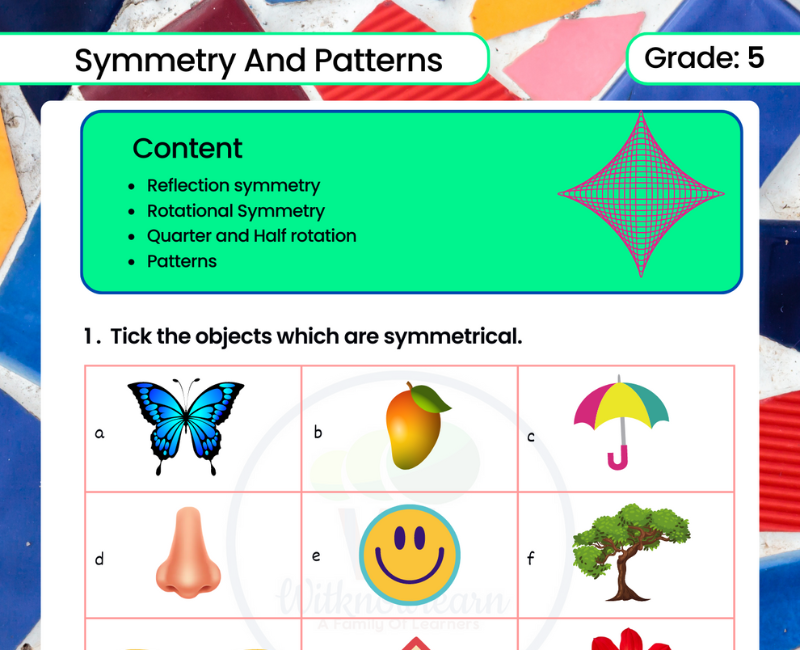
Symmetry and Patterns Class 5 Maths Worksheet with Quiz and Activities
Find lines of symmetry, draw mirror images, spot rotation and continue number patterns. On WitKnowLearn you get the Symmetry and Patterns Class 5 online quiz, online activities and interactive games, a pattern lab, a virtual lab and a worksheet-style practice sheet, all on one page.
Symmetry and Patterns Class 5 Online Quiz
20 questions: 10 easy, 5 average and 5 thinking. Tap an answer and the next question comes up.
Symmetry and Patterns Class 5 Activities
👆 Tap a tab to switch: Learn, Games, Labs, Challenges, Virtual Lab and Practice sheet
Symmetry and Patterns: the Mirror Garden Story
A short read for Class 5 before you play. These notes are written for this page.
🪞 Mirror halves
Fold a paper leaf down the middle. If the two halves match, the fold is a line of symmetry.
🔢 Counting lines
A square has 4 lines, a rectangle has 2 and a circle has endless lines. A shape with no matching fold has none.
🔤 Letters
Letters can be symmetric too. A has one line, H has two and F has none.
🔄 Turning
A pinwheel looks the same after a part turn. That is rotational symmetry.
🔁 Patterns
A pattern follows a rule. It may repeat, like AB AB AB, or grow, like 4, 7, 10 sticks.
📖 Case studies
Bead borders and railings use patterns. Find the rule, then work out the colour or the number.
Symmetry and Patterns Class 5 Activities
Fold, turn and continue on the Number Train. Earn up to 3 stars in every activity.
Symmetry and patterns help children see order in shapes and numbers. This page helps Class 5 children find lines of symmetry, draw mirror images, spot rotation and continue number patterns.
The activities turn each idea into a game. Children sort shapes, pop true facts, match words, fill gaps and solve pattern stories. Explore more Class 5 maths worksheets on WitKnowLearn after this topic.
Formulas and facts to know
| Shape | Lines of symmetry |
|---|---|
| Square | 4 |
| Rectangle | 2 |
| Equilateral triangle | 3 |
| Isosceles triangle | 1 |
| Scalene triangle | 0 |
| Circle | Endless |
How to use this page
- Flip the six cards and try the Symmetry and Patterns Lab in the Learn tab.
- Play the five games and the five labs to practise each idea.
- Finish the five challenges to collect up to 15 points.
- Take the 20-question online quiz, with assertion and reason and case study questions, and fill in the practice sheet.
Worked examples
9 + 9 = 18 squares.
The rule is add 13, so 52 + 13 = 65.
The paper has 4 equal parts, so each is 1/4.
This Symmetry and Patterns worksheet for Class 5 maths gives you online activities and interactive games that turn folds and rules into play. Every activity has a goal, a hint and a short fact, so children learn while they enjoy.
Complete Guide: Maths Symmetry and Patterns Class 5
This guide is for Class 5 students, parents and teachers. It explains symmetry and patterns in simple words and shows how to use the quiz, labs and games on this page.
Introduction to Symmetry and Patterns
Symmetry and patterns are found in leaves, rangolis, tiles and railings. Learning to see them builds the habit of looking for rules.
What is there in this topic
- Lines of symmetry of shapes.
- Symmetry in letters.
- Mirror images on a grid.
- Rotational symmetry.
- Repeating patterns.
- Number patterns and rules.
- Growing patterns with matchsticks.
- Word problems and case studies.
Learning objectives
- Find the lines of symmetry of common shapes.
- Complete a figure by its mirror image.
- Recognise rotation around a point.
- Find the rule of a number pattern.
- Extend repeating and growing patterns.
- Reason about assertions and case studies.
Learning outcomes
- The child can count lines of symmetry.
- The child can double a figure across a mirror line.
- The child can find the next number in a pattern.
- The child can solve a case study on a bead border.
Symmetry and Patterns Class 5 resources on this page
| Resource | What it gives |
|---|---|
| Online quiz | 20 questions: 10 easy, 5 average and 5 thinking, with assertion and reason and case study questions and a full review |
| Flip cards | 6 picture cards with one-line rules |
| Symmetry and Patterns Lab | A hands-on lab with 3 rounds |
| Games | 5 interactive games |
| Labs | 5 activity labs |
| Virtual Lab | 2 experiments with aim, procedure, observation table and conclusion |
| Challenges | 5 challenges, 15 points in all |
| Practice sheet | A worksheet-style sheet with 16 questions, name and date lines and a live score |
Key facts
| Idea | Rule |
|---|---|
| Line of symmetry | Splits a shape into matching halves. |
| Mirror image | Same size, other side of the line. |
| Rotation | Looks the same after a part turn. |
| Repeating pattern | Same order again and again. |
| Growing pattern | Changes by the same amount each step. |
Types of questions you may see
- Count the lines of symmetry.
- Complete a mirror image.
- Continue a number or shape pattern.
- Assertion and reason questions.
- Case study questions on borders and railings.
Solved examples
It has 6 sides, so 6 lines.
The rule is subtract 4, so 24.
12 + 12 = 24.
Odd places are red, so the 11th is red.
3, 6, 12, 24, 48.
4 + 9 × 3 = 31.
Common mistakes
| Mistake | Correct idea |
|---|---|
| Counting diagonals of a rectangle as lines of symmetry. | A rectangle has only 2 lines. |
| Giving a scalene triangle 3 lines. | It has none. |
| Guessing the next number without a rule. | Check the gap between numbers first. |
| Forgetting to double the squares in a mirror image. | Add the mirror half. |
Symmetry and Patterns in daily life
Children see symmetry in butterflies and rangoli, and patterns in tiles and fences. A walk around the home turns the idea into a hunt.
Tips for parents and teachers
- Fold paper shapes and cut them out.
- Use a small mirror on a drawing.
- Make bead or button patterns at home.
- Practise one assertion and one case study each week.
Related Class 5 Maths Worksheets
Symmetry and Patterns Class 5 FAQs
What is symmetry in Class 5 maths?
A shape is symmetric when one half is the exact mirror image of the other half. If we fold it along a line, both halves fit on each other.
What is a line of symmetry?
A line of symmetry is a fold line that splits a shape into two matching halves. It is also called a mirror line.
How many lines of symmetry does a square have?
A square has 4 lines of symmetry: 2 through the middle of opposite sides and 2 along the diagonals.
How many lines of symmetry does a rectangle have?
A rectangle has 2 lines of symmetry, one vertical and one horizontal through the middle. Its diagonals are not lines of symmetry.
How many lines of symmetry does a circle have?
A circle has endless lines of symmetry, because every line through the centre folds it into two equal halves.
Which letters have lines of symmetry?
Letters such as A, M, T and U have one line, while H, I and O have two or more. Letters such as F, G and R have none.
What is a mirror image or reflection?
A mirror image is the picture you see on the other side of a mirror line. It has the same size and shape but faces the other way.
What is rotational symmetry?
A shape has rotational symmetry if it looks the same after a part turn around its centre. A pinwheel with 4 equal blades looks the same 4 times in one full turn.
What is a pattern in maths?
A pattern is a set of shapes, colours or numbers that follows a rule and repeats or grows in a regular way.
How do you find the next number in a pattern?
Find the rule by checking the difference or the multiplier between the numbers. Then use the rule once more, so 5, 10, 15, 20 adds 5 and the next number is 25.
What is the difference between a repeating and a growing pattern?
A repeating pattern follows the same order again and again, like red, blue, red, blue. A growing pattern changes by the same amount each step, like 4, 7, 10 sticks.
What can children do on this page?
Children can take a 20-question online quiz with assertion and reason and case study questions, play five games, try five online activities, finish five challenges, run the Symmetry and Patterns Lab and two virtual experiments, and fill in a 16-question practice sheet with a Show answers button.
 Download