Perimeter and Area Class 5 Maths Worksheet with Quiz and Activities
Find the perimeter and area of rectangles and squares, tell fences from tiles and solve case studies. On WitKnowLearn you get the Perimeter and Area Class 5 online quiz, online activities and interactive games, shape labs, a virtual lab and a worksheet-style practice sheet, all on one page.
Perimeter and Area Class 5 Online Quiz
20 questions: 10 easy, 5 average and 5 thinking. Tap an answer and the next question comes up.
Perimeter and Area Class 5 Activities
👆 Tap a tab to switch: Learn, Games, Labs, Challenges, Virtual Lab and Practice sheet
Perimeter and Area: the Garden Story
A short read for Class 5 before you play. These notes are written for this page.
🚶 Perimeter
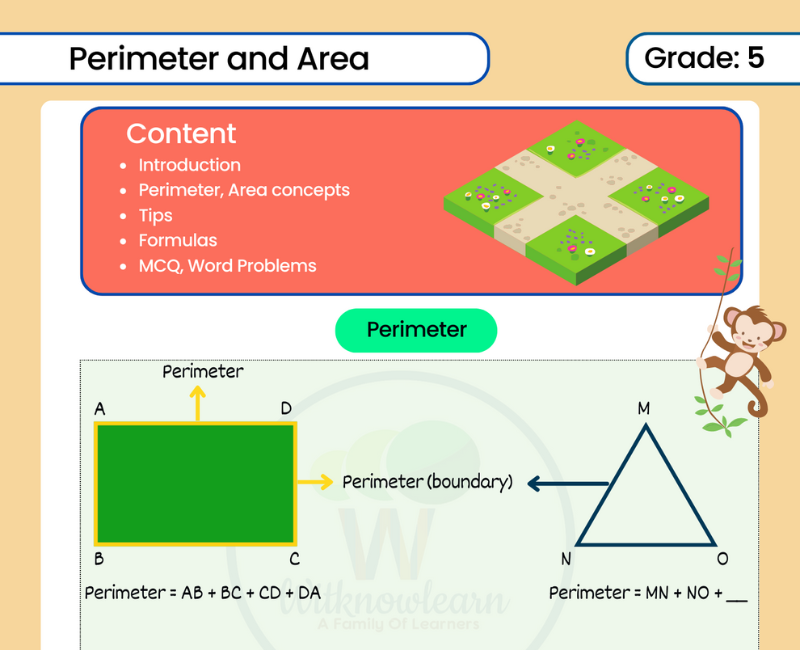
Walk once round the edge of a garden and you have walked its perimeter. It is the total length of the boundary.
🟩 Area
Cover the garden with grass and you have covered its area. Area counts the unit squares inside a shape.
📐 Rectangles
The perimeter of a rectangle is twice the sum of its length and breadth. Its area is the length times the breadth.
🟨 Squares
A square has four equal sides. Its perimeter is 4 times a side and its area is a side times a side.
🧱 Joined shapes
For a shape with many sides, add every side to get the perimeter. Split it into rectangles to find the area.
📖 Case studies
Real stories ask for a fence, tiles or paint. Choose perimeter for the edge and area for the surface.
Perimeter and Area Class 5 Activities
Measure, walk and tile on the Number Train. Earn up to 3 stars in every activity.
Perimeter and area help us fence gardens, tile floors and paint walls. This page helps Class 5 children tell the two ideas apart, use the right formula and write the right unit.
The activities turn each idea into a game. Children sort clues, pop true formula facts, match shape words, fill gaps and compare measures. Explore more Class 5 maths worksheets on WitKnowLearn after this topic.
Formulas and facts to know
| Shape | Perimeter | Area |
|---|---|---|
| Rectangle 9 cm by 4 cm | 26 cm | 36 cm^2 |
| Rectangle 12 cm by 5 cm | 34 cm | 60 cm^2 |
| Square of side 7 cm | 28 cm | 49 cm^2 |
How to use this page
- Flip the six cards and try the Perimeter and Area Lab in the Learn tab.
- Play the five games and the five labs to practise each idea.
- Finish the five challenges to collect up to 15 points.
- Take the 20-question online quiz, with assertion and reason and case study questions, and fill in the practice sheet.
Worked examples
2 × (15 + 8) = 2 × 23 = 46 cm.
13 × 13 = 169, so the area is 169 m^2.
84 ÷ 12 = 7 cm.
This Perimeter and Area worksheet for Class 5 maths gives you online activities and interactive games that turn shapes into play. Every activity has a goal, a hint and a short fact, so children learn while they enjoy.
Complete Guide: Maths Perimeter and Area Class 5
This guide is for Class 5 students, parents and teachers. It explains perimeter and area in simple words and shows how to use the quiz, labs and games on this page.
Introduction to Perimeter and Area
Perimeter and area describe the size of flat shapes in two different ways. One looks at the edge and the other looks at the inside.
What is there in this topic
- Perimeter as the distance around.
- Area as the space inside.
- Counting unit squares.
- Formulas for rectangles and squares.
- Perimeter of joined and L-shaped figures.
- Finding a missing side.
- Word problems and case studies.
Learning objectives
- Define perimeter and area and tell them apart.
- Use the formulas for rectangles and squares.
- Write the right unit for each answer.
- Find a missing side from the area or the perimeter.
- Reason about assertions and case studies.
Learning outcomes
- The child can find the perimeter of a 9 cm by 4 cm rectangle.
- The child can find the area of a square of side 7 cm.
- The child can choose perimeter for a fence and area for tiles.
- The child can solve a case study on a garden.
Perimeter and Area Class 5 resources on this page
| Resource | What it gives |
|---|---|
| Online quiz | 20 questions: 10 easy, 5 average and 5 thinking, with assertion and reason and case study questions and a full review |
| Flip cards | 6 picture cards with one-line rules |
| Perimeter and Area Lab | A hands-on lab with 3 rounds |
| Games | 5 interactive games |
| Labs | 5 activity labs |
| Virtual Lab | 2 experiments with aim, procedure, observation table and conclusion |
| Challenges | 5 challenges, 15 points in all |
| Practice sheet | A worksheet-style sheet with 16 questions, name and date lines and a live score |
Key facts
| Idea | Rule |
|---|---|
| Perimeter | Distance around a shape, in cm or m. |
| Area | Space inside a shape, in cm^2 or m^2. |
| Rectangle | Perimeter 2 × (l + b) and area l × b. |
| Square | Perimeter 4 × side and area side × side. |
| Missing side | Use the formula backwards. |
Types of questions you may see
- Find the perimeter or the area.
- Find a missing side.
- Assertion and reason questions.
- Case study questions.
- Fence, tile and paint stories.
Solved examples
4 × 14 = 56 cm.
18 × 6 = 108 m^2.
52 ÷ 4 = 13 cm.
Half of 50 is 25, and 25 − 15 = 10 cm.
10 × 7 = 70 tiles.
4 × 3/4 = 3 m.
Common mistakes
| Mistake | Correct idea |
|---|---|
| Writing area in cm instead of cm^2. | Area always uses square units. |
| Adding length and breadth to find the area. | Multiply them for the area. |
| Forgetting to double the sum for the perimeter. | Perimeter = 2 × (l + b). |
| Using area for a fence. | A fence goes round the edge, so use the perimeter. |
Perimeter and Area in daily life
Children meet perimeter in fences, frames and borders, and area in floors, walls and fields. Measuring a book or a room at home makes the idea real.
Tips for parents and teachers
- Draw shapes on squared paper and count the squares.
- Measure a table with a ruler and find its perimeter.
- Ask whether a job needs perimeter or area.
- Practise one assertion and one case study each week.
Related Class 5 Maths Worksheets
Perimeter and Area Class 5 FAQs
What is perimeter and area in Class 5 maths?
Perimeter is the total distance around a shape, and area is the space inside it. Perimeter is measured in cm or m, and area is measured in square cm or square m.
What is the formula for the perimeter of a rectangle?
Perimeter of a rectangle = 2 x (length + breadth). For a rectangle 9 cm long and 4 cm wide, the perimeter is 2 x 13 = 26 cm.
What is the formula for the area of a rectangle?
Area of a rectangle = length x breadth. A rectangle 12 cm long and 5 cm wide has an area of 60 square cm.
What is the formula for the perimeter and area of a square?
Perimeter of a square = 4 x side and area of a square = side x side. For a square of side 7 cm, the perimeter is 28 cm and the area is 49 square cm.
What is the difference between perimeter and area?
Perimeter measures the boundary, so we use it for a fence or a border. Area measures the surface, so we use it for tiles, paint or grass.
What are the units of perimeter and area?
Perimeter uses units of length such as cm, m and km. Area uses square units such as square cm and square m.
How do you find the perimeter of an L-shaped figure?
Add the lengths of all the sides of the shape. For an L-shape with sides 6, 2, 4, 4, 10 and 6 cm, the perimeter is 32 cm.
How do you find a missing side when the area is given?
Divide the area by the known side. If the area is 72 square cm and the length is 9 cm, the breadth is 72 divided by 9, which is 8 cm.
How do you find the side of a square from its perimeter?
Divide the perimeter by 4. A square with a perimeter of 60 cm has a side of 15 cm.
Can two shapes have the same perimeter but different areas?
Yes. A 5 cm by 3 cm rectangle and a 4 cm by 4 cm square both have a perimeter of 16 cm, but their areas are 15 and 16 square cm.
How do you solve perimeter and area word problems?
Decide if the job goes round the edge, like a fence, or covers the inside, like tiles. Then pick the perimeter or the area formula and write the right unit.
What can children do on this page?
Children can take a 20-question online quiz with assertion and reason and case study questions, play five games, try five online activities, finish five challenges, run the Perimeter and Area Lab and two virtual experiments, and fill in a 16-question practice sheet with a Show answers button.
 Download