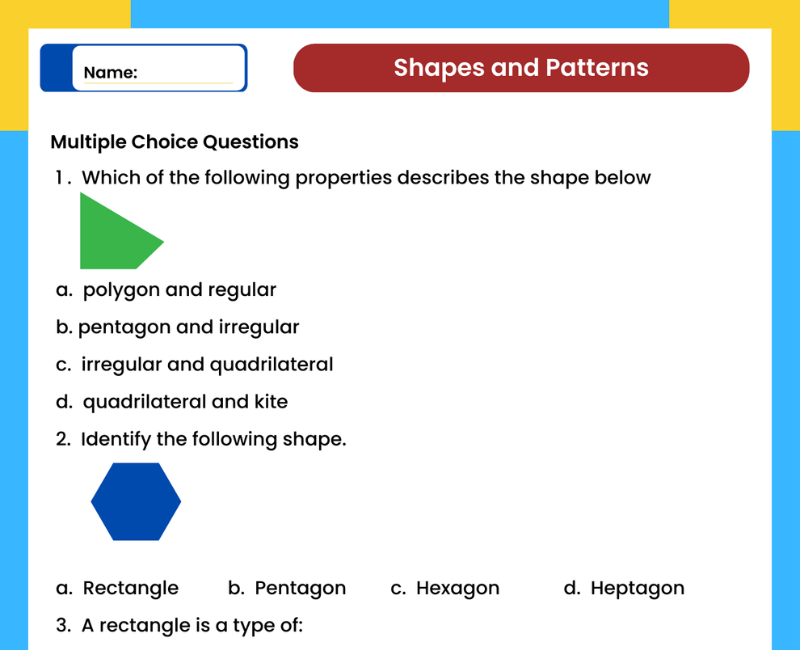
Shapes and Patterns Class 5 Maths Worksheet with Quiz and Activities
Weave patterns, tessellate shapes, name triangles and kites, and solve cube case studies. On WitKnowLearn you get the Shapes and Patterns Class 5 online quiz, online activities and interactive games, a shapes lab, a virtual lab and a worksheet-style practice sheet for NCERT Math Mela Chapter 7.
Shapes and Patterns Class 5 Online Quiz
20 questions: 10 easy, 5 average and 5 thinking. Tap an answer and the next question comes up.
Shapes and Patterns Class 5 Activities
👆 Tap a tab to switch: Learn, Games, Labs, Challenges, Virtual Lab and Practice sheet
Shapes and Patterns: the Weaver's Workshop Story
A short read for Class 5 before you play. These notes follow Chapter 7 of NCERT Math Mela.
🧺 Weaving mats
A weaver goes 1 under, 1 over in the first row, and 1 over, 1 under in the next. Every row follows a rule that repeats.
🧩 Tiles that fit
Six triangles, four squares or three hexagons fit around a point with no gap. Pentagons leave a gap, so they do not tessellate.
🔺 Three kinds of triangles
Count the equal sides. Three equal sides make an equilateral triangle, two make an isosceles and none make a scalene.
🪁 Kites and parallelograms
A kite has two pairs of equal adjacent sides. A parallelogram has equal opposite sides, and a rectangle is a special parallelogram.
🧊 Cubes and solids
A big cube of 27 small cubes has 8 corner cubes, 12 edge cubes, 6 face cubes and 1 hidden centre cube.
📖 Case studies
Floors, mats, kites and painted cubes all hide shapes. Count the sides and angles to choose the right name.
Shapes and Patterns Class 5 Activities
Weave, tile and build on the Number Train. Earn up to 3 stars in every activity.
This page follows NCERT Class 5 Maths Math Mela, Chapter 7. Children weave patterns, explore tessellation, name triangles and four-sided shapes, play with circles and tangrams, and study cubes and solids.
The activities turn each idea into a game. Children sort triangles, pop true facts, match words, fill gaps and solve pattern stories. Explore more Class 5 maths worksheets on WitKnowLearn after this chapter.
Formulas and facts to know
| Shape | Key feature | Tessellates alone? |
|---|---|---|
| Equilateral triangle | 3 equal sides | Yes |
| Square | 4 equal sides, 4 right angles | Yes |
| Regular hexagon | 6 equal sides | Yes |
| Regular pentagon | 5 equal sides | No |
| Regular octagon | 8 equal sides | No |
How to use this page
- Flip the six cards and try the Shapes Lab in the Learn tab.
- Play the five games and the five labs to practise each idea.
- Finish the five challenges to collect up to 15 points.
- Take the 20-question online quiz, with assertion and reason and case study questions, and fill in the practice sheet.
Worked examples
Two sides are equal, so it is an isosceles triangle.
Each angle is 120 degrees, so 360 ÷ 120 = 3 hexagons.
12 ÷ 3 = 4 repeats, and 4 × 2 = 8 are over.
This Shapes and Patterns worksheet for Class 5 maths gives you online activities and interactive games that make geometry fun. Every activity has a goal, a hint and a short fact, so children learn while they enjoy.
Complete Guide: NCERT Class 5 Maths Shapes and Patterns Chapter 7
This guide is for Class 5 students, parents and teachers. It covers Chapter 7 of NCERT Math Mela and shows how to use the quiz, labs and games on this page.
Introduction to Shapes and Patterns
The chapter links shapes with patterns, from woven mats and floor tiles to kites and cubes. Children observe, build and describe shapes with their sides and angles.
What is there in this chapter
- Weaving mats with over and under rules.
- Tiling and tessellation.
- Making shapes from the pieces of a rhombus.
- Isosceles, equilateral and scalene triangles.
- Kites, parallelograms and rectangles.
- The tangram.
- Circle designs and diameters.
- Cube connections and painted cubes.
- Icosahedron and dodecahedron.
Learning objectives
- Describe and continue a repeating weave pattern.
- Decide whether a regular shape tessellates.
- Name triangles by their equal sides.
- Name quadrilaterals by their sides and angles.
- Count faces, edges and corners of cubes and solids.
- Reason about assertions and case studies.
Learning outcomes
- The child can say why pentagons do not tessellate.
- The child can name a triangle with sides 4, 4 and 6.
- The child can tell a kite from a parallelogram.
- The child can solve a case study on a painted cube or a weaving row.
Shapes and Patterns Class 5 resources on this page
| Resource | What it gives |
|---|---|
| Online quiz | 20 questions: 10 easy, 5 average and 5 thinking, with assertion and reason and case study questions and a full review |
| Flip cards | 6 picture cards with one-line rules |
| Shapes Lab | A hands-on lab with 3 rounds |
| Games | 5 interactive games |
| Labs | 5 activity labs |
| Virtual Lab | 2 experiments with aim, procedure, observation table and conclusion |
| Challenges | 5 challenges, 15 points in all |
| Practice sheet | A worksheet-style sheet with 16 questions, name and date lines and a live score |
Key facts
| Idea | Rule |
|---|---|
| Tessellation | Shapes fit with no gap and no overlap. |
| Equilateral | 3 equal sides and 3 equal angles. |
| Isosceles | 2 equal sides and 2 equal angles. |
| Scalene | No equal sides. |
| Kite | Two pairs of equal adjacent sides. |
| Parallelogram | Opposite sides and opposite angles equal. |
Types of questions you may see
- Name the triangle or the quadrilateral.
- Does this shape tessellate?
- Continue a weaving pattern.
- Assertion and reason questions.
- Case study questions on tiles, mats and cubes.
Solved examples
No sides are equal, so it is scalene.
No. 5 × 90 = 450, which is more than 360 degrees.
7 - 5 = 2 pieces.
A cube has 12 edges.
A rectangle.
Yes. A rectangle is a special parallelogram.
Common mistakes
| Mistake | Correct idea |
|---|---|
| Saying a scalene triangle has two equal sides. | A scalene triangle has no equal sides. |
| Thinking a rectangle is not a parallelogram. | A rectangle is a special parallelogram. |
| Saying pentagons tessellate. | Pentagons leave a gap around a point. |
| Counting only the visible small cubes. | Include the cube hidden in the centre. |
Shapes and Patterns in daily life
Children see tessellation in floor tiles and honeycombs, weaving in baskets and mats, and cubes in dice and boxes. Spotting shapes around them makes geometry real.
Tips for parents and teachers
- Weave paper strips with the child and describe each row.
- Cut shapes from cardboard and test which ones tessellate.
- Fold a paper kite and name the shapes inside it.
- Practise one assertion and one case study each week.
Related Class 5 Maths Worksheets
- 🚆We the Travellers I Class 5 (NCERT Chapter 1)
- 🍕Fractions Class 5 (NCERT Chapter 2)
- 🔄Angles as Turns Class 5 (NCERT Chapter 3)
- 🗺We the Travellers II Class 5 (NCERT Chapter 4)
- 📏Far and Near Class 5 (NCERT Chapter 5)
- 🐄The Dairy Farm Class 5 (NCERT Chapter 6)
- 📐Geometry Class 5
- 🦋Symmetry and Patterns Class 5
- 📏Angles Class 5
- 🟩Perimeter and Area Class 5
- ✖Multiplication Class 5
- 📏Measurement Class 5
Shapes and Patterns Class 5 FAQs
What is Chapter 7 of NCERT Class 5 Maths Math Mela?
Chapter 7 is Shapes and Patterns. It covers weaving patterns, tiling and tessellation, kinds of triangles, kites, parallelograms and rectangles, tangrams, circle designs, cubes and solids like the icosahedron and dodecahedron.
What is tessellation?
Tessellation means covering a flat region with shapes that fit together with no gaps and no overlaps. Regular triangles, squares and hexagons tessellate on their own.
Which regular shapes tessellate?
Equilateral triangles, squares and regular hexagons tessellate. Regular pentagons and regular octagons leave gaps, so they do not tessellate alone.
What is a regular shape?
A regular shape has all its sides equal, like a square, an equilateral triangle or a regular hexagon. A regular pentagon has 5 equal sides and a regular octagon has 8.
What are the three kinds of triangles?
An equilateral triangle has 3 equal sides, an isosceles triangle has 2 equal sides and a scalene triangle has no equal sides. Equal sides come with equal angles.
What is an isosceles triangle?
An isosceles triangle has two equal sides and two equal angles. If you fold it in half along its line of symmetry, the two halves match.
What is a kite in maths?
A kite is a four-sided shape with two pairs of equal adjacent sides. Adjacent sides are sides that share a corner.
What is a parallelogram and how is it different from a rectangle?
A parallelogram is a quadrilateral with opposite sides equal and opposite angles equal. A rectangle is a special parallelogram in which all angles are right angles.
What is a rhombus?
A rhombus is a shape with all four sides equal. A rhombus can be divided into four triangles, and its opposite angles are equal.
What is a tangram?
A tangram is a puzzle of 7 flat pieces cut from a square: five triangles, one square and one parallelogram. The pieces can be arranged to make many shapes.
How many cubes have 3, 2, 1 or 0 painted faces in a painted 27-cube?
In a 3 by 3 by 3 cube painted outside, 8 cubes have 3 painted faces, 12 have 2, 6 have 1 and 1 has none. They add up to 27.
What can children do on this page?
Children can take a 20-question online quiz with assertion and reason and case study questions, play five games, try five online activities, finish five challenges, run the Shapes Lab and two virtual experiments, and fill in a 16-question practice sheet with a Show answers button.
 Download