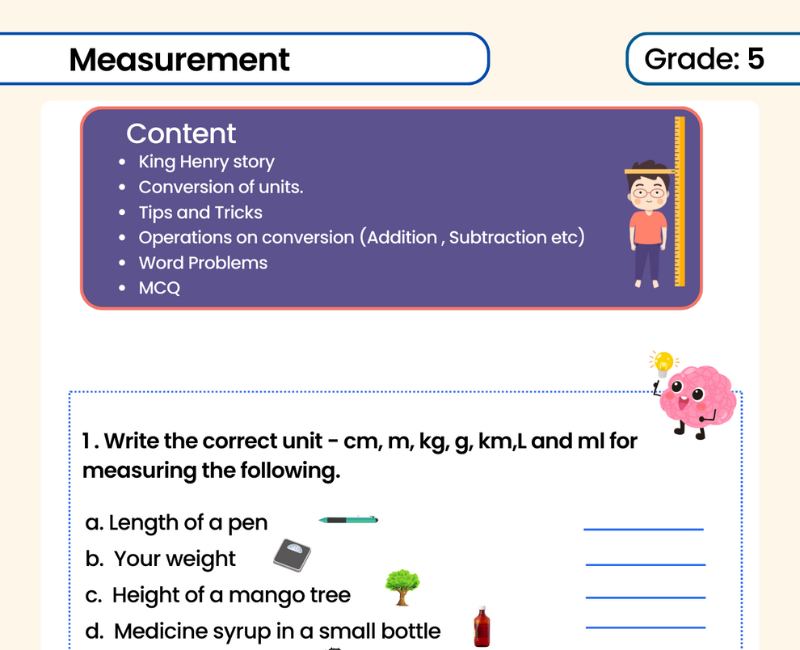
Measurement Class 5 Maths Worksheet with Quiz and Activities
Measure length, mass and capacity, choose the best unit and convert km to m, kg to g and L to mL. On WitKnowLearn you get the Measurement Class 5 online quiz, online activities and interactive games, measuring labs, a virtual lab and a worksheet-style practice sheet, all on one page.
Measurement Class 5 Online Quiz
20 questions: 10 easy, 5 average and 5 thinking. Tap an answer and the next question comes up.
Measurement Class 5 Activities
👆 Tap a tab to switch: Learn, Games, Labs, Challenges, Virtual Lab and Practice sheet
Measurement: the Market Day Story
A short read for Class 5 before you play. These notes are written for this page.
📏 Length
Length tells us how long something is. We use centimetres for small things, metres for rooms and roads, and kilometres for faraway places.
⚖️ Mass
Mass tells us how heavy something is. A coin is measured in grams, while a bag of rice is measured in kilograms.
🥛 Capacity
Capacity tells us how much a container holds. A spoon of medicine is in millilitres, and a bucket of water is in litres.
🔁 Changing units
Big unit to small unit: multiply by 10, 100 or 1000. Small unit to big unit: divide by the same number.
➕ Adding measures
Measures can be added or subtracted when they are in the same unit. Change them first if they are not.
🧰 Right tool
A ruler measures length, a balance measures mass and a jug measures capacity. Choosing the right tool and unit makes every answer sensible.
Measurement Class 5 Activities
Measure, convert and compare on the Number Train. Earn up to 3 stars in every activity.
Measurement is one of the most useful skills in Class 5 maths. This page helps children choose the right unit, read a ruler and a scale, convert between units and solve simple measure stories.
The activities turn each idea into a game. Children sort units, pop true conversion facts, match units to things, fill gaps and compare measures. Explore more Class 5 maths worksheets on WitKnowLearn after this topic.
Formulas and facts to know
| Measure | Units | Example |
|---|---|---|
| Length | mm, cm, m, km | A pencil is 15 cm |
| Mass | g, kg | A mango is 250 g |
| Capacity | mL, L | A bottle is 1 L |
How to use this page
- Flip the six cards and try the Measurement Lab in the Learn tab.
- Play the five games and the five labs to practise each idea.
- Finish the five challenges to collect up to 15 points.
- Take the 20-question online quiz and fill in the practice sheet.
Worked examples
7 × 1000 = 7000, so 7 km = 7000 m.
300 + 500 = 800 g and 4 + 2 = 6 kg, so the total is 6 kg 800 g.
3 L = 3000 mL, and 3000 ÷ 200 = 15 cups.
This Measurement worksheet for Class 5 maths gives you online activities and interactive games that turn units into play. Every activity has a goal, a hint and a short fact, so children learn while they enjoy.
Complete Guide: Maths Measurement Class 5
This guide is for Class 5 students, parents and teachers. It explains the units of length, mass and capacity in simple words and shows how to use the quiz, labs and games on this page.
Introduction to Measurement
We measure all the time: the length of a cloth, the mass of vegetables or the milk in a glass. Standard units let everyone get the same answer.
What is there in this topic
- Units of length: mm, cm, m and km.
- Units of mass: g and kg.
- Units of capacity: mL and L.
- Reading a ruler, a scale and a jug.
- Changing big units to small units and back.
- Adding and subtracting measures.
- Measure story problems.
Learning objectives
- Choose a sensible unit for length, mass and capacity.
- Read measures from a ruler, a scale and a jug.
- Convert between units using 10, 100 and 1000.
- Add and subtract measures with the same units.
- Solve simple word problems on measures.
Learning outcomes
- The child can say that 1 km is 1000 m.
- The child can change 3 kg into 3000 g.
- The child can pick the best tool for each measure.
- The child can solve a story on ribbon, milk or rice.
Measurement Class 5 resources on this page
| Resource | What it gives |
|---|---|
| Online quiz | 20 questions: 10 easy, 5 average and 5 thinking, with a full review |
| Flip cards | 6 picture cards with one-line rules |
| Measurement Lab | A hands-on lab with 3 rounds |
| Games | 5 interactive games |
| Labs | 5 activity labs |
| Virtual Lab | 2 experiments with aim, procedure, observation table and conclusion |
| Challenges | 5 challenges, 15 points in all |
| Practice sheet | A worksheet-style sheet with 16 questions, name and date lines and a live score |
Key facts
| Idea | Rule |
|---|---|
| Length | 1 km = 1000 m, 1 m = 100 cm, 1 cm = 10 mm. |
| Mass | 1 kg = 1000 g. |
| Capacity | 1 L = 1000 mL. |
| Big to small | Multiply. |
| Small to big | Divide. |
Types of questions you may see
- Choose the best unit.
- Read a ruler or a scale.
- Convert units.
- Add or subtract measures.
- Story problems on measures.
Solved examples
9 × 100 = 900 cm.
4500 g = 4 kg 500 g.
12 × 1000 = 12000 mL.
5 m = 500 cm, and 500 ÷ 50 = 10 pieces.
3000 - 1250 = 1750 g = 1 kg 750 g.
2 km = 2000 m, so 2 km is more.
Common mistakes
| Mistake | Correct idea |
|---|---|
| Thinking 1 kg is 100 g. | 1 kg is 1000 g. |
| Dividing when going to a smaller unit. | A smaller unit needs more pieces, so multiply. |
| Adding 2 m and 50 cm as 52. | Change both to cm: 200 + 50 = 250 cm. |
| Starting a ruler at 1 instead of 0. | Line up the zero mark with the start of the object. |
Measurement in daily life
Children measure when they cook, shop for vegetables, fill water bottles or check how far school is. Talking about units at home builds confidence.
Tips for parents and teachers
- Let children weigh fruit and pour water into measuring jugs.
- Measure furniture with a tape and say the answer in cm and m.
- Ask for the best unit before every measure.
- Read labels on bottles and packets together.
Related Class 5 Maths Worksheets
Measurement Class 5 FAQs
What is measurement in Class 5 maths?
Measurement is finding how long, how heavy or how much liquid something is, using standard units. In Class 5 children learn the units of length, mass and capacity and how to change one unit into another.
What are the units of length?
The units of length are the millimetre (mm), centimetre (cm), metre (m) and kilometre (km). We use cm for a pencil, m for a room and km for the distance between towns.
How do you convert km to m and m to cm?
To change a big unit to a small unit, multiply. 1 km = 1000 m, so 5 km is 5 multiplied by 1000, which is 5000 m, and 1 m = 100 cm, so 3 m = 300 cm.
How do you convert cm to m and g to kg?
To change a small unit to a big unit, divide. 400 cm divided by 100 is 4 m, and 6000 g divided by 1000 is 6 kg.
What are the units of mass and weight?
Mass is measured in grams (g) and kilograms (kg), and 1 kg = 1000 g. In daily life people say weight, but at school we call it mass.
What are the units of capacity?
Capacity is measured in millilitres (mL) and litres (L), and 1 L = 1000 mL. A spoon holds about 5 mL, while a bucket holds several litres.
What is the difference between mass and capacity?
Mass tells us how heavy an object is, and we use grams and kilograms. Capacity tells us how much liquid a container can hold, and we use millilitres and litres.
Which tool is used to measure length, mass and capacity?
We use a ruler or measuring tape for length, a weighing scale or balance for mass, and a measuring jug for capacity.
How do you read a ruler correctly?
Place the zero mark at the start of the object and read the mark at the other end. Each small line on a centimetre ruler is 1 mm.
How do you add and subtract measures?
Write the same units in a column. Add or subtract the small units first, then the big units. For example 2 m 45 cm + 1 m 30 cm = 3 m 75 cm.
How many ml are there in 1/2 litre and 1/4 litre?
There are 500 mL in 1/2 litre and 250 mL in 1/4 litre, because 1 litre is 1000 mL.
What can children do on this page?
Children can take a 20-question online quiz with a full review, play five games, try five online activities, finish five challenges, run the Measurement Lab and two virtual experiments, and fill in a 16-question practice sheet with a Show answers button.
 Download