Factors and Multiples Class 5 Maths Worksheet with Quiz and Activities
List factors, hop through multiples, spot prime numbers and find the HCF and LCM. On WitKnowLearn you get the Factors and Multiples Class 5 online quiz, online activities and interactive games, factor labs, a virtual lab and a worksheet-style practice sheet, all on one page.
Factors and Multiples Class 5 Online Quiz
20 questions: 10 easy, 5 average and 5 thinking. Tap an answer and the next question comes up.
Factors and Multiples Class 5 Activities
👆 Tap a tab to switch: Learn, Games, Labs, Challenges, Virtual Lab and Practice sheet
🧪 Factors Lab
Do the experiment on screen: 3 rounds, then see what we found.
Lab progress
- 🧪 Round 1 of 3
- ⬜ Round 2 of 3
- ⬜ Round 3 of 3
- ⬜ What did we find?
🎯 Prime or Composite?
⭐⭐⭐Goal: Sort 8 numbers into prime and composite.
How to play: Drag each card into its bin, or tap a card and then tap a bin.
Look for a factor other than 1 and the number.
Prime
two factorsComposite
more than twoFACTS: A prime number has exactly two factors.
🫧 True Factor Bubbles
⭐⭐⭐Goal: Pop the 5 bubbles where the first number is a factor of the second. Leave the 4 false ones.
How to play: Tap a bubble to pop it. False bubbles wobble and stay.
Divide the second number by the first.
FACTS: A factor divides a number exactly.
🧠 Factors and Multiples Words Memory
⭐⭐⭐Goal: Match each word with its meaning.
How to play: Flip two cards. If they match, they stay open. Find all 6 pairs.
A word matches the phrase that explains it.
FACTS: Maths words make ideas easy to share.
📝 Factors and Multiples Gaps
⭐⭐⭐Goal: Fill each gap with the right word from the tray. One word is extra.
How to play: Drag a word into a gap, or tap a word and then tap a gap.
Read the whole sentence before you choose a word.
Every number has as a factor.
Exactly two factors makes a number .
More than two factors makes a number .
The first multiple of a number is the number .
The list of multiples is .
FACTS: Factors are few, multiples go on forever.
⚖ Which Has More Factors?
⭐⭐⭐Goal: In each pair, tap the number with more factors.
How to play: Tap one card in every pair.
List the factors of both numbers.
FACTS: A bigger number can have fewer factors.
🔗 Factor Pair Lab
⭐⭐⭐Goal: Find the partner of each factor of 36.
How to play: Drag a number into each gap, or tap a number and then a gap.
Think of the multiplication fact that makes 36.
With 4 we get 4 × = 36.
With 2 we get 2 × = 36.
With 3 we get 3 × = 36.
With 6 we get 6 × = 36.
FACTS: Factors come in pairs.
💥 Multiples Lab
⭐⭐⭐Goal: Skip count to find multiples of 7.
How to play: Drag the right number into each gap.
Multiply 7 by the number of the multiple.
The 3rd multiple of 7 is .
The 5th multiple of 7 is .
The 8th multiple of 7 is .
The 10th multiple of 7 is .
FACTS: Each multiple is 7 more than the one before.
📋 Prime Factorisation Lab
⭐⭐⭐Goal: Follow the factor tree of 60.
How to play: Drag the right number into each gap.
Keep splitting until only primes are left.
60 splits into 6 × .
6 splits into 2 × .
10 splits into 2 × .
Multiplying the primes: 2 × 2 × 3 × 5 = .
FACTS: Every composite number is a product of primes.
➖ HCF Lab
⭐⭐⭐Goal: Find the HCF of 24 and 36.
How to play: Drag the right number into each gap.
List the factors of both numbers.
Factors of 24 include 1, 2, 3, 4, 6, 8, 12 and .
Factors of 36 include 1, 2, 3, 4, 6, 9, 12, 18 and .
Common factors of both: 1, 2, 3, 4, 6 and .
The HCF of 24 and 36 divides 24 exactly times.
FACTS: The HCF is the greatest common factor.
📏 How Many Factors?
⭐⭐⭐Goal: Sort 6 numbers by how many factors they have.
How to play: Drag each card into a bin, or tap a card and then tap a bin.
List the factors of each number.
Exactly 2 factors
prime3 or 4 factors
fewMore than 4 factors
manyFACTS: Primes have the fewest factors.
❓ Factors and Multiples Quiz
⭐⭐⭐Goal: Answer 3 questions. Each correct answer earns 1 point.
How to play: Tap the best option.
Think about what each word means.
1. Which number is a factor of every number?
2. Which is the smallest prime number?
3. What is the least number that is a multiple of two numbers called?
FACTS: Maths words have clear meanings.
💦 True or False Splash
⭐⭐⭐Goal: Decide if each statement is true or false.
How to play: Tap True or False.
Think about the meaning of each word.
1. The number 2 is the only even prime number.
2. A multiple of a number can be smaller than the number.
3. A factor of a number is never greater than the number.
FACTS: Check with examples.
➗ Factors and Multiples Sums
⭐⭐⭐Goal: Solve 3 calculations. Type the number.
How to play: Type your answer and press Check.
List factors or multiples first.
1. Find the HCF of 16 and 40.
2. What is the LCM of 5 and 15?
3. How many factors does 36 have?
FACTS: Lists make the answer easy to spot.
🔗 Match the List
⭐⭐⭐Goal: Match each description with its answer.
How to play: Drag each card onto its partner, or tap a card and then tap a partner.
Write the list first.
FACTS: Lists help us check.
📖 Story Problems
⭐⭐⭐Goal: Read 3 short stories and choose the best answer.
How to play: Tap an answer.
Decide whether the story needs a factor or a multiple.
1. 🍪 Ria has 24 cookies and packs them equally into boxes with none left. Which box size does NOT work?
2. 🚦 One light blinks every 6 seconds and another every 10 seconds. They blink together now. When will they blink together next?
3. 🧱 A floor 18 m by 30 m is covered with the largest possible square tiles. What is the side of each tile?
FACTS: HCF shares, LCM meets.
🔢 Counting Factors Experiment
⭐⭐⭐Aim
To count the factors of numbers and spot a prime number.
Objectives
- List the factors of each number.
- Write how many there are.
Procedure
- Read the number in each row.
- List its factors in pairs.
- Type the count in the last column.
- Choose the conclusion.
Find pairs that multiply to the number.
Observation table
| Number | Number of factors |
|---|---|
| 18 | |
| 25 | |
| 37 | |
| 40 |
Conclusion
Outcomes
- I can list factors.
- I can spot a prime number.
🔁 Common Multiples Experiment
⭐⭐⭐Aim
To find the LCM of pairs of numbers by listing multiples.
Objectives
- List multiples of both numbers.
- Find the first common one.
Procedure
- Read the pair of numbers in each row.
- List multiples of both until one matches.
- Type the LCM in the last column.
- Choose the conclusion.
Count in steps of the bigger number and test each.
Observation table
| Pair | LCM |
|---|---|
| LCM of 3 and 4 = | |
| LCM of 4 and 5 = | |
| LCM of 6 and 9 = | |
| LCM of 8 and 12 = |
Conclusion
Outcomes
- I can find an LCM by listing.
- I know what common multiples are.
Read the chapter first. Write each answer on the line. The page checks your answer as you type.
A. Factors and primes
B. Multiples
C. HCF and LCM
D. Word problems
Factors and Multiples: the Number Family Story
A short read for Class 5 before you play. These notes are written for this page.
🔗 Factors in pairs
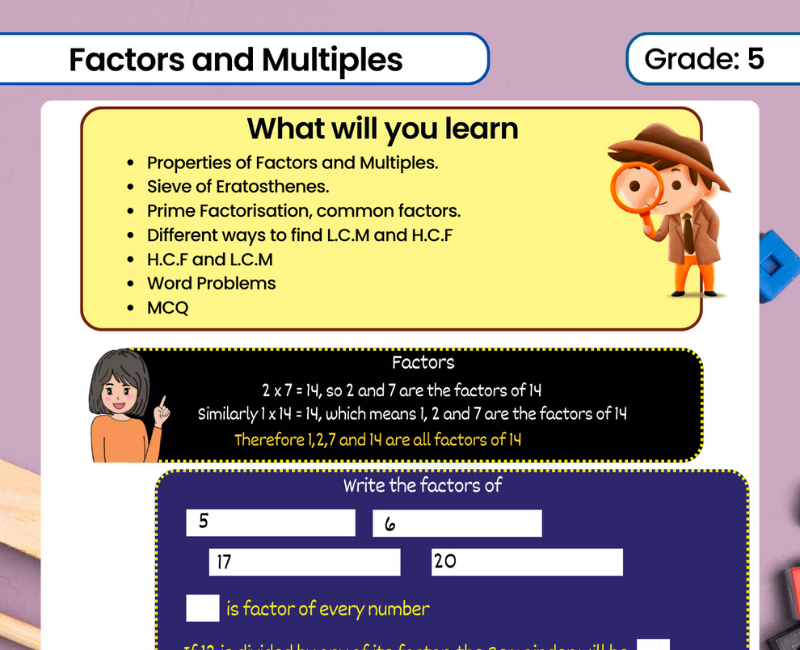
Factors divide a number exactly and they come in pairs. Pair them up starting from 1 until the pairs begin to repeat.
🦘 Multiples by hopping
Multiples are what you land on when you hop in equal steps. They start at the number itself and never end.
🔢 Prime and composite
A prime number has just two factors. A composite number has more. The number 1 stands alone, neither prime nor composite.
🌳 Factor trees
Split a number into two factors, and keep splitting until only primes are left. Multiply the primes to get back the number.
⭕ HCF
The highest common factor is the biggest number that divides both numbers. It helps us cut things into the largest equal pieces.
🔁 LCM
The lowest common multiple is the first number that appears in both lists of multiples. It tells us when two repeating events meet again.
Factors and Multiples Class 5 Activities
Pair, hop and match on the Number Train. Earn up to 3 stars in every activity.
Factors and multiples are the number-family skill of Class 5 maths. This page helps children list factors, count in multiples, spot prime numbers and find the HCF and LCM with confidence.
The activities turn each idea into a game. Children sort prime and composite numbers, pop true factor bubbles, match maths words, fill gaps and compare how many factors numbers have. Explore more Class 5 maths worksheets on WitKnowLearn after this topic.
Words and facts to know
| Word | Meaning | Example |
|---|---|---|
| Factor | Divides a number exactly | 5 is a factor of 35 |
| Multiple | Product of a number and a counting number | 35 is a multiple of 5 |
| Prime | Exactly two factors | 19 has factors 1 and 19 |
| Composite | More than two factors | 26 has 1, 2, 13 and 26 |
| HCF | Highest common factor | HCF of 14 and 21 is 7 |
| LCM | Lowest common multiple | LCM of 3 and 5 is 15 |
How to use this page
- Flip the six cards and try the Factors Lab in the Learn tab.
- Play the five games and the five labs to practise each idea.
- Finish the five challenges to collect up to 15 points.
- Take the 20-question online quiz and fill in the practice sheet.
Worked examples
1 × 32, 2 × 16 and 4 × 8, so the factors are 1, 2, 4, 8, 16 and 32.
Factors of 14: 1, 2, 7, 14. Factors of 21: 1, 3, 7, 21. The greatest common one is 7.
Multiples of 3: 3, 6, 9, 12, 15. Multiples of 5: 5, 10, 15. The first common one is 15.
This Factors and Multiples worksheet for Class 5 maths gives you online activities and interactive games that turn lists into play. Every activity has a goal, a hint and a short fact, so children learn while they enjoy.
Complete Guide: Maths Factors and Multiples Class 5
This guide is for Class 5 students, parents and teachers. It explains factors, multiples, primes, HCF and LCM in simple words and shows how to use the quiz, labs and games on this page.
Introduction to Factors and Multiples
Every counting number belongs to a family of factors and a family of multiples. Knowing both helps children divide, simplify and plan repeating events.
What is there in this topic
- Factors and factor pairs.
- Multiples and skip counting.
- Prime and composite numbers.
- Prime factorisation with factor trees.
- Common factors and the HCF.
- Common multiples and the LCM.
- Co-prime numbers and word problems.
Learning objectives
- List all the factors of a number up to 100.
- List multiples of a number.
- Classify a number as prime or composite.
- Find the HCF and LCM of two numbers.
- Solve word problems about equal sharing and repeating events.
Learning outcomes
- The child can list factors using pairs.
- The child can say why 1 is neither prime nor composite.
- The child can build a factor tree.
- The child can decide whether to use HCF or LCM in a story.
Factors and Multiples Class 5 resources on this page
| Resource | What it gives |
|---|---|
| Online quiz | 20 questions: 10 easy, 5 average and 5 thinking, with a full review |
| Flip cards | 6 picture cards with one-line rules |
| Factors Lab | A hands-on lab with 3 rounds |
| Games | 5 interactive games |
| Labs | 5 activity labs |
| Virtual Lab | 2 experiments with aim, procedure, observation table and conclusion |
| Challenges | 5 challenges, 15 points in all |
| Practice sheet | A worksheet-style sheet with 16 questions, name and date lines and a live score |
Key facts
| Topic | Key idea |
|---|---|
| Factors | Never greater than the number. |
| Multiples | Never smaller than the number and endless. |
| One | Neither prime nor composite. |
| Two | The only even prime number. |
| HCF and LCM | HCF divides both, LCM is divided by both. |
Types of questions you may see
- List the factors or multiples.
- Prime or composite.
- Factor trees.
- HCF and LCM by listing.
- Word problems about sharing and meeting again.
Solved examples
9, 18, 27, 36 and 45.
No, 87 = 3 × 29.
48 = 2 × 2 × 2 × 2 × 3.
The common factors are 1, 2, 3 and 6, so the HCF is 6.
Multiples of 10: 10, 20, 30. Multiples of 15: 15, 30. The LCM is 30.
The LCM of 8 and 12 is 24 seconds.
Common mistakes
| Mistake | Correct idea |
|---|---|
| Forgetting 1 and the number itself as factors. | Every number has at least these two factors. |
| Calling 1 a prime number. | 1 has only one factor. |
| Mixing up HCF and LCM. | HCF is a factor, LCM is a multiple. |
| Thinking every odd number is prime. | 9 and 15 are odd but composite. |
Factors and Multiples in daily life
Children use factors when they pack things in equal groups and multiples when they plan repeating events such as bus timings or bell rings. Doing these at home builds confidence.
Tips for parents and teachers
- Use counters to make rectangles and discover factor pairs.
- Skip count aloud with a clap on each multiple.
- Play a prime number hunt on a hundreds chart.
- Use timetables for LCM stories.
Related Class 5 Maths Worksheets
Factors and Multiples Class 5 FAQs
What are factors and multiples in Class 5 maths?
A factor is a number that divides another number exactly, and a multiple is a number we get by multiplying a number by 1, 2, 3 and so on. For example 4 is a factor of 20 and 20 is a multiple of 4. Class 5 also covers prime and composite numbers, HCF and LCM.
How do you find the factors of a number?
Write the multiplication pairs that make the number, starting with 1. For 24 the pairs are 1 and 24, 2 and 12, 3 and 8, 4 and 6, so the factors are 1, 2, 3, 4, 6, 8, 12 and 24. Stop when the pairs start to repeat.
How do you find the multiples of a number?
Multiply the number by 1, 2, 3, 4 and so on, or skip count in steps of that number. The multiples of 7 are 7, 14, 21, 28 and 35. The list of multiples never ends.
What is the difference between factors and multiples?
Factors divide a number and are never greater than it, so the list is short. Multiples are made from a number and are never smaller than it, so the list goes on forever. If 6 is a factor of 42, then 42 is a multiple of 6.
What are prime and composite numbers?
A prime number has exactly two factors, 1 and itself, such as 13. A composite number has more than two factors, such as 21, which has 1, 3, 7 and 21.
Is 1 a prime number?
No. The number 1 has only one factor, so it is neither prime nor composite. The smallest prime number is 2, and it is the only even prime.
What are the prime numbers from 1 to 50?
The prime numbers up to 50 are 2, 3, 5, 7, 11, 13, 17, 19, 23, 29, 31, 37, 41, 43 and 47. There are fifteen of them.
What is prime factorisation and a factor tree?
Prime factorisation writes a number as a product of primes. In a factor tree we split a number into two factors again and again until only primes are left. For 36 we get 2 times 2 times 3 times 3.
What is HCF and how do we find it?
HCF means highest common factor, the greatest number that divides two or more numbers exactly. List the factors of each number, mark the common ones and pick the greatest. The HCF of 12 and 18 is 6.
What is LCM and how do we find it?
LCM means lowest common multiple, the smallest number that is a multiple of two or more numbers. List the multiples of each and pick the first one they share. The LCM of 4 and 6 is 12.
What are co-prime numbers?
Co-prime numbers are two numbers whose only common factor is 1, such as 8 and 15. Co-prime numbers do not have to be prime themselves.
What can children do on this page?
Children can take a 20-question online quiz with a full review, play five games, try five online activities, finish five challenges, run the Factors Lab and two virtual experiments, and fill in a 16-question practice sheet with a Show answers button.
 Download