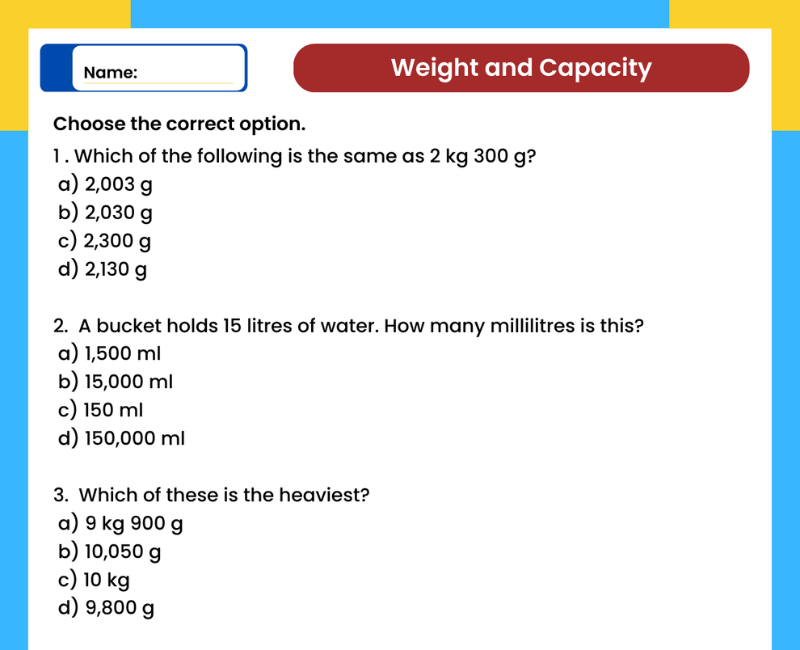
Weight and Capacity Class 5 Maths Worksheet with Quiz and Activities
Read scales, change between kg, g and mg, learn quintals and tonnes, and measure capacity in litres and millilitres. On WitKnowLearn you get the Weight and Capacity Class 5 online quiz, online activities and interactive games, a weight and capacity lab, a virtual lab and a worksheet-style practice sheet for NCERT Math Mela Chapter 8.
Weight and Capacity Class 5 Online Quiz
20 questions: 10 easy, 5 average and 5 thinking. Tap an answer and the next question comes up.
Weight and Capacity Class 5 Activities
👆 Tap a tab to switch: Learn, Games, Labs, Challenges, Virtual Lab and Practice sheet
Weight and Capacity: the Market Day Story
A short read for Class 5 before you play. These notes follow Chapter 8 of NCERT Math Mela.
⚖️ Reading the scale
A weighing scale shows kilograms and grams. A needle halfway between 2 kg and 3 kg shows 2 kg 500 g.
🍎 Same weight, two names
A bag of 3 kg is also 3,000 g. Two different balances can show the same weight in different units.
🐜 Tiny weights
An ant weighs only a few milligrams. 1,000 mg make 1 g, so milligrams suit medicine and gold.
🚛 Heavy loads
100 kg make 1 quintal and 10 quintals make 1 tonne. Trucks and elephants are weighed in tonnes.
🥛 Capacity
A bottle holds 500 ml and a bucket holds litres. 1 l is 1,000 ml, so 3 l needs 6 bottles of 500 ml.
📖 Case studies
Grocery shops, petrol pumps and kitchens all use weight and capacity. Change to one unit, calculate, and change back.
Weight and Capacity Class 5 Activities
Weigh, measure and convert on the Number Train. Earn up to 3 stars in every activity.
This page follows NCERT Class 5 Maths Math Mela, Chapter 8. Children read weighing scales, change between kg, g and mg, learn quintals and tonnes, and measure capacity in litres and millilitres.
The activities turn each idea into a game. Children sort things by unit, pop true facts, match words, fill gaps and solve grocery stories. Explore more Class 5 maths worksheets on WitKnowLearn after this chapter.
Formulas and facts to know
| Unit | Short form | Used for |
|---|---|---|
| Milligram | mg | Medicine and gold |
| Gram | g | Spices and fruit |
| Kilogram | kg | Rice and vegetables |
| Quintal and tonne | q and t | Crops and trucks |
| Litre and millilitre | l and ml | Milk and water |
How to use this page
- Flip the six cards and try the Weight and Capacity Lab in the Learn tab.
- Play the five games and the five labs to practise each idea.
- Finish the five challenges to collect up to 15 points.
- Take the 20-question online quiz, with assertion and reason and case study questions, and fill in the practice sheet.
Worked examples
500 g + 750 g = 1,250 g = 1 kg 250 g, and 2 + 1 + 1 = 4 kg, so the total is 4 kg 250 g.
2,500 g - 1,750 g = 750 g.
4,800 g ÷ 4 = 1,200 g = 1 kg 200 g.
This Weight and Capacity worksheet for Class 5 maths gives you online activities and interactive games that make units of weight and capacity fun. Every activity has a goal, a hint and a short fact, so children learn while they enjoy.
Complete Guide: NCERT Class 5 Maths Weight and Capacity Chapter 8
This guide is for Class 5 students, parents and teachers. It covers Chapter 8 of NCERT Math Mela and shows how to use the quiz, labs and games on this page.
Introduction to Weight and Capacity
The chapter extends weighing from grams and kilograms to milligrams, quintals and tonnes, and measuring capacity from litres to millilitres. Children then add, subtract, multiply and divide quantities in everyday settings.
What is there in this chapter
- Checking sensible weights of everyday items.
- Reading different weighing scales.
- Different units, same measure, with kg and g.
- Comparing weights.
- The milligram, the quintal and the tonne.
- Adding and subtracting weights.
- Multiplying and dividing weights.
- Measuring capacity in litres and millilitres.
- Petrol pump and milk delivery problems.
Learning objectives
- Read scales and choose the right unit of weight.
- Convert between mg, g, kg, quintals and tonnes.
- Convert between litres and millilitres.
- Add, subtract, multiply and divide weights and capacities.
- Compare weights and capacities in mixed units.
- Reason about assertions and case studies.
Learning outcomes
- The child can write 3 kg 500 g as 3,500 g.
- The child can write 4 g 100 mg as 4,100 mg.
- The child can say that 10 quintals make 1 tonne.
- The child can solve a case study on groceries or a petrol pump.
Weight and Capacity Class 5 resources on this page
| Resource | What it gives |
|---|---|
| Online quiz | 20 questions: 10 easy, 5 average and 5 thinking, with assertion and reason and case study questions and a full review |
| Flip cards | 6 picture cards with one-line rules |
| Weight and Capacity Lab | A hands-on lab with 3 rounds |
| Games | 5 interactive games |
| Labs | 5 activity labs |
| Virtual Lab | 2 experiments with aim, procedure, observation table and conclusion |
| Challenges | 5 challenges, 15 points in all |
| Practice sheet | A worksheet-style sheet with 16 questions, name and date lines and a live score |
Key facts
| Idea | Rule |
|---|---|
| Gram | 1,000 mg = 1 g. |
| Kilogram | 1,000 g = 1 kg. |
| Quintal | 100 kg = 1 quintal. |
| Tonne | 1,000 kg = 1 tonne = 10 quintals. |
| Litre | 1 l = 1,000 ml. |
Types of questions you may see
- Read the scale and write the weight.
- Convert between kg, g, mg, quintals and tonnes.
- Add and subtract weights and capacities.
- Assertion and reason questions.
- Case study questions on groceries and petrol pumps.
Solved examples
7,000 + 67 = 7,067 g.
12,042 = 12,000 + 42, so 12 kg 42 g.
1,600 g is less than 1,700 g.
90 quintals and 9 tonnes.
Double the quantity, so double the cost: ₹146.
9,000 - 5,300 = 3,700 ml = 3 l 700 ml.
Common mistakes
| Mistake | Correct idea |
|---|---|
| Writing 5 kg 50 g as 5,500 g. | 5 kg = 5,000 g, so 5 kg 50 g = 5,050 g. |
| Writing 1 l 400 ml as 1,040 ml. | 1 l = 1,000 ml, so it is 1,400 ml. |
| Mixing up quintal and tonne. | 1 quintal = 100 kg and 1 tonne = 1,000 kg. |
| Comparing kg with g directly. | Change both to the same unit first. |
Weight and Capacity in daily life
Children weigh vegetables, pour milk, read petrol pump bills and help in the kitchen. Choosing the right unit makes every number easy to understand.
Tips for parents and teachers
- Weigh groceries at home and write the weight in kg and g.
- Pour water with a measuring jug and read the ml marks.
- Read the weights and volumes on packets together.
- Practise one assertion and one case study each week.
Related Class 5 Maths Worksheets
- 🚆We the Travellers I Class 5 (NCERT Chapter 1)
- 🍕Fractions Class 5 (NCERT Chapter 2)
- 🔄Angles as Turns Class 5 (NCERT Chapter 3)
- 🗺We the Travellers II Class 5 (NCERT Chapter 4)
- 📏Far and Near Class 5 (NCERT Chapter 5)
- 🐄The Dairy Farm Class 5 (NCERT Chapter 6)
- 🔷Shapes and Patterns Class 5 (NCERT Chapter 7)
- 📐Measurement Class 5
- ⏰Time and Temperature Class 5
- 💰Money Addition and Subtraction Class 5
- ✖Multiplication Class 5
- ➗Division Class 5
Weight and Capacity Class 5 FAQs
What is Chapter 8 of NCERT Class 5 Maths Math Mela?
Chapter 8 is Weight and Capacity. It covers reading weighing scales, converting kg and g, the milligram, quintals and tonnes, adding, subtracting, multiplying and dividing weights, and measuring capacity in litres and millilitres.
How many grams are there in 1 kg?
1 kg = 1,000 g. The word kilo stands for thousand, so 3 kg is 3,000 g and 3 kg 500 g is 3,500 g.
How do you convert kg to g?
Multiply the kilograms by 1,000 and add the extra grams. So 5 kg 50 g = 5,000 g + 50 g = 5,050 g.
How do you convert g to kg?
Divide by 1,000. The quotient is the kilograms and the remainder is the grams. So 10,760 g = 10 kg 760 g.
What is a milligram?
A milligram is a very small unit of weight. 1 g = 1,000 mg. It is used for medicine ingredients, gold jewellery and tiny things like ants.
How many kg make a quintal and a tonne?
100 kg = 1 quintal and 1,000 kg = 1 tonne. So 10 quintals = 1 tonne.
What is the order of weight units from small to big?
The order is milligram, gram, kilogram, quintal and tonne. 1,000 mg = 1 g, 1,000 g = 1 kg, 100 kg = 1 quintal and 10 quintals = 1 tonne.
How do you add and subtract weights?
Add or subtract like units, that is kg with kg and g with g, and regroup 1,000 g as 1 kg. Or change both weights to grams, calculate and change back.
How do you multiply and divide weights?
Break the weight into kg and g and multiply each part, or change it to grams first. For division, divide the grams and change back, so 4 kg 800 g divided by 4 is 1 kg 200 g.
What is the difference between weight and capacity?
Weight tells how heavy a thing is and is measured in g and kg. Capacity tells how much liquid a container can hold and is measured in ml and l.
How many millilitres are there in 1 litre?
1 l = 1,000 ml. So 2 l 300 ml = 2,300 ml, and 8,400 ml = 8 l 400 ml.
What can children do on this page?
Children can take a 20-question online quiz with assertion and reason and case study questions, play five games, try five online activities, finish five challenges, run the Weight and Capacity Lab and two virtual experiments, and fill in a 16-question practice sheet with a Show answers button.
 Download