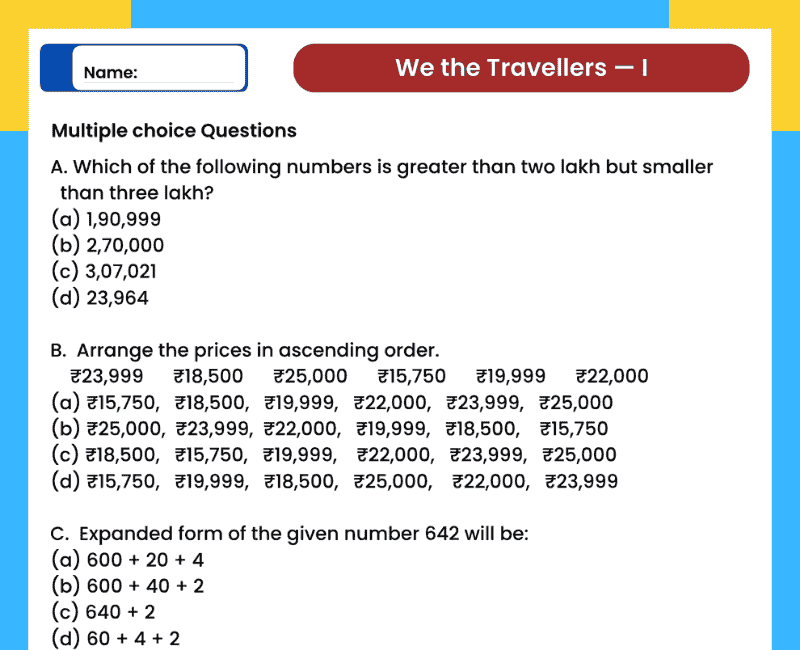
We the Travellers I Class 5 Maths Worksheet with Quiz and Activities
Read and write numbers up to ten thousand and beyond, compare them, round them and solve trip stories. On WitKnowLearn you get the We the Travellers I Class 5 online quiz, online activities and interactive games, a number lab, a virtual lab and a worksheet-style practice sheet for NCERT Math Mela Chapter 1.
We the Travellers I Class 5 Online Quiz
20 questions: 10 easy, 5 average and 5 thinking. Tap an answer and the next question comes up.
We the Travellers I Class 5 Activities
👆 Tap a tab to switch: Learn, Games, Labs, Challenges, Virtual Lab and Practice sheet
We the Travellers I: the Long Journey Story
A short read for Class 5 before you play. These notes follow Chapter 1 of NCERT Math Mela.
🛶 Travelling then and now
People once walked, rode animals and sailed in boats. Today we use cycles, cars, trains, ships and aeroplanes.
🔢 Ten thousand
Ten thousands make a new place called TTh. Adding 1,000 to 9,000 gives 10,000, so numbers now have five digits.
📖 Reading numbers
Use commas to read big numbers. 45,867 is forty-five thousand eight hundred sixty-seven.
🐇 Nearest number
A hungry rabbit hops to the closest ten, hundred or thousand. That idea is called rounding.
💵 Counting notes
Place value tells us how many tens, hundreds or thousands are in an amount of money.
🧩 Pastime puzzles
Sanju and Mira play with river crossings, piles of pebbles and digit differences. These train logical thinking.
We the Travellers I Class 5 Activities
Travel along the Number Train. Earn up to 3 stars in every activity.
This page follows NCERT Class 5 Maths Math Mela, Chapter 1. Children read and write numbers up to 5 digits, compare and order them, round them and solve travel stories.
The activities turn each idea into a game. Children sort numbers, pop true facts, match words, fill gaps and solve trip problems. Explore more Class 5 maths worksheets on WitKnowLearn after this chapter.
Formulas and facts to know
| Number | Nearest ten | Nearest hundred | Nearest thousand |
|---|---|---|---|
| 2,346 | 2,350 | 2,300 | 2,000 |
| 7,835 | 7,840 | 7,800 | 8,000 |
| 5,789 | 5,790 | 5,800 | 6,000 |
How to use this page
- Flip the six cards and try the We the Travellers Lab in the Learn tab.
- Play the five games and the five labs to practise each idea.
- Finish the five challenges to collect up to 15 points.
- Take the 20-question online quiz, with assertion and reason and case study questions, and fill in the practice sheet.
Worked examples
30,000 + 5,000 + 200 + 8 = 35,208.
The tens digit is 8, so round up to 6,500.
9,450 has 94 hundreds, so 94 notes.
This We the Travellers I worksheet for Class 5 maths gives you online activities and interactive games that turn big numbers into play. Every activity has a goal, a hint and a short fact, so children learn while they enjoy.
Complete Guide: NCERT Class 5 Maths We the Travellers I Chapter 1
This guide is for Class 5 students, parents and teachers. It covers Chapter 1 of NCERT Math Mela and shows how to use the quiz, labs and games on this page.
Introduction to We the Travellers I
The chapter starts with a journey. As the numbers for distances and vehicles grow, children meet ten thousands and learn to read, compare and round them.
What is there in this chapter
- Reading and writing numbers up to 5 digits.
- Place value with the TTh column.
- Number names and the comma.
- Comparing and ordering numbers.
- Digit swap.
- Nearest tens, hundreds and thousands.
- Travelling, now and then.
- Finding large numbers around us.
- Pastime puzzles.
- Expanded form, notes and word problems.
Learning objectives
- Read and write 5-digit numbers.
- Compare and order large numbers.
- Round to the nearest ten, hundred and thousand.
- Write numbers in expanded form.
- Solve travel and money problems.
- Reason about assertions and case studies.
Learning outcomes
- The child can read 45,867 in words.
- The child can round 7,835 to the nearest thousand.
- The child can tell why 49,014 is greater than 9,990.
- The child can solve a case study on a school trip.
We the Travellers I Class 5 resources on this page
| Resource | What it gives |
|---|---|
| Online quiz | 20 questions: 10 easy, 5 average and 5 thinking, with assertion and reason and case study questions and a full review |
| Flip cards | 6 picture cards with one-line rules |
| We the Travellers Lab | A hands-on lab with 3 rounds |
| Games | 5 interactive games |
| Labs | 5 activity labs |
| Virtual Lab | 2 experiments with aim, procedure, observation table and conclusion |
| Challenges | 5 challenges, 15 points in all |
| Practice sheet | A worksheet-style sheet with 16 questions, name and date lines and a live score |
Key facts
| Idea | Rule |
|---|---|
| Ten thousand | 10 thousands, written 10,000. |
| Comparing | More digits means a greater number. |
| Rounding | 5 or more rounds up. |
| Expanded form | Split by place value. |
| Distance | Speed times time. |
Types of questions you may see
- Write number names.
- Round to the nearest ten, hundred or thousand.
- Order numbers.
- Assertion and reason questions.
- Case study questions on trips and money.
Solved examples
20,000 + 3,000 + 4.
The hundreds digit is 9, so 5,000.
34,407, 34,740, 40,347.
5 × 80 = 400 km.
65 thousands.
73 - 37 = 36, then 63 - 36 = 27, 72 - 27 = 45, 54 - 45 = 9.
Common mistakes
| Mistake | Correct idea |
|---|---|
| Comparing only the first digit. | Count the digits first. |
| Rounding 2,346 to the nearest hundred as 2,400. | 46 is less than 50, so it is 2,300. |
| Writing 10,458 as 1,458. | Ten thousand needs five digits. |
| Forgetting the leftover when counting notes. | Count only full notes. |
We the Travellers I in daily life
Children meet big numbers in bus fares, distances, populations and prices. Rounding helps them estimate quickly.
Tips for parents and teachers
- Ask the child to read distances on road signs.
- Round the prices on a shopping bill.
- Play the pile of pebbles game together.
- Practise one assertion and one case study each week.
Related Class 5 Maths Worksheets
- 🔢Large Numbers Class 5
- ➕Addition Class 5
- ✖Multiplication Class 5
- ➗Division Class 5
- 🌳Factors and Multiples Class 5
- 📏Measurement Class 5
- 💰Money Addition and Subtraction Class 5
- 🟩Perimeter and Area Class 5
- 🕒Time and Temperature Class 5
- 📊Data Handling Class 5
- 🪞Symmetry and Patterns Class 5
- 📐Angles Class 5
We the Travellers I Class 5 FAQs
What is Chapter 1 of NCERT Class 5 Maths Math Mela?
Chapter 1 is We the Travellers I. It teaches reading and writing numbers up to 5 digits, comparing and ordering them, rounding to the nearest ten, hundred and thousand, and solving travel problems.
How do you write ten thousand?
Ten thousand is written as 10,000. It is 10 thousands, with 1 in the TTh place and zeros in the Th, H, T and O places.
What does TTh mean in the place value chart?
TTh stands for ten thousands. It is the place to the left of the thousands place, so the digit 4 in 45,867 is worth 40,000.
How do you write number names for 5-digit numbers?
Say the thousands part first and then the rest. For example 10,458 is ten thousand four hundred fifty-eight.
How do you compare large numbers?
First count the digits, because a number with more digits is greater. If the digits are equal, compare from the left, so 9,990 is smaller than 49,014 even though 9 is greater than 4.
How do you round to the nearest ten, hundred and thousand?
Look at the digit to the right of the place you are rounding to. If it is 5 or more, round up, and if it is less than 5, round down, so 2,346 is 2,350 to the nearest ten and 2,300 to the nearest hundred.
What is the nearest thousand of 7,835?
The hundreds digit is 8, which is more than 5, so 7,835 rounds up to 8,000.
What is the expanded form of 70,405?
The expanded form is 70,000 + 400 + 5. Each digit is written with its place value.
How many notes of 100 rupees are there in Rs.7,934?
Ignore the last two digits, so 7,934 has 79 hundreds. There are 79 notes of Rs.100.
How do you arrange numbers in ascending and descending order?
Ascending means smallest to greatest, and descending means greatest to smallest. Compare the digits from the left to place each number.
Why does Mira always get 9 in the digit puzzle?
The difference of two numbers made from the same two digits is always a multiple of 9. Repeating the steps shrinks it down to 9.
What can children do on this page?
Children can take a 20-question online quiz with assertion and reason and case study questions, play five games, try five online activities, finish five challenges, run the We the Travellers Lab and two virtual experiments, and fill in a 16-question practice sheet with a Show answers button.
 Download