Far and Near Class 5 Maths Worksheet with Quiz and Activities
Measure small and long lengths, change between km, m, cm and mm, add and subtract distances and solve journey case studies. On WitKnowLearn you get the Far and Near Class 5 online quiz, online activities and interactive games, a length lab, a virtual lab and a worksheet-style practice sheet for NCERT Math Mela Chapter 5.
Far and Near Class 5 Online Quiz
20 questions: 10 easy, 5 average and 5 thinking. Tap an answer and the next question comes up.
Far and Near Class 5 Activities
👆 Tap a tab to switch: Learn, Games, Labs, Challenges, Virtual Lab and Practice sheet
Far and Near: the Long Journey Story
A short read for Class 5 before you play. These notes follow Chapter 5 of NCERT Math Mela.
📏 Small and tiny lengths
A centimetre has ten tiny marks. Each mark is 1 millimetre, so a sprout of 4 cm 5 mm is 45 mm long.
🧵 Saris and stoles
One length can have many names. A stole of 240 cm is also 2 m 40 cm, and a double number line shows both together.
🗿 Tall statues
The Statue of Unity is 182 m tall. Subtracting two heights tells us how much taller one statue is.
🏃 The 3 km race
A race of 3 km is 3,000 m. Water stations every 500 m make a neat pattern along the track.
🚂 The longest train ride
The Vivek Express runs from Dibrugarh to Kanniyakumari, a journey of 4,187 km. Subtracting station distances shows how far apart two stations are.
📖 Case studies
Cloth, roads, ribbons and routes all need lengths in mixed units. Change to one unit, calculate, and change back.
Far and Near Class 5 Activities
Measure, convert and compare on the Number Train. Earn up to 3 stars in every activity.
This page follows NCERT Class 5 Maths Math Mela, Chapter 5. Children learn the new units millimetre and kilometre, change between km, m, cm and mm, and add, subtract, multiply and divide lengths.
The activities turn each idea into a game. Children sort lengths, pop true facts, match words, fill gaps and solve journey stories. Explore more Class 5 maths worksheets on WitKnowLearn after this chapter.
Formulas and facts to know
| Unit | Short form | Used to measure |
|---|---|---|
| Millimetre | mm | Tiny lengths like a screw |
| Centimetre | cm | A pencil or a handkerchief |
| Metre | m | A room or a cloth roll |
| Kilometre | km | Roads and train routes |
How to use this page
- Flip the six cards and try the Length Lab in the Learn tab.
- Play the five games and the five labs to practise each idea.
- Finish the five challenges to collect up to 15 points.
- Take the 20-question online quiz, with assertion and reason and case study questions, and fill in the practice sheet.
Worked examples
450 m + 650 m = 1,100 m = 1 km 100 m, and 3 km + 4 km = 7 km, so the total is 8 km 100 m.
6,300 cm - 1,675 cm = 4,625 cm = 46 m 25 cm.
100 ÷ 5 = ₹20.
This Far and Near worksheet for Class 5 maths gives you online activities and interactive games that make units of length fun. Every activity has a goal, a hint and a short fact, so children learn while they enjoy.
Complete Guide: NCERT Class 5 Maths Far and Near Chapter 5
This guide is for Class 5 students, parents and teachers. It covers Chapter 5 of NCERT Math Mela and shows how to use the quiz, labs and games on this page.
Introduction to Far and Near
The chapter extends measuring length with two new units, the millimetre for small things and the kilometre for long distances. It then shows how to change units and how to add, subtract, multiply and divide lengths.
What is there in this chapter
- Choosing the right unit of length.
- Different units but the same measure.
- Comparing lengths and the tallest statues.
- Measuring long distances and the kilometre.
- The 3 km race and the longest train journey.
- The world of small things and the millimetre.
- Converting between km, m, cm and mm.
- Adding, subtracting, multiplying and dividing lengths.
- Estimating, and feet and inches.
Learning objectives
- Use mm, cm, m and km to measure lengths.
- Change a length from one unit to another.
- Add and subtract lengths with regrouping.
- Multiply and divide lengths in daily life problems.
- Estimate lengths and distances.
- Reason about assertions and case studies.
Learning outcomes
- The child can write 4 cm 5 mm as 45 mm.
- The child can write 6 km 30 m as 6,030 m.
- The child can add 3 km 450 m and 4 km 650 m.
- The child can solve a case study on cloth, a road or a race.
Far and Near Class 5 resources on this page
| Resource | What it gives |
|---|---|
| Online quiz | 20 questions: 10 easy, 5 average and 5 thinking, with assertion and reason and case study questions and a full review |
| Flip cards | 6 picture cards with one-line rules |
| Length Lab | A hands-on lab with 3 rounds |
| Games | 5 interactive games |
| Labs | 5 activity labs |
| Virtual Lab | 2 experiments with aim, procedure, observation table and conclusion |
| Challenges | 5 challenges, 15 points in all |
| Practice sheet | A worksheet-style sheet with 16 questions, name and date lines and a live score |
Key facts
| Idea | Rule |
|---|---|
| Millimetre | 1 cm = 10 mm. |
| Metre | 1 m = 100 cm. |
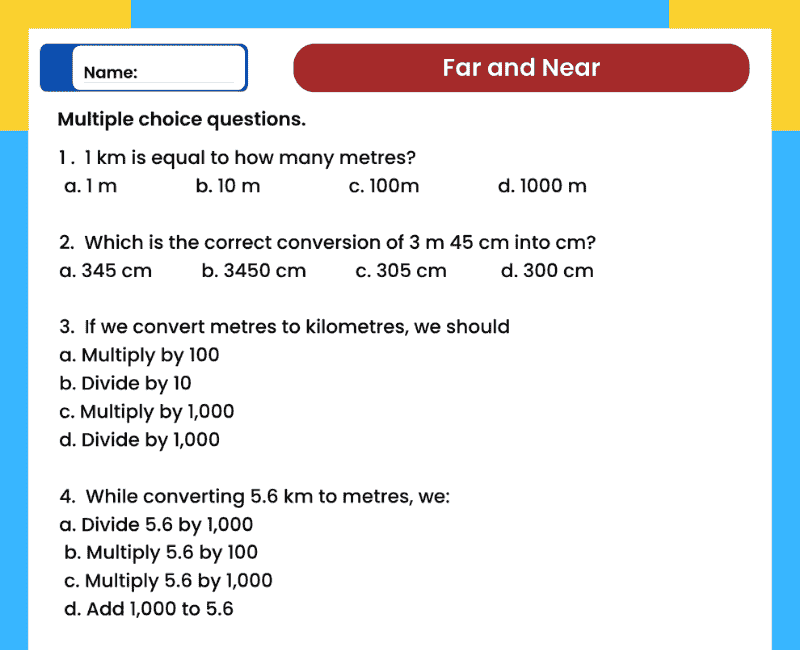
| Kilometre | 1 km = 1,000 m. |
| Feet and inches | 1 foot = 12 inches = about 30 cm. |
| Mixed units | Change to the smaller unit, calculate, change back. |
Types of questions you may see
- Choose the unit for a length.
- Fill in the blanks on a double number line.
- Convert between km, m, cm and mm.
- Assertion and reason questions.
- Case study questions on cloth, roads and routes.
Solved examples
89 = 80 + 9, so 8 cm 9 mm.
5,792 = 5,700 + 92, so 57 m 92 cm.
10,552 = 10,000 + 552, so 10 km 552 m.
20 m + 1,600 cm = 20 m + 16 m = 36 m.
12,600 m ÷ 6 = 2,100 m = 2 km 100 m.
245 cm is longer, by 45 cm.
Common mistakes
| Mistake | Correct idea |
|---|---|
| Writing 4 cm 5 mm as 4.5 mm or 405 mm. | 4 cm = 40 mm, so it is 45 mm. |
| Writing 6 km 30 m as 630 m. | 6 km = 6,000 m, so it is 6,030 m. |
| Adding cm to m directly. | Change both to the same unit first. |
| Forgetting to regroup 1,000 m as 1 km. | Every 1,000 m make 1 km. |
Far and Near in daily life
Children use these lengths when they tailor clothes, plan a walk or a bus ride, and read distances on a map. Estimating first keeps the answers sensible.
Tips for parents and teachers
- Measure a small object in cm and mm with a ruler.
- Walk 100 m with the child and count the steps.
- Read distances on road signs during a drive.
- Practise one assertion and one case study each week.
Related Class 5 Maths Worksheets
- 🚆We the Travellers I Class 5 (NCERT Chapter 1)
- 🍕Fractions Class 5 (NCERT Chapter 2)
- 🔄Angles as Turns Class 5 (NCERT Chapter 3)
- 🗺We the Travellers II Class 5 (NCERT Chapter 4)
- 📏Measurement Class 5
- 🟩Perimeter and Area Class 5
- ⏰Time and Temperature Class 5
- 💰Money Addition and Subtraction Class 5
- 🔢Large Numbers Class 5
- ➕Addition Class 5
- ➖Subtraction Class 5
- 📐Angles Class 5
Far and Near Class 5 FAQs
What is Chapter 5 of NCERT Class 5 Maths Math Mela?
Chapter 5 is Far and Near. It covers units of length, millimetres, kilometres, converting between km, m, cm and mm, adding, subtracting, multiplying and dividing lengths, and estimating distances.
What is the relation between km, m, cm and mm?
10 mm = 1 cm, 100 cm = 1 m and 1,000 m = 1 km. So 1 m is also 1,000 mm and 1 km is 100,000 cm.
How do you convert km to m?
Multiply the kilometres by 1,000. So 3 km = 3 x 1,000 = 3,000 m, and 6 km 30 m = 6,030 m.
How do you convert m to cm?
Multiply the metres by 100 and add the extra centimetres. So 6 m 34 cm = 600 cm + 34 cm = 634 cm.
How do you convert cm to mm?
Multiply the centimetres by 10 and add the extra millimetres. So 4 cm 5 mm = 40 mm + 5 mm = 45 mm.
What is a millimetre and why do we need it?
A millimetre is one of the ten equal parts of a centimetre. The small marks on a ruler show millimetres, and they help us measure small things like a sprout or a screw more exactly.
How do you add lengths in km and m?
Add like units, that is km with km and m with m. If the metres make 1,000 or more, regroup 1,000 m as 1 km. Or change both lengths to metres, add, and change back.
How do you subtract lengths?
Subtract like units. If the top metres are fewer, regroup 1 km as 1,000 m (or 1 m as 100 cm) and then subtract. You can also change both lengths to the smaller unit first.
How do you multiply and divide lengths?
Break the length into its parts and multiply each part, or change it to the smaller unit first. So 20 x 1 m 80 cm = 20 x 180 cm = 3,600 cm = 36 m. For division, divide the smaller unit and change back.
How do we measure long distances?
We use a long tape, a rangefinder, a laser distance meter and a rodometer, which is a measuring wheel. Counting steps also helps us estimate a distance.
How many cm and mm are there in 1 inch and 1 foot?
1 inch is about 2 cm 5 mm, and 1 foot is 12 inches, which is about 30 cm.
What can children do on this page?
Children can take a 20-question online quiz with assertion and reason and case study questions, play five games, try five online activities, finish five challenges, run the Length Lab and two virtual experiments, and fill in a 16-question practice sheet with a Show answers button.
 Download