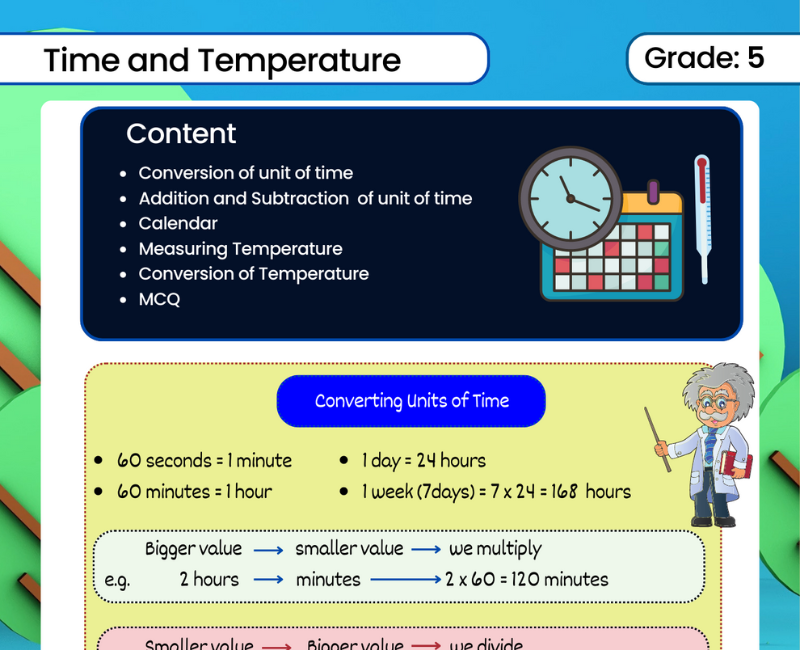
Time and Temperature Class 5 Maths Worksheet with Quiz and Activities
Read clocks, use the 24-hour clock, find how long things take and read a thermometer. On WitKnowLearn you get the Time and Temperature Class 5 online quiz, online activities and interactive games, clock labs, a virtual lab and a worksheet-style practice sheet, all on one page.
Time and Temperature Class 5 Online Quiz
20 questions: 10 easy, 5 average and 5 thinking. Tap an answer and the next question comes up.
Time and Temperature Class 5 Activities
👆 Tap a tab to switch: Learn, Games, Labs, Challenges, Virtual Lab and Practice sheet
Time and Temperature: the Railway Station Story
A short read for Class 5 before you play. These notes are written for this page.
🕒 Reading the clock
The short hand shows the hour and the long hand shows the minutes. Each number is 5 minutes, so the number 4 means 20 minutes past.
⏱️ Units of time
60 seconds make a minute and 60 minutes make an hour. A day has 24 hours and a week has 7 days.
⌛ Duration
Duration is the time between a start and an end. Count up to the next hour, then add the rest.
📅 The calendar
A year has 12 months and 365 days, or 366 days in a leap year. Some months have 30 days and some have 31.
🌡️ Temperature
A thermometer measures how hot or cold something is in degrees Celsius. Water freezes at 0 and boils at 100.
📖 Case studies
Train timetables and weather reports are real case studies. Find the start, the end and the difference.
Time and Temperature Class 5 Activities
Read, count and measure on the Number Train. Earn up to 3 stars in every activity.
Time and temperature are part of every day, from school bells to weather reports. This page helps Class 5 children read clocks, use the 24-hour clock, find durations, use the calendar and read a thermometer.
The activities turn each idea into a game. Children sort activities by time, pop true facts, match words, fill gaps and compare times. Explore more Class 5 maths worksheets on WitKnowLearn after this topic.
Formulas and facts to know
| Unit | Equal to | Example |
|---|---|---|
| 1 minute | 60 seconds | 5 minutes = 300 seconds |
| 1 hour | 60 minutes | 3 hours = 180 minutes |
| 1 day | 24 hours | 4 days = 96 hours |
| 1 week | 7 days | 2 weeks = 14 days |
How to use this page
- Flip the six cards and try the Time and Temperature Lab in the Learn tab.
- Play the five games and the five labs to practise each idea.
- Finish the five challenges to collect up to 15 points.
- Take the 20-question online quiz, with assertion and reason and case study questions, and fill in the practice sheet.
Worked examples
3 × 60 = 180, and 180 + 25 = 205 minutes.
10:45 + 2 hours = 12:45, and 12:45 + 40 minutes = 1:25 PM.
3/4 of 60 = 45 minutes.
This Time and Temperature worksheet for Class 5 maths gives you online activities and interactive games that turn clocks and thermometers into play. Every activity has a goal, a hint and a short fact, so children learn while they enjoy.
Complete Guide: Maths Time and Temperature Class 5
This guide is for Class 5 students, parents and teachers. It explains time and temperature in simple words and shows how to use the quiz, labs and games on this page.
Introduction to Time and Temperature
Children use time and temperature every day. Reading a clock, planning a journey and checking the weather all depend on these skills.
What is there in this topic
- Reading an analog clock.
- Units of time and conversions.
- AM, PM and the 24-hour clock.
- Duration and end time.
- The calendar, months and leap years.
- Temperature and the Celsius scale.
- Word problems and case studies.
Learning objectives
- Read and write time to the minute.
- Convert between hours, minutes and seconds.
- Change between 12-hour and 24-hour time.
- Find the duration between two times.
- Read a thermometer and find a rise or fall.
- Reason about assertions and case studies.
Learning outcomes
- The child can read 7:20 on a clock.
- The child can say that 6 PM is 18:00.
- The child can find the time from 8:30 AM to 1:15 PM.
- The child can find a temperature change.
Time and Temperature Class 5 resources on this page
| Resource | What it gives |
|---|---|
| Online quiz | 20 questions: 10 easy, 5 average and 5 thinking, with assertion and reason and case study questions and a full review |
| Flip cards | 6 picture cards with one-line rules |
| Time and Temperature Lab | A hands-on lab with 3 rounds |
| Games | 5 interactive games |
| Labs | 5 activity labs |
| Virtual Lab | 2 experiments with aim, procedure, observation table and conclusion |
| Challenges | 5 challenges, 15 points in all |
| Practice sheet | A worksheet-style sheet with 16 questions, name and date lines and a live score |
Key facts
| Idea | Rule |
|---|---|
| Clock | Short hand is hours and long hand is minutes. |
| Conversion | 1 hour = 60 minutes, 1 minute = 60 seconds. |
| 24-hour time | Add 12 to the PM hour. |
| Leap year | Has 366 days. |
| Water | Freezes at 0°C and boils at 100°C. |
Types of questions you may see
- Read the clock.
- Convert units of time.
- Find the duration or end time.
- Assertion and reason questions.
- Case study questions on timetables and weather.
Solved examples
5 + 12 = 17, so it is 17:40.
8 × 60 = 480 seconds.
7:50 to 10:00 is 2 hours 10 minutes, and 10:00 to 10:20 is 20 minutes, so 2 hours 30 minutes.
40 − 26 = 14°C.
6 × 7 = 42 days.
1/2 of 60 = 30 minutes.
Common mistakes
| Mistake | Correct idea |
|---|---|
| Thinking 1 hour is 100 minutes. | 1 hour is 60 minutes. |
| Reading the long hand as hours. | The long hand shows the minutes. |
| Writing 6 PM as 6:00 in 24-hour time. | 6 PM is 18:00. |
| Adding temperatures to find a change. | Subtract the smaller from the larger. |
Time and Temperature in daily life
Children use time to plan school and play, and temperature to decide what to wear. Reading a train timetable or a weather chart together builds confidence.
Tips for parents and teachers
- Let children read the wall clock aloud.
- Ask how long the school bus ride takes.
- Check the outside temperature each morning.
- Practise one assertion and one case study each week.
Related Class 5 Maths Worksheets
Time and Temperature Class 5 FAQs
How do you read time on an analog clock?
The short hand shows the hour and the long hand shows the minutes. Each number on the clock is 5 minutes, so the long hand on 4 means 20 minutes past the hour.
How many minutes are there in an hour and seconds in a minute?
There are 60 minutes in 1 hour and 60 seconds in 1 minute. So 5 minutes is 300 seconds.
How do you convert hours to minutes?
Multiply the hours by 60 and add the extra minutes. For example 2 hours 15 minutes is 2 x 60 + 15 = 135 minutes.
What is 24-hour time and how do you convert PM to 24-hour time?
The 24-hour clock counts from 00:00 to 23:59 with no AM or PM. For a PM time, add 12 to the hour, so 6 PM is 18:00 and 3 PM is 15:00.
How do you find the duration or elapsed time between two times?
Count from the start time to the next full hour, then add the whole hours, then add the last minutes. From 9:40 AM to 1:10 PM is 3 hours 30 minutes.
How do you find the end time when the start time and duration are given?
Add the hours and the minutes to the start time. A film that starts at 6:15 PM and lasts 2 hours 30 minutes ends at 8:45 PM.
How many days are there in each month and in a leap year?
April, June, September and November have 30 days, February has 28 days, and the other months have 31 days. A leap year has 366 days because February has 29 days.
How many days are there in a week and in a year?
There are 7 days in a week, 12 months in a year and 365 days in a normal year.
What is temperature and how is it measured?
Temperature tells us how hot or cold something is. We measure it with a thermometer in degrees Celsius.
What are the freezing point and boiling point of water?
Water freezes at 0 degrees Celsius and boils at 100 degrees Celsius. Normal body temperature is about 37 degrees Celsius.
How do you find a rise or fall in temperature?
Subtract the smaller temperature from the larger one. If it rises from 18 to 31 degrees, the rise is 31 - 18 = 13 degrees.
What can children do on this page?
Children can take a 20-question online quiz with assertion and reason and case study questions, play five games, try five online activities, finish five challenges, run the Time and Temperature Lab and two virtual experiments, and fill in a 16-question practice sheet with a Show answers button.
 Download