Profit and Loss Class 5 Maths Worksheet with Quiz and Activities
Learn cost price and selling price, find profit and loss and solve shop stories and case studies. On WitKnowLearn you get the Profit and Loss Class 5 online quiz, online activities and interactive games, shop labs, a virtual lab and a worksheet-style practice sheet, all on one page.
Profit and Loss Class 5 Online Quiz
20 questions: 10 easy, 5 average and 5 thinking. Tap an answer and the next question comes up.
Profit and Loss Class 5 Activities
👆 Tap a tab to switch: Learn, Games, Labs, Challenges, Virtual Lab and Practice sheet
Profit and Loss: the Market Stall Story
A short read for Class 5 before you play. These notes are written for this page.
🛒 Buying and selling
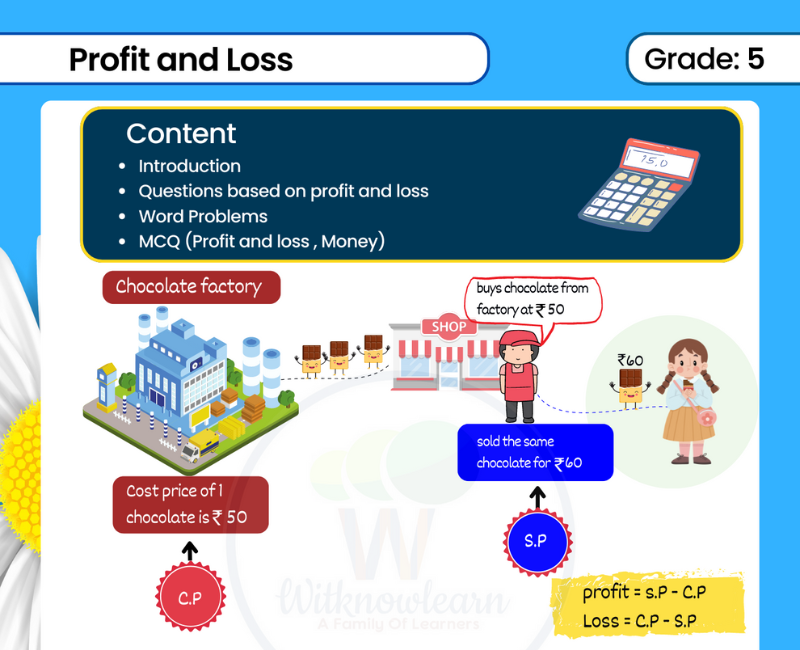
A shopkeeper buys goods and sells them again. The price paid is the cost price and the price received is the selling price.
📈 Profit
If the shopkeeper sells for more than he paid, he makes a profit. The profit is the extra money he gets.
📉 Loss
If he sells for less than he paid, he has a loss. The loss is the money that does not come back.
⚖️ No profit, no loss
When both prices are the same, the shopkeeper breaks even. Nothing is gained and nothing is lost.
🧮 Finding the missing price
Add a profit to the cost price to get the selling price. Subtract a loss from the cost price to get the selling price.
📖 Case studies
Real stories have many numbers. Find the total cost and the total selling price first, then compare them.
Profit and Loss Class 5 Activities
Buy, sell and compare on the Number Train. Earn up to 3 stars in every activity.
Profit and loss bring money sums to life. This page helps Class 5 children understand cost price and selling price, find profit and loss and solve shop stories and case studies.
The activities turn each idea into a game. Children sort deals, pop true formula facts, match shop words, fill gaps and decide which result is better for the shopkeeper. Explore more Class 5 maths worksheets on WitKnowLearn after this topic.
Formulas and facts to know
| Compare | Result | Example |
|---|---|---|
| SP > CP | Profit | ₹300 − ₹240 = ₹60 profit |
| SP < CP | Loss | ₹150 − ₹115 = ₹35 loss |
| SP = CP | Neither | ₹300 and ₹300 |
How to use this page
- Flip the six cards and try the Profit and Loss Lab in the Learn tab.
- Play the five games and the five labs to practise each idea.
- Finish the five challenges to collect up to 15 points.
- Take the 20-question online quiz, with assertion and reason and case study questions, and fill in the practice sheet.
Worked examples
170 is more than 145, so there is a profit of 170 − 145 = ₹25.
CP = SP + Loss = 260 + 40 = ₹300.
CP = 8 × 6 = ₹48 and 60 − 48 = ₹12 profit.
This Profit and Loss worksheet for Class 5 maths gives you online activities and interactive games that turn deals into play. Every activity has a goal, a hint and a short fact, so children learn while they enjoy.
Complete Guide: Maths Profit and Loss Class 5
This guide is for Class 5 students, parents and teachers. It explains profit and loss in simple words and shows how to use the quiz, labs and games on this page.
Introduction to Profit and Loss
Every shop buys and sells. Profit and loss tell us whether a deal gained or lost money, which is why they are an important part of everyday maths.
What is there in this topic
- Cost price and selling price.
- Profit and loss.
- No profit and no loss.
- Finding the profit or loss.
- Finding the selling price and the cost price.
- Shop word problems and case studies.
Learning objectives
- Define cost price, selling price, profit and loss.
- Find the profit or loss in a deal.
- Find SP from CP and CP from SP.
- Solve one-step and two-step shop stories.
- Reason about assertions and case studies.
Learning outcomes
- The child can say whether a deal is a profit or a loss.
- The child can find the profit when CP is ₹240 and SP is ₹300.
- The child can find the SP when a profit or loss is given.
- The child can solve a case study on a fruit seller.
Profit and Loss Class 5 resources on this page
| Resource | What it gives |
|---|---|
| Online quiz | 20 questions: 10 easy, 5 average and 5 thinking, with assertion and reason and case study questions and a full review |
| Flip cards | 6 picture cards with one-line rules |
| Profit and Loss Lab | A hands-on lab with 3 rounds |
| Games | 5 interactive games |
| Labs | 5 activity labs |
| Virtual Lab | 2 experiments with aim, procedure, observation table and conclusion |
| Challenges | 5 challenges, 15 points in all |
| Practice sheet | A worksheet-style sheet with 16 questions, name and date lines and a live score |
Key facts
| Idea | Rule |
|---|---|
| Profit | SP minus CP, when SP is more. |
| Loss | CP minus SP, when CP is more. |
| Selling price | CP plus profit, or CP minus loss. |
| Cost price | SP minus profit, or SP plus loss. |
| Equal prices | No profit and no loss. |
For older children
Types of questions you may see
- Find the profit or the loss.
- Find SP or CP.
- Assertion and reason questions.
- Case study questions.
- Shop story problems.
Solved examples
105 − 88 = ₹17 profit.
340 − 295 = ₹45 loss.
125 + 30 = ₹155.
210 − 35 = ₹175.
Neither, because both prices are equal.
CP = 180 and 200 − 180 = ₹20 profit.
Common mistakes
| Mistake | Correct idea |
|---|---|
| Subtracting CP from SP to find a loss. | A loss is CP minus SP. |
| Mixing up CP and SP. | CP is the price paid and SP is the price received. |
| Forgetting to find the total CP of many items. | Multiply the price of one by the number of items. |
| Thinking profit and loss can both happen in one deal. | A deal gives only one result. |
Profit and Loss in daily life
Children see profit and loss in school fairs, lemonade stalls and shops. Talking about the cost and selling price of everyday things makes the idea real.
Tips for parents and teachers
- Run a mini stall at home with toy money.
- Ask children to label each item with its CP and SP.
- Pose a story and let them decide profit or loss.
- Practise one assertion and one case study each week.
Related Class 5 Maths Worksheets
Profit and Loss Class 5 FAQs
What is profit and loss in Class 5 maths?
Profit and loss tell us what a shopkeeper gains or loses in a deal. If the selling price is more than the cost price there is a profit, and if it is less there is a loss.
What is the formula for profit and loss?
Profit = Selling price - Cost price, when SP is more than CP. Loss = Cost price - Selling price, when CP is more than SP.
What is the difference between cost price and selling price?
The cost price (CP) is the price a shopkeeper pays to buy goods. The selling price (SP) is the price at which he sells them to customers.
How do you find the profit?
Subtract the cost price from the selling price. If CP is Rs. 240 and SP is Rs. 300, the profit is 300 - 240 = Rs. 60.
How do you find the loss?
Subtract the selling price from the cost price. If CP is Rs. 150 and SP is Rs. 115, the loss is 150 - 115 = Rs. 35.
How do you find the selling price when the profit is given?
Add the profit to the cost price. SP = CP + Profit, so if CP is Rs. 250 and profit is Rs. 45, then SP is Rs. 295.
How do you find the selling price when the loss is given?
Subtract the loss from the cost price. SP = CP - Loss, so if CP is Rs. 150 and loss is Rs. 25, then SP is Rs. 125.
How do you find the cost price?
Subtract the profit from the selling price, or add the loss to the selling price. If SP is Rs. 180 and loss is Rs. 25, then CP is Rs. 205.
When is there no profit and no loss?
When the selling price is equal to the cost price, the shopkeeper neither gains nor loses. For example CP Rs. 300 and SP Rs. 300.
What are real-life examples of profit and loss?
A fruit seller who buys oranges at Rs. 100 and sells them for Rs. 128 makes a profit. A boy who buys a kite for Rs. 45 and sells it for Rs. 36 has a loss.
How do you solve profit and loss word problems easily?
Find the total cost and the total selling price first. Then compare them and subtract the smaller from the greater to get the profit or the loss.
What can children do on this page?
Children can take a 20-question online quiz with assertion and reason and case study questions, play five games, try five online activities, finish five challenges, run the Profit and Loss Lab and two virtual experiments, and fill in a 16-question practice sheet with a Show answers button.
 Download