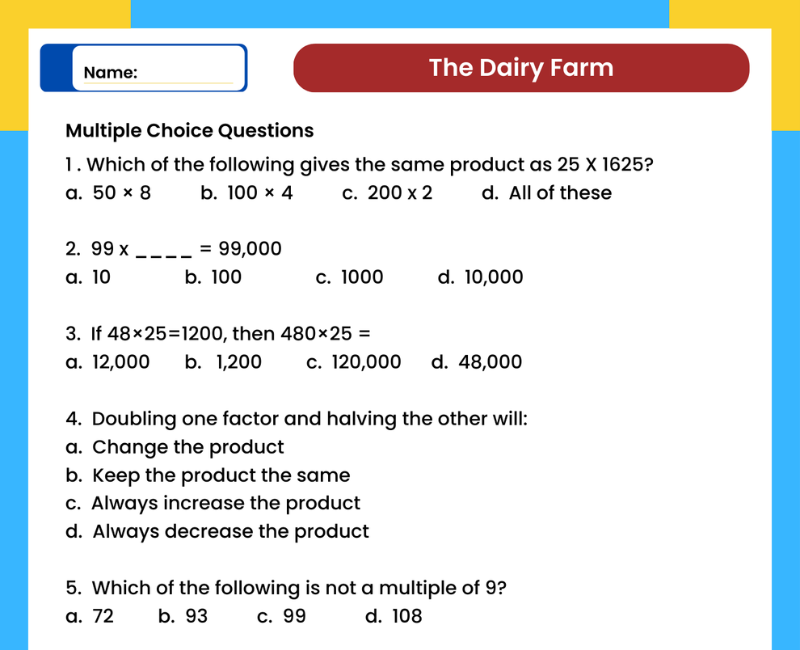
The Dairy Farm Class 5 Maths Worksheet with Quiz and Activities
Multiply by 10s and 100s, halve and double, use the nearest multiple and multiply with boxes. On WitKnowLearn you get the The Dairy Farm Class 5 online quiz, online activities and interactive games, a multiplication lab, a virtual lab and a worksheet-style practice sheet for NCERT Math Mela Chapter 6.
The Dairy Farm Class 5 Online Quiz
20 questions: 10 easy, 5 average and 5 thinking. Tap an answer and the next question comes up.
The Dairy Farm Class 5 Activities
👆 Tap a tab to switch: Learn, Games, Labs, Challenges, Virtual Lab and Practice sheet
The Dairy Farm: the Milk and Butter Story
A short read for Class 5 before you play. These notes follow Chapter 6 of NCERT Math Mela.
🧈 Butter packets
3 rows of 6 packets and 6 rows of 3 packets hold the same butter. The order of the numbers does not change the product.
🔟 Tens and hundreds
Multiplying 36 by 10 gives 360. Each digit moves one place to the left, and a zero fills the gap.
✂️ Double and half
3 x 18 and 6 x 9 are the same. Double one number, halve the other, and the product stays at 54.
🎯 The nearest multiple
To find 6 x 19, multiply 6 x 20 = 120 and take away 6. The answer is 114.
🐄 Gir cows and the dairy cooperative
A dairy cooperative gets milk from many villagers. Multiplying the number of cows by the litres each gives gives the milk for the day.
📖 Case studies
Crates, curd packs, fodder and compost all need big products. Pick a strategy that fits the numbers.
The Dairy Farm Class 5 Activities
Multiply with smart strategies on the Number Train. Earn up to 3 stars in every activity.
This page follows NCERT Class 5 Maths Math Mela, Chapter 6. Children multiply by 10s and 100s, swap the order of numbers, halve and double, use the nearest multiple and multiply large numbers with the box and long methods.
The activities turn each strategy into a game. Children sort products, pop true facts, match words, fill gaps and solve dairy stories. Explore more Class 5 maths worksheets on WitKnowLearn after this chapter.
Formulas and facts to know
| Multiply by | Digits shift | Example |
|---|---|---|
| 10 | 1 place left | 36 × 10 = 360 |
| 100 | 2 places left | 36 × 100 = 3,600 |
| 1,000 | 3 places left | 36 × 1,000 = 36,000 |
How to use this page
- Flip the six cards and try the Multiplication Lab in the Learn tab.
- Play the five games and the five labs to practise each idea.
- Finish the five challenges to collect up to 15 points.
- Take the 20-question online quiz, with assertion and reason and case study questions, and fill in the practice sheet.
Worked examples
28 × 30 = 840 and 28 × 5 = 140, so 840 + 140 = 980.
372 × 4 = 1,488 and 372 × 10 = 3,720, so 1,488 + 3,720 = 5,208.
Halve 12 and double 25 to get 50 × 6 = 300.
This The Dairy Farm worksheet for Class 5 maths gives you online activities and interactive games that make multiplication strategies fun. Every activity has a goal, a hint and a short fact, so children learn while they enjoy.
Complete Guide: NCERT Class 5 Maths The Dairy Farm Chapter 6
This guide is for Class 5 students, parents and teachers. It covers Chapter 6 of NCERT Math Mela and shows how to use the quiz, labs and games on this page.
Introduction to The Dairy Farm
The chapter builds many ways to multiply, using a dairy farm and a milk cooperative as the setting. Children move from patterns with 10s and 100s to strategies for large products.
What is there in this chapter
- Number puzzles with shapes and clues.
- The order of numbers in multiplication.
- Patterns in multiplication by 10s and 100s.
- Many ways to multiply.
- Doubling and halving.
- The nearest multiple.
- Word problems on waste and composting.
- The box method and the long method.
- The dairy cooperative and 3-digit products.
Learning objectives
- Multiply by 10, 100 and 1,000 using place value.
- Use the order of numbers to make sums easier.
- Apply halving and doubling and the nearest multiple.
- Multiply 2-digit and 3-digit numbers with partial products.
- Solve word problems with a fitting strategy.
- Reason about assertions and case studies.
Learning outcomes
- The child can find 36 × 100 = 3,600.
- The child can find 25 × 12 by halving and doubling.
- The child can find 6 × 19 with the nearest multiple.
- The child can solve a case study on crates, cows or compost.
The Dairy Farm Class 5 resources on this page
| Resource | What it gives |
|---|---|
| Online quiz | 20 questions: 10 easy, 5 average and 5 thinking, with assertion and reason and case study questions and a full review |
| Flip cards | 6 picture cards with one-line rules |
| Multiplication Lab | A hands-on lab with 3 rounds |
| Games | 5 interactive games |
| Labs | 5 activity labs |
| Virtual Lab | 2 experiments with aim, procedure, observation table and conclusion |
| Challenges | 5 challenges, 15 points in all |
| Practice sheet | A worksheet-style sheet with 16 questions, name and date lines and a live score |
Key facts
| Idea | Rule |
|---|---|
| Order | a × b = b × a. |
| Tens and hundreds | Digits shift left, zeros fill the gap. |
| Halve and double | The product stays the same. |
| Nearest multiple | Round, multiply, then add or subtract. |
| Box method | Add the four partial products. |
Types of questions you may see
- Multiply by 10s, 100s and 1,000s.
- Use halving and doubling or the nearest multiple.
- Multiply with the box or long method.
- Assertion and reason questions.
- Case study questions on dairy, crates and compost.
Solved examples
6 × 5 = 30 and two zeros give 3,000.
Halve 22 and double 15 to get 30 × 11 = 330.
100 × 15 - 15 = 1,500 - 15 = 1,485.
60 × 45 = 2,700 and 9 × 45 = 405, so 3,105.
800 + 240 + 32 = 1,072.
150 × 20 = 3,000 and 150 × 4 = 600, so 3,600.
Common mistakes
| Mistake | Correct idea |
|---|---|
| Adding one zero for 100. | Multiplying by 100 puts two zeros. |
| Doubling both numbers. | Double one and halve the other. |
| Adding instead of subtracting for 19. | 19 is 1 less than 20, so subtract. |
| Forgetting the zero in 10 × a partial product. | Tens give a zero at the end. |
The Dairy Farm in daily life
Children use multiplication to count packets in crates, to find milk for many cows and to work out costs in a shop. Estimating first keeps the answers sensible.
Tips for parents and teachers
- Let the child arrange coins in rows and swap rows and columns.
- Practise 25 and 50 times tables with halving and doubling.
- Ask for the nearest multiple when shopping for 9, 19 or 99 items.
- Practise one assertion and one case study each week.
Related Class 5 Maths Worksheets
- 🚆We the Travellers I Class 5 (NCERT Chapter 1)
- 🍕Fractions Class 5 (NCERT Chapter 2)
- 🔄Angles as Turns Class 5 (NCERT Chapter 3)
- 🗺We the Travellers II Class 5 (NCERT Chapter 4)
- 📏Far and Near Class 5 (NCERT Chapter 5)
- ✖Multiplication Class 5
- ➗Division Class 5
- 🌳Factors and Multiples Class 5
- 🔢Large Numbers Class 5
- 💰Money Addition and Subtraction Class 5
- 📐Measurement Class 5
- 🟩Perimeter and Area Class 5
The Dairy Farm Class 5 FAQs
What is Chapter 6 of NCERT Class 5 Maths Math Mela?
Chapter 6 is The Dairy Farm. It covers multiplying by 10s, 100s and 1,000s, the order of numbers in multiplication, halving and doubling, the nearest multiple, the box method and the long method.
How do you multiply a number by 10, 100 and 1,000?
Multiplying by 10 shifts each digit one place to the left, by 100 two places and by 1,000 three places. Zeros fill the empty places, so 36 x 100 = 3,600.
What is the rule for multiplying numbers with zeros?
Multiply the non-zero parts first and then write all the zeros. For 70 x 80, do 7 x 8 = 56 and add two zeros to get 5,600.
Does the order of numbers matter in multiplication?
No. 6 x 3 and 3 x 6 give the same product, because the number of groups and the group size can be swapped. Any number multiplied by 0 gives 0.
What is the halving and doubling strategy?
Halve one number and double the other. The product stays the same, so 5 x 18 = 10 x 9 = 90. It works well with 5, 15, 25 and 50.
How do you multiply by the nearest multiple?
Round one number to a tens number, multiply, and then add or subtract the extra. So 4 x 19 = 4 x 20 - 4 = 80 - 4 = 76.
How do you multiply a 2-digit number by a 2-digit number?
Split both numbers into tens and ones, multiply the parts, and add the four partial products. For 26 x 14 this gives 200 + 60 + 80 + 24 = 364.
What is the box method of multiplication?
The box method draws a grid with the tens and ones of each number on the sides. Each cell holds one partial product, and the cells are added at the end.
How do you multiply 3-digit numbers?
Split the number into hundreds, tens and ones, multiply each part and add. For 268 x 4, do 800 + 240 + 32 = 1,072. Place value tells where each part goes.
How do you solve multiplication word problems?
Find the number of groups and the size of each group, then multiply. Choose a strategy that fits the numbers, like halving and doubling for 25 x 12.
How do you check a multiplication answer?
Estimate with rounded numbers, or solve with a second strategy. If 28 x 35 is close to 30 x 35 = 1,050, then 980 is sensible.
What can children do on this page?
Children can take a 20-question online quiz with assertion and reason and case study questions, play five games, try five online activities, finish five challenges, run the Multiplication Lab and two virtual experiments, and fill in a 16-question practice sheet with a Show answers button.
 Download