Class 3 Mathematics
Rupees and Paise Worksheets Class 3 with Online Activities & Quiz
Learn the value of coins and notes, change rupees into paise, add and subtract money and make change. Use the printable PDF worksheet, then practise online.
Explore WitKnowLearn’s rupees and paise worksheets for Class 3 with online quiz and online activities. Count coins and notes, change rupees into paise, add prices to find a bill, work out the change and solve money word problems. Every activity uses coins, notes, price tags or short shopping stories you can tap.
Rupees and Paise Online Quiz for Class 3
How many paise make 1 rupee?
Rupees and Paise Online Activities for Class 3
Coin Sorter
Game 1 of 5Goal: Sort amounts by comparing them with ₹1.
How to play: Tap an amount, then tap a group. Press Check.
Rupees and Paise for Class 3: complete money guide with conversion, change and bills
This guide supports the rupees and paise worksheets for Class 3 on this page. It covers Indian money, coins and notes, the value of 1 rupee in paise, changing rupees to paise and paise to rupees, adding and subtracting money, finding the total bill, making change and money word problems. It follows the Class 3 maths money topic taught in CBSE and NCERT style classrooms. Use it with the printable PDF worksheet, the online quiz and the 15 online activities above.
What are rupees and paise?
Rupees and paise are the units of Indian money. The rupee is written with the sign ₹. A smaller unit of money is the paisa, and many of them are called paise. We use money to buy things such as books, toys, fruit and bus tickets. Paise coins are rarely used in shops today, but paise still appear in prices and in school maths.
Coins and notes
Money comes as coins and notes. Coins are used for small amounts, such as ₹1, ₹2 and ₹5. Notes are used for bigger amounts, such as ₹10, ₹20, ₹50 and ₹100. To count money, start with the biggest note and then add the smaller notes and coins.
| Type | Examples | Used for |
|---|---|---|
| Paise coins | 25 paise, 50 paise | Very small amounts |
| Rupee coins | ₹1, ₹2, ₹5, ₹10 | Small amounts |
| Notes | ₹10, ₹20, ₹50, ₹100, ₹500 | Bigger amounts |
How many paise make 1 rupee?
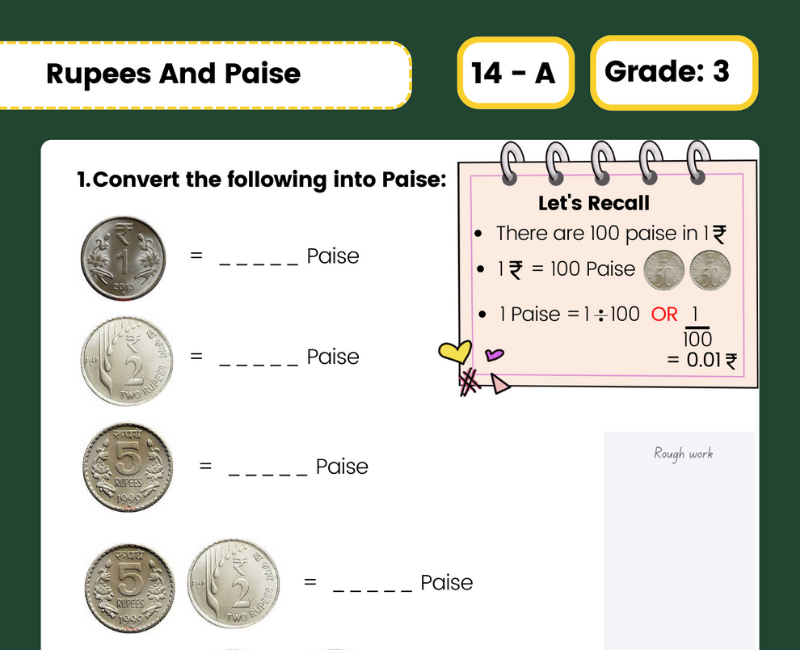
1 rupee = 100 paise. This is the most important rule in the rupees and paise chapter. 50 paise is half a rupee, because 50 is half of 100. Two coins of 50 paise make ₹1, and four coins of 25 paise make ₹1.
Changing rupees to paise
Multiply the number of rupees by 100. For example, ₹3 = 3 × 100 = 300 paise, ₹5 = 500 paise and ₹17 = 1,700 paise. Putting two zeros at the end of the number of rupees gives the same answer.
Changing paise to rupees
Count how many groups of 100 paise there are. 500 paise has five groups of 100, so it is ₹5. 700 paise = ₹7 and 1,000 paise = ₹10. When the paise are not a multiple of 100, such as 350 paise, write it as ₹3 and 50 paise.
Rupees and paise together
An amount can have both rupees and paise, such as ₹4 and 35 paise. Change the rupees into paise first, then add the paise: 4 × 100 = 400, and 400 + 35 = 435 paise. Be careful with small paise. ₹2 and 5 paise is 205 paise, not 25 paise.
Comparing amounts of money
To compare two amounts, change both to paise or both to rupees. Then compare the numbers. Is ₹3 more than 250 paise? ₹3 = 300 paise, and 300 is more than 250, so yes. Use the signs <, > and = to write the comparison.
Adding money
Write the amounts in columns with the ones, tens and hundreds lined up. Add the ones first and carry when a column makes 10 or more. For example, ₹245 + ₹178: ones 5 + 8 = 13, tens 4 + 7 + 1 = 12, hundreds 2 + 1 + 1 = 4. The total is ₹423. When you add paise, 130 paise is ₹1 and 30 paise.
Subtracting money
Subtracting money means taking an amount away. Write the larger amount on top, start with the ones and regroup when you need to. For example, ₹50 − ₹28 = ₹22. Subtraction helps you find how much money is left after you buy something.
What is change?
Change is the money the shopkeeper gives back when you pay more than the price. Change = money paid − price. If a notebook costs ₹45 and you pay ₹50, the change is ₹5. A good way to check is to count on from the price: ₹45 plus ₹5 makes ₹50.
Bills and total cost
A bill is a list of items with their prices. To find the total bill, add all the prices. For example, a bag for ₹245 and a book for ₹178 give a total bill of ₹423. Words such as total, in all and altogether tell you to add.
Money word problems
Read the story slowly and underline the numbers. Decide if you must add, subtract or find change. Write the number sentence, solve it and write the answer with the unit ₹ or paise. For example, Amit has ₹100 and buys a toy for ₹64, so 100 − 64 = ₹36 is left.
Solved examples
Common mistakes
| Mistake | Correction |
|---|---|
| Thinking ₹1 = 10 paise | ₹1 = 100 paise. Multiply by 100, not 10. |
| Writing ₹2 and 5 paise as 25 paise | ₹2 = 200 paise. Add 5 paise to get 205 paise. |
| Comparing rupees with paise without changing units | Change both amounts to paise first. Then compare. |
| Adding rupees and paise as plain numbers | Add rupees to rupees and paise to paise. Then regroup 100 paise as ₹1. |
| Forgetting the unit ₹ or paise in the answer | Always write the unit with the number. |
Money in daily life
We use money every day to pay bus fares, buy snacks, pay a shop bill and save in a piggy bank. Practising with real coins and notes, or with a play shop at home, helps children remember the value of money.
What your child learns in the Class 3 rupees and paise worksheets
- Identifying and counting coins and notes
- Knowing that ₹1 = 100 paise
- Changing rupees to paise and paise to rupees
- Comparing amounts of money
- Adding and subtracting rupees and paise
- Finding the total bill
- Making change
- Solving money word problems about buying and selling
Tips for parents and teachers
Set up a play shop at home with price tags and real or toy coins. Ask your child to pay an exact amount and then to work out the change. Say the rule aloud: “1 rupee is 100 paise.” Use the printable PDF worksheet for written practice and the online activities for quick revision. Revisit the common mistakes table when you see the same error twice.
Related Maths Worksheets
- Place Value Class 3 worksheet with online activities and quizRead 3 digit numbers
- Addition and Subtraction word problems for Class 3Practise story problems
- House of Hundreds II Class 3 worksheetNCERT Maths Mela practice
- Money addition and subtraction worksheet for Class 3Add and take away amounts
- Give and Take Class 3 worksheetsMore addition and subtraction
- Multiplication worksheets for Class 3Multiply to find totals
- Division Class 3 worksheet with online activities and quizShare money equally
- Data Handling Class 3 worksheet with online activities and quizRead and draw simple charts
- Perimeter and Area worksheet for Class 3Add side lengths
- Time worksheets for Class 3Hours and minutes
- Geometry Class 3 worksheet with online activities and quizShapes and their sides
- Fractions Class 3 worksheet with online activities and quizParts of a whole
Frequently Asked Questions
How many paise make 1 rupee?
100 paise make 1 rupee. So 1 rupee = 100 paise, and 50 paise is half a rupee.
How do I change rupees into paise?
Multiply the number of rupees by 100. For example, ₹3 = 3 × 100 = 300 paise and ₹17 = 1,700 paise.
How do I change paise into rupees?
Divide the paise by 100, or count the groups of 100 paise. For example, 500 paise = ₹5 and 700 paise = ₹7.
How do I write rupees and paise together?
Write the rupees first, then the paise, such as ₹4 and 35 paise. To change it to paise, turn the rupees into paise and add: 400 + 35 = 435 paise.
What is the sign for the rupee?
The rupee sign is ₹. We write it before the number, as in ₹25.
What coins and notes are used in India?
Common rupee coins are ₹1, ₹2, ₹5 and ₹10. Common notes are ₹10, ₹20, ₹50, ₹100 and ₹500. Paise coins such as 25 paise and 50 paise are rarely used in shops today.
How do I compare amounts of money?
Change both amounts to the same unit, paise or rupees. Then compare the numbers. For example, ₹3 = 300 paise, which is more than 250 paise.
How do I add rupees and paise?
Add the rupees to the rupees and the paise to the paise. If the paise make 100 or more, change 100 paise into ₹1 and add it to the rupees.
What is change in money?
Change is the money you get back when you pay more than the price. Change = money paid − price.
How do I find the total bill?
Add all the prices on the bill. Add the ones first and carry when a column makes 10 or more. Write the answer with the ₹ sign.
How do I solve a money word problem?
Read the story and underline the numbers. Decide whether to add, subtract or find change. Write the number sentence, solve it and write the answer with ₹ or paise.
What is included on this rupees and paise page for Class 3?
This page has a printable PDF worksheet on rupees and paise for Class 3, a 20-question online quiz and 15 online activities. The activities include counting coins and notes, paying exact amounts, changing rupees to paise, shop bills and making change.
 Download