CLASS 2 MATHS • THE LITTLE RUPEE MARKET
Indian Money Worksheets for Class 2
with Online Activities and Quiz
Count a wallet, build a bill and find the change. Explore Indian rupees and paise through playful shopping, colourful learning models and thinking challenges.
Build and Explore
Count money models, make exact payments and find change.
See Hear and Do
Exchange coins, compare wallets and build savings.
Think It Through
Choose within a budget, repair mistakes and explain different solutions.
Indian Money Class 2 Online Quiz
Question 1 / 20 • Easy
Which symbol represents the Indian rupee?
Read each value. Decide whether to count, add, subtract or compare.
Tap an answer to continue.
Quiz and listening guide
Try 10 easy, five average and five thinking questions. The 20-minute timer starts with the first answer or question-navigation action. Read-aloud alone does not start it. Answers advance except at the final question. Review using the question numbers. Submission or timeout shows every explanation. Restart clears answers and pauses the timer. Speech depends on the browser and available voices; all questions and instructions remain visible.
Five Indian Money Adventure Games
Tap the raised selector to choose a game. Each one has five challenges.
Count and Tap Wallet
Tap every listed piece once, then write the total in rupees.
Count all the money. Mark each piece and enter the total in rupees.
Read every denomination. Two 50-paise coins make ₹1.
Five Hands-On Online Indian Money Activities
Use a model, listen if you wish and explain how the money values combine.
Indian Money Reasoning and Extra Practice
Little Money Stories
Read the question and enter the answer in rupees.
A child has ₹12 and receives ₹8. What is the total?
Decide whether to add, subtract or compare. Include every item once.
Read each value. Decide whether to count, add, subtract or compare.
How the activity sets work
Five games, five activities and five extra-practice sets provide 75 tasks, separate from the quiz. Games and activities share one active main workspace. Extra practice is independent. Switching sets keeps progress while this page stays open. Use Reset options for one task or its whole set. Work in short sessions. Read-aloud, diagrams and practical suggestions are optional ways to explore the same idea.
Eight Money Tips for Children
- Read the value on each coin or note.
- Count the money value, not just the number of pieces.
- Group equal denominations to make counting easier.
- Remember that 100 paise equals ₹1.
- Add item costs to find a bill total.
- Subtract the bill from the amount paid to find change.
- Check that a chosen basket stays within its budget.
- Explain another way to make the same amount.
Five Tips for Parents and Teachers
- Begin with whole-rupee amounts before adding paise notation.
- Use supervised real examples or clearly labelled play money.
- Ask children to explain why fewer pieces can still be worth more.
- Offer pictures, optional reading aloud, role-play and tap controls as flexible participation choices.
- Use the pretend prices as maths examples; they are not current market prices.
Indian Money Worksheets for Class 2 Guide Examples and Reasoning Questions
Can three coins be worth more than five? How can ₹20 be paid in different ways? These Indian money worksheets for Class 2 connect rupees, paise, counting, addition and subtraction with everyday shopping. Use the printable worksheets available on this page together with the online activities to build, compare and explain amounts.
This is a general topic resource rather than a particular NCERT chapter. Most activities use whole rupees. A few supported tasks introduce 50 paise, writing rupees and paise, and the relationship 100 paise = ₹1. Choose practice that matches the child’s current classroom sequence.
Indian Rupees and Paise
India’s currency is the Indian rupee, written with the symbol ₹. One rupee equals one hundred paise. The amount ₹5 means five rupees. The amount ₹5.50 means five rupees and fifty paise. The two digits after the decimal point represent paise.
₹2.50 = 2 rupees and 50 paise.
₹2.05 = 2 rupees and 5 paise.
The zero matters. Fifty paise and five paise are different amounts.
Written paise amounts help explain money notation even when those individual coin denominations are not used. This page’s spendable coin models use 50 paise and whole-rupee denominations.
Recognising Indian Coins and Notes
Read the denomination, which is the value printed or marked on the money. The learning models here include ₹1, ₹2, ₹5, ₹10 and ₹20 coins, with a 50-paise example, and larger-value note models. ₹10 and ₹20 can also be encountered as banknotes.
These are simplified learning models, not reproductions of actual currency designs. Their colours and sizes are teaching choices. Real coins and notes can have different designs, so do not identify value from colour or size alone.
Currency Facts Checked against RBI Information
RBI’s currency guidance lists 50 paise and ₹1, ₹2, ₹5, ₹10 and ₹20 coins as legal tender. It also states that different officially minted ₹10 coin designs remain legal tender, including designs with or without the rupee symbol. A design difference alone does not change the denomination.
For adults checking current details, use the RBI currency questions and answers. This is a short teacher reference; the children’s activities focus on counting and using small amounts.
Counting Coins and Notes Worksheets
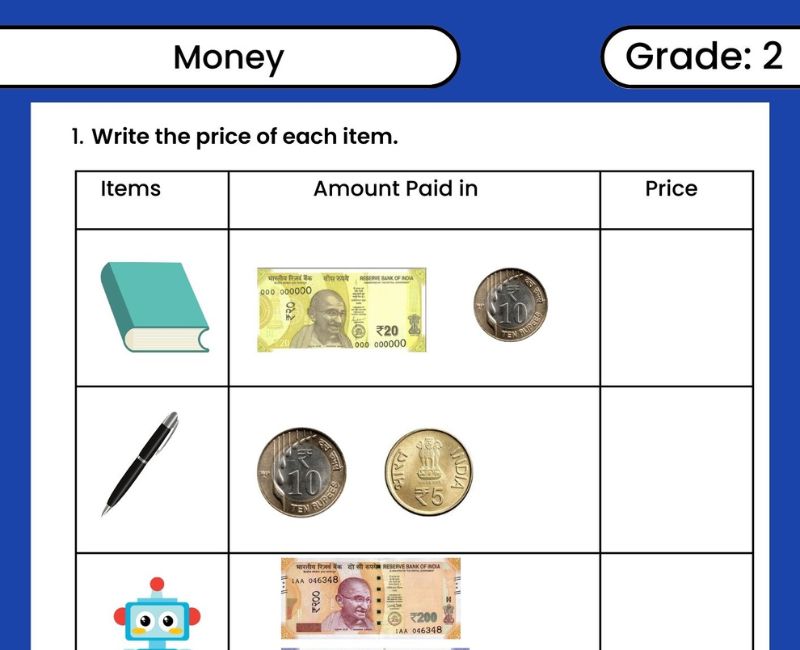
Add the value of every piece once. One ₹10 coin, one ₹5 coin and two ₹2 coins make ₹10 + ₹5 + ₹2 + ₹2 = ₹19. Four pieces of money do not mean four rupees.
When values repeat, group them. Three ₹5 coins total ₹15. Then add other denominations. Two ₹50 notes and one ₹10 coin total ₹110. The count-and-tap game highlights each listed piece as it is counted to help avoid missing or double-counting pieces.
Making the Same Amount in Different Ways
₹10 can be made with one ₹10 coin, two ₹5 coins, five ₹2 coins or ten ₹1 coins. Each collection has the same total value but a different number of pieces. The exact-payment activity accepts different combinations of its available denominations.
₹10 + ₹5 + ₹2 = ₹17.
₹5 + ₹5 + ₹5 + ₹2 = ₹17.
Both are valid exact payments.
Adding Money and Making a Bill
A bill adds the cost of all selected items, including repeated items. If one pencil costs ₹3, two pencils cost ₹6. Add a ₹5 eraser and the bill becomes ₹11. The bill-building game shows quantity, unit price and line total together.
Two pencils at ₹3 each = ₹6.
One eraser at ₹5 = ₹5.
Total cost = ₹6 + ₹5 = ₹11.
All shop prices on this page are pretend classroom prices. They are used for maths practice and do not claim to reflect current shop prices.
Finding Change Word Problems
Change is the amount returned when a customer pays more than the bill. Calculate amount paid − total cost. If a toy costs ₹13 and the customer pays ₹20, the change is ₹7. Check by adding the cost and change: ₹13 + ₹7 = ₹20.
Cost ₹13
Paid ₹20
Change ₹7
Check ₹13 + ₹7 = ₹20
Pretend prices for maths practice
Do not add the cost to the payment to find change. If payment exactly matches the bill, the change is zero. If payment is less than the bill, more money is needed rather than ordinary positive change being returned.
Money Word Problems for Class 2 with Solutions
A child has ₹12 and receives ₹8 more. The new total is ₹12 + ₹8 = ₹20.
A child has ₹30 and spends ₹18. The amount left is ₹30 − ₹18 = ₹12.
A book costs ₹27. A customer pays ₹50. The change is ₹50 − ₹27 = ₹23.
One wallet holds ₹24 and another holds ₹17. The difference is ₹24 − ₹17 = ₹7.
Read what the story asks. A total, an amount remaining, a difference and change are related but different questions.
Rupees to Paise Questions
Use 100 paise = ₹1. Two rupees equal 200 paise, and five rupees equal 500 paise. For three rupees and fifty paise, combine 300 paise and 50 paise to get 350 paise.
When writing in rupees, 250 paise is ₹2.50. This means two complete groups of 100 paise and fifty paise left. The practice tasks state whether the answer should be entered in rupees or paise.
Budget Activities for Class 2
A budget is the amount available to spend in the activity. “Within budget” means the total cost does not exceed that amount. Spending exactly the budget is allowed unless the question asks for money to remain.
With a ₹10 budget, an item costing ₹3 and another costing ₹5 total ₹8, leaving ₹2. An item costing ₹3 and another costing ₹7 total ₹10, leaving zero. Both pairs are within budget. The open shopping puzzles accept every pair meeting the stated conditions.
Coin Exchanges and Savings
Exchanging one value for equal-value smaller pieces does not create more money. Exchanging ₹10 for five ₹2 coins keeps the value at ₹10. In the exchange activity, the amount still held by the exchange bank plus the coins collected always equals the starting amount.
Savings activities add equal deposits to a starting amount. Starting with ₹5 and adding ₹2 three times gives ₹5 + ₹2 + ₹2 + ₹2 = ₹11. Count deposits as well as the final value.
Money Reasoning Questions with Answers
-
Are five coins always worth more than three?
No. Five ₹1 coins total ₹5, while three ₹5 coins total ₹15. Compare values rather than the number of pieces.
-
Does changing one ₹10 coin into two ₹5 coins increase the amount?
No. The number of pieces increases, but the value stays ₹10.
-
Can two different baskets stay within the same budget?
Yes. More than one combination can satisfy a spending limit. Check the total and the conditions.
-
How can we check change?
Add the bill and the change. Their sum should equal the amount paid.
-
Are 50 paise and ₹50 equal?
No. Fifty paise is half a rupee, written ₹0.50. Fifty rupees is much greater.
Learning with Pictures Listening and Shopping Role-Play
Children can view money models, hear a question, tap denominations, act as shopkeeper or customer, and explain a solution with drawings or supervised real examples. These are flexible ways to participate rather than fixed learning-style labels. Every instruction remains visible if browser speech is unavailable.
Try a pretend classroom shop with clearly marked prices. Ask one child to build a bill and another to check the payment and change. Use play money and avoid sharing personal payment details or real account information.
Using Printable Money Worksheets with Online Activities
Count a model collection, record its value, then find another way to make the same amount. Combine a few written sums with an untimed activity. Use quiz explanations to discuss why a method works and revisit a model when an error needs attention.
More Class 2 Maths Practice
Frequently Asked Questions
What do Indian money worksheets for Class 2 cover?
Counting coins and notes, making amounts, addition, bills, change, budgets, savings and simple rupees-and-paise relationships.
How many paise make one rupee?
One hundred paise make one rupee. Fifty paise is ₹0.50, and two 50-paise coins make ₹1.
How should children count mixed coins and notes?
Read each denomination, group equal values if helpful and add every piece once. Do not confuse the number of pieces with the total value.
Can the same amount be made in different ways?
Yes. ₹10 can be made with one ₹10 coin, two ₹5 coins or five ₹2 coins. Exact-payment tasks accept different valid combinations.
How do children calculate change?
Subtract the bill total from the amount paid. Check by adding the cost and change to recover the payment.
How is a bill calculated when an item is bought twice?
Multiply or repeatedly add its unit price for the quantity, then add all line totals. Two ₹3 pencils and a ₹5 eraser cost ₹11.
What does within budget mean?
The total cost is less than or equal to the available amount. The budget puzzles state any extra rules.
Are ₹20 coins and different ₹10 coin designs valid?
RBI currency guidance lists ₹20 coins as legal tender and confirms that officially minted ₹10 coins of different designs remain legal tender. Check the linked RBI reference for current currency details.
Are the money pictures exact currency designs?
No. They are clearly labelled learning models. Read their values; real currency colours, sizes and designs can differ.
Are the shopping prices current market prices?
No. All item prices are invented classroom examples for practising money calculations.
Can children hear the questions and use tap controls?
Yes, when browser speech is available. Text remains visible. Activities use tapping, typing and buttons without requiring dragging.
Is this a particular NCERT chapter worksheet?
No. It is a general Indian money resource. Choose tasks that match the child’s current school sequence.
 Download