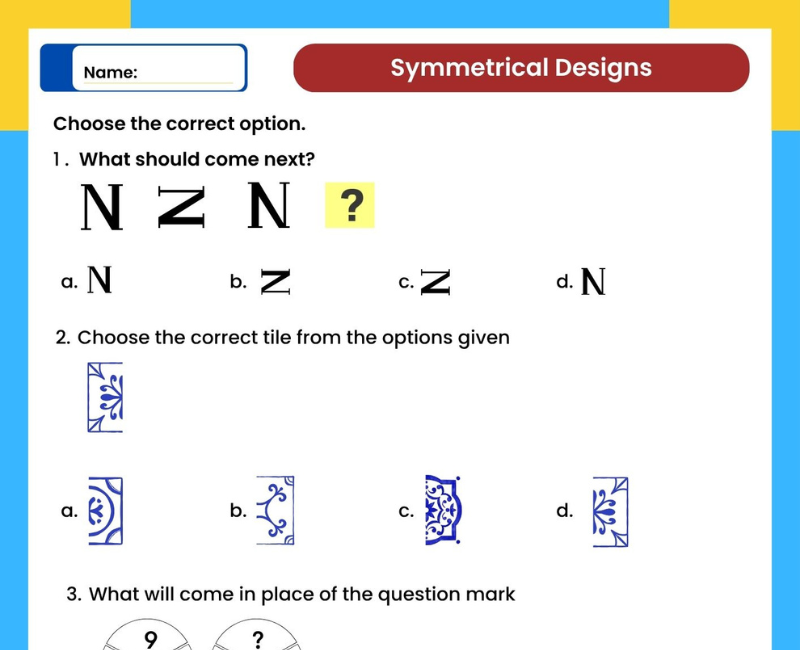
Are your students struggling to grasp the foundational concepts of patterns and geometry, or are you looking for engaging resources to elevate your classroom math lessons? Look no further than NCERT Class 5 Maths Chapter 10, titled "Symmetrical Designs."
This essential chapter transforms abstract geometric orientations into a vibrant, hands-on creative journey based on alphabet cutouts and rotating windmill patterns
Whether you are actively compiling a comprehensive CBSE Class 5 math worksheet for daily practice or searching for high-quality Class 5 maths worksheets with answer keys to make independent tracking entirely seamless, this chapter provides the perfect operational blueprint. By exploring how letters like 'A' and 'H' are systematically folded, cut, and mirrored, young learners intuitively master lines of symmetry and rotational turns
Mastering primary grade geometry requires structured, high-quality practice materials that align perfectly with national learning objectives. NCERT Class 5 Maths emphasizes deep conceptual visualization over rote learning, especially when exploring spatial movements, shapes, and complex patterns.
Utilizing a dedicated Maths Mela Class 5 worksheet, students can dive headfirst into the interactive world of NCERT Class 5 Maths Chapter 10: "Symmetrical Designs"
This chapter uniquely introduces two core areas of spatial mathematics: reflection symmetry (lines of symmetry) and rotational symmetry (turns)
As students advance through the curriculum, their practice needs to progress from simple mirror reflections to exploring symmetry across alphabet letters, numbers, and historical block prints
For instance, worksheet problems present letters such as E, N, X, T, K, V, and O, prompting students to systematically classify which ones possess vertical lines of symmetry, horizontal lines of symmetry, or both
Furthermore, integrating Class 5 maths worksheets with answer charts allows children to independently check complex challenges, like identifying multi-digit symmetrical numbers (such as 11 or 1001) or determining how many times a traditional Rajasthani woodblock design repeats itself perfectly during a full rotation
 Download