CLASS 2 MATHS • THE GIVE AND TAKE STUDIO
Give and Take Class 2 Worksheets
Online Activities Games and Quiz
Pass a counter, reverse a change and discover what stays the same. Explore giving, receiving and missing amounts through colourful maths models and thinking challenges.
Give Receive Compare
Move counters between people, equalise their collections and track the correct viewpoint.
Act Out Each Change
Regroup blocks, record stock and build different collections with the same total.
Find Explain Repair
Recover missing starts, solve story sums and explain a robot’s mistake.
Give and Take Online Quiz for Class 2
Question 17 / 20 • Thinking • Answered 0/20
Optional audio controls
A child gives away 9 marbles and has 17 left. Which calculation finds the starting amount?
Tap an answer to continue.
Quiz and listening guide
Try 10 easy, five average and five thinking questions. The 20-minute timer starts with the first answer or question-navigation action. Read-aloud alone does not start it. Answers advance except at the final question. Review using the question numbers. Submission or timeout shows every explanation. Restart clears answers and pauses the timer. Speech depends on the browser and available voices; all questions and instructions remain visible.
Five Give and Take Discovery Games
Use the raised selector to choose a game. Each game has five different tasks.
Whose Amount Changes
Read the named person carefully before deciding whether their amount increases or decreases.
Choose the change for the person or collection named in each card.
Identify whose amount is being counted. A giver loses while the receiver gains.
Choose a category, then tap every card. Each card needs a category.
Five Give and Take Maths Activities
Follow changes in order and connect each action with its number sentence.
Missing Numbers Story Sums and Reasoning
Find the Starting Collection
Reverse the change to recover the amount before the story began.
Some counters receive 8 more and finish at 35. How many were there at first?
Reverse the change. Undo a gain by subtracting and undo a loss by adding.
Using these challenge sets
Five games, five model activities and five thinking sets provide 75 tasks, separate from the 20-question quiz. The games and model activities share the main workspace; extra practice stays independent. Choices and progress remain while the page stays open. Reset one task or its entire set using Reset options. Work through a few tasks at a time and explain the changes.
Eight Give and Take Habits
- Identify whose collection the question describes.
- Say whether that person gives or receives.
- Track what changes for the other person too.
- Find the total before and after a transfer.
- Separate the starting amount, the change and the final amount.
- Complete two events in the order stated.
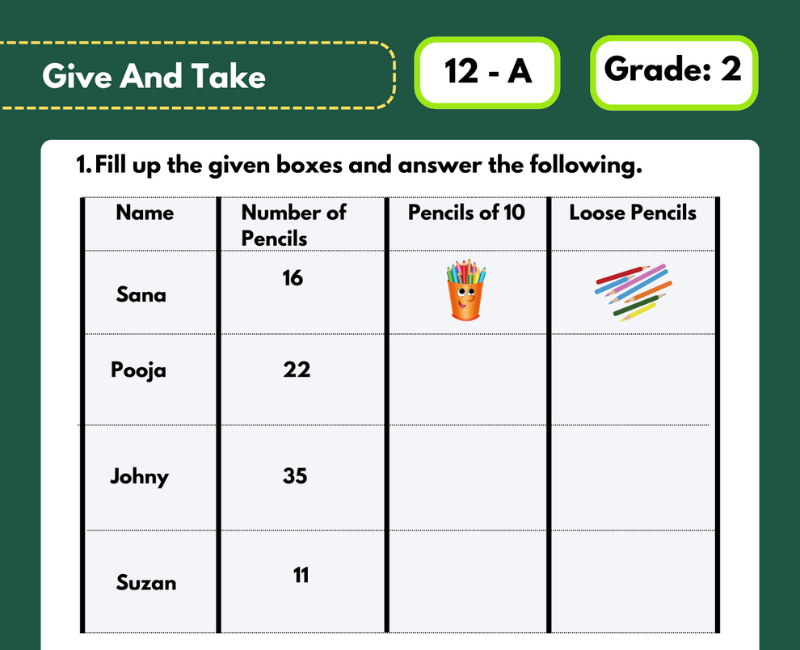
- Use tens and ones when an exchange is needed.
- Check a missing amount by putting it back into the story.
Practical Ideas for Adults
- Use two bowls and a small fixed collection of counters.
- Ask the child to describe the same transfer from each person’s viewpoint.
- Hide the starting collection and reveal the change and amount left.
- Represent ten loose counters with one labelled ten-card when regrouping.
- Offer visible models, optional listening, manipulation and discussion as flexible ways to explore the ideas.
Give and Take Class 2 Maths Explained with Examples Word Problems and Missing Numbers
When one child gives a counter to another, two amounts change. The giver has one fewer, the receiver has one more, and their combined collection stays the same if nothing is lost. These Give and Take Class 2 worksheets connect that simple event with addition, subtraction, missing-number sums and reasoning about totals.
Use the worksheet resource with these original online examples. The activities focus on understanding the situation before choosing an operation. They support topic practice without claiming to reproduce every exercise from a particular textbook edition.
What Does Give and Take Mean in Maths?
The operation depends on whose amount is being counted. If Asha gives Kabir five beads, Asha’s amount decreases by five while Kabir’s increases by five. Saying that the word “give” always means subtraction can therefore lead to an incorrect answer when the question asks about the receiver.
Begin by naming the person or collection. Then identify the starting amount, what changes and what must be found. A question may ask for the final amount, the number transferred or the amount present before the event.
Giving Receiving and the Combined Total
Asha has 24 counters and Kabir has 12. Asha gives Kabir six. Asha now has 24 − 6 = 18, while Kabir has 12 + 6 = 18. Their combined total remains 36.
The transfer games let children move a counter in either direction. Ask what happens to both collections after each tap. The total remains a useful check, but it does not identify each person’s amount on its own.
Making Two Collections Equal
For collections of 24 and 12, the initial difference is twelve. Moving one counter from the larger collection to the smaller reduces that difference by two: one amount falls and the other rises. Moving six counters makes both amounts eighteen.
This supported puzzle is different from simply removing twelve from the larger collection. The counters are being transferred to the other person. Model each move before using a shortcut, and check that the two final amounts match.
Give and Take Addition and Subtraction Examples
If a child has 27 counters and receives 18, the new amount is 27 + 18 = 45. The fifteen ones are represented as one ten and five ones; the exchanged ten belongs in the tens column.
For 44 − 18, four ones cannot supply eight ones. Represent forty-four as three tens and fourteen ones. Remove one ten and eight ones to leave two tens and six ones. The answer is 26.
An equal-value exchange changes the representation before the removal. It does not add ten to the starting amount. In the regrouping activities, the model must be changed as well as the answer entered.
Missing Number Sums for Class 2
A collection starts at 19 and finishes at 35 after receiving more. The missing change is 35 − 19 = 16. Check with 19 + 16 = 35.
The two parts of the bond are nineteen and sixteen, and the whole is thirty-five. A missing-number box can represent either part or the whole, so read its place in the number sentence carefully.
A child begins with 46 stickers and has 28 left after giving some away. The amount given is 46 − 28 = 18. Substituting gives 46 − 18 = 28.
Finding a Missing Starting Amount
Reverse the known change. If a child gives away eleven counters and has twenty-four left, put the eleven back: 24 + 11 = 35. If a child receives thirteen and finishes with forty-two, remove the thirteen received: 42 − 13 = 29.
The Reverse the Number Machine game makes the start adjustable. Its output changes as the proposed start changes. A correct start must produce the required finish after the stated operation.
Two-Step Give and Take Word Problems
A shelf has 28 books, receives 16 and lends 9. First calculate 28 + 16 = 44. Then calculate 44 − 9 = 35. There are 35 books on the shelf after both events.
A child has 47 stickers, gives away 18 and receives 12. After giving, 29 remain. After receiving, the collection becomes 29 + 12 = 41.
Record the intermediate amount instead of applying both changes to the original number separately. The journey activity requires the first event to be completed before the second begins.
Reading a Simple Stock Ledger
A ledger records changes to one named stock. A positive entry adds received items; a negative entry removes items given out. If a cupboard begins with 34 notebooks, receives 12 and gives out 9, its entries are +12 and −9. The intermediate stock is 46 and the final stock is 37.
The ledger activity applies one whole entry at a time. Read what the stock represents before calculating. A sale reduces a shop’s notebook stock even though the shop receives money; this page tracks the notebooks.
Two Collections with the Same Total
A total of 25 can be split into 10 and 15, 11 and 14, or many other positive pairs. Increasing one part by one and decreasing the other by one preserves the total.
The open activity asks for two distinct ordered pairs. The collection labels matter: collection A holding ten and B holding fifteen is a different ordered arrangement from A holding fifteen and B holding ten. A repeated saved arrangement does not count again.
Common Give and Take Mistakes
Following a keyword without identifying the person A giver’s amount decreases, but the receiver’s amount increases. Read the viewpoint first.
Adding again when undoing a receipt To find the starting amount before receiving, subtract the received amount from the finish.
Forgetting the intermediate amount The second event changes the result of the first event.
Changing the total during a transfer Moving counters between two collections preserves the combined total when none are added or lost.
Reasoning Questions with Answers
Does giving seven and later receiving seven change the final amount? No. These opposite changes cancel, provided both events can take place as stated.
Can two different splits have the same whole? Yes. The parts may change while their sum stays fixed.
Does a regrouping exchange make the collection larger? No. One ten and ten ones represent equal values.
Using Worksheets Models and Optional Audio
Try one short story with real counters, write its number sentence and check it by reversing the change. Then choose a related online task. Pictures, listening, tapping and explaining can be combined according to the child’s needs; they are not fixed learner categories.
Use the untimed games for exploration and the quiz review to discuss answers. Optional reading controls stay separate from the MCQ question card so the question and choices remain easy to see.
Related Class 2 Maths Worksheets
Frequently Asked Questions
What is Give and Take in Class 2 maths?
It connects giving, receiving and changing collections with addition, subtraction, missing amounts and word problems.
Does the word give always mean subtraction?
Identify whose amount is counted. Giving decreases the giver’s collection while increasing the receiver’s collection.
What stays the same when counters move between two people?
Their combined total stays the same if none are added or lost. Each individual amount changes.
How do children find a missing starting amount?
Undo the change. Add back an amount given away or subtract an amount received from the finishing amount.
How is a missing amount received calculated?
Subtract the starting amount from the final amount, then check by adding the change to the start.
How do you make two collections equal by transferring?
Move objects from the larger collection to the smaller and track both amounts. In the whole-number examples here, half their initial difference is transferred.
Why are tens and ones used in Give and Take?
They show the values behind carrying and borrowing. An exchange preserves the amount before any objects are removed.
How should two-step word problems be solved?
Calculate the amount after the first event, then apply the second event to that intermediate amount.
Can different pairs of collections have the same total?
Yes. The open activity accepts two distinct positive ordered pairs that match its target total.
Are the online questions copied from a textbook exercise?
No. They are original topic practice and do not claim to reproduce a complete exercise from any particular edition.
Where are the audio controls?
The quiz reading and Stop Reading buttons are in a separate audio box above the question card. Speech depends on the browser; the text stays visible.
When does the quiz timer start?
The first answer or question-navigation action starts it. Reading alone does not. Timer and End Quiz remain within the quiz section, and the active countdown continues when scrolling away.
 Download