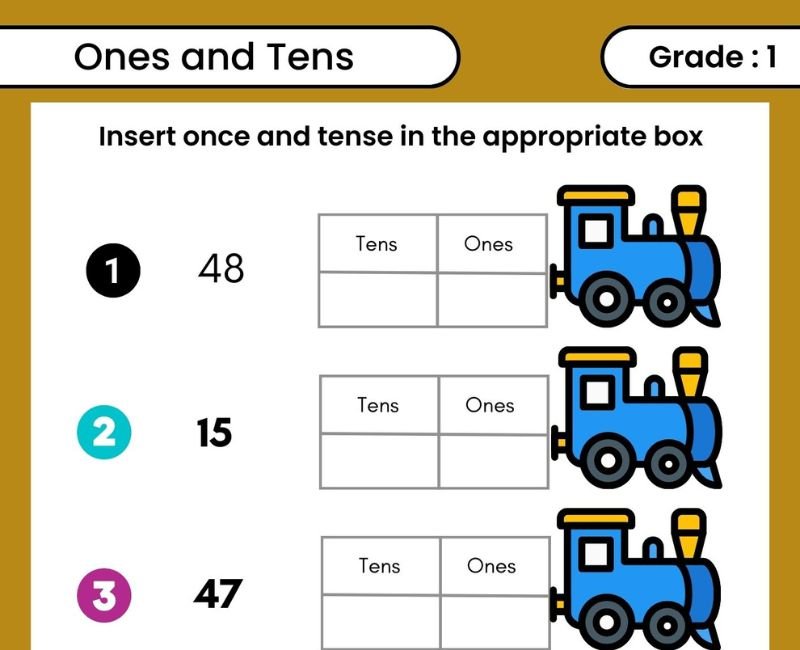
Tens and Ones Worksheet for Class 1
Help children understand two-digit numbers with this tens and ones worksheet for Class 1. Place value explains why a digit has a different value depending on its position. In 34, the digit 3 represents thirty and the digit 4 represents four.
This general Grade 1 maths resource supports practice with grouping, building numbers and identifying tens and ones. Use objects and drawings before moving to written answers. The original examples and questions with answers below provide additional activities alongside the worksheet available on this page.
One Ten Is a Group of Ten Ones
Place ten counters on a table and count them one by one. Put them together as one complete group. Explain that ten ones make one ten. The quantity stays the same when the counters are grouped.
Build twenty with two groups of ten, then add three loose counters to make twenty-three. Children can count ten, twenty, then twenty-one, twenty-two, twenty-three.
Use bundled sticks, base-ten blocks or drawn groups. Make sure every group contains exactly ten objects so the representation matches the number.
Read a Tens and Ones Place Value Chart
For a two-digit whole number, the left digit is in the tens place and the right digit is in the ones place. Read the positions and the complete number together.
| Number | Tens | Ones |
|---|---|---|
| 24 | 2 | 4 |
| 57 | 5 | 7 |
| 80 | 8 | 0 |
In 57, there are five tens and seven ones. Five tens have a value of fifty, so the number is fifty-seven.
Build Numbers and Write Expanded Form
Ask children to build four tens and six ones. Four tens make forty, and six more make forty-six. Write 46 = 40 + 6 to connect the grouped objects with expanded form.
Try the task in reverse. Show the numeral 32 and ask the child to make three groups of ten and two loose ones. Then write 32 = 30 + 2.
Keep the distinction clear: in 46, the tens digit is 4, but its place value is 40. The digit tells how many tens there are; the place value tells the amount those tens represent.
Understand Zero and Reversed Digits
In 70, there are seven tens and zero ones in its usual tens-and-ones representation. Build seven complete groups of ten with no loose counters. Zero shows that there are no extra ones.
Compare 26 and 62. Twenty-six has two tens and six ones; sixty-two has six tens and two ones. The digits are the same, but their positions change their values.
If a child reverses digits, rebuild both numbers with objects. Ask which collection matches the intended number instead of relying only on a handwriting correction.
A Hands-On Place Value Activity
Make two labelled spaces: Tens and Ones. Give the child a number card, such as 35. Place three bundles of ten in the Tens space and five loose counters in the Ones space.
Ask the child to read the number, explain the groups and write 35 = 30 + 5. Change the card and repeat with a manageable number.
For an extra challenge, add one counter to a collection with nine loose ones. Regroup the resulting ten ones as another ten. This shows why 29 becomes 30 when one is added.
Original Place Value Practice with Answers
Use these additional questions orally or in a notebook.
- Three tens and four ones make ______.
- Write the tens and ones in 58.
- What is the tens digit in 72?
- What is the place value of 7 in 72?
- What is the ones digit in 46?
- Complete: 63 = 60 + ______.
- Five tens and zero ones make ______.
- Complete: 20 + 9 = ______.
- Do 24 and 42 have the same value?
- How many ones make one ten?
- Write 81 in expanded form.
- Two tens and nine ones gain one more one. What number is formed?
Show Practice Answers
1. 34
2. 5 tens and 8 ones
3. 7
4. 70
5. 6
6. 3
7. 50
8. 29
9. No
10. 10
11. 80 + 1
12. 30
How to Use This Class 1 Place Value Worksheet
Use the worksheet download option on this page for written practice. Read each instruction aloud when needed and check whether it asks for a digit, its value or the complete number.
Begin with objects, move to drawings and then use a place value chart. Ask children to explain each representation. Short practice sessions with several different examples can reveal whether they understand the groups.
The answers above apply to the original questions on this page. Answers to the downloadable worksheet depend on its actual questions and pictures.
Related General Class 1 Maths Worksheets
Before and After Numbers WorksheetPractise number order and neighbouring numbers. Numbers 1 to 20 Worksheet
Build counting and number recognition skills. Comparing Numbers Worksheets
Compare numbers using tens and ones. Browse All Class 1 Maths Worksheets
Find general topic resources and separately labelled textbook worksheets.
Tens and Ones FAQs
What are tens and ones?
One ten is a group of ten ones. In 34, there are three tens and four ones.
How do I teach place value to Class 1?
Group objects into tens, keep the extra ones separate and connect the collection with a numeral and place value chart.
What is the difference between a digit and its place value?
In 53, the tens digit is 5 and its place value is 50.
What does zero mean in 40?
Forty has four tens and zero extra ones in its usual tens-and-ones representation.
What is expanded form?
Expanded form separates a number into its place values. For example, 67 = 60 + 7.
Why are 36 and 63 different?
The positions change. Thirty-six has three tens and six ones; sixty-three has six tens and three ones.
Can nine ones and one more make a ten?
Yes. Ten ones can be grouped as one ten without changing the total quantity.
Are practice answers provided?
Yes. Expand Show Practice Answers to check the twelve original questions on this page.
 Download