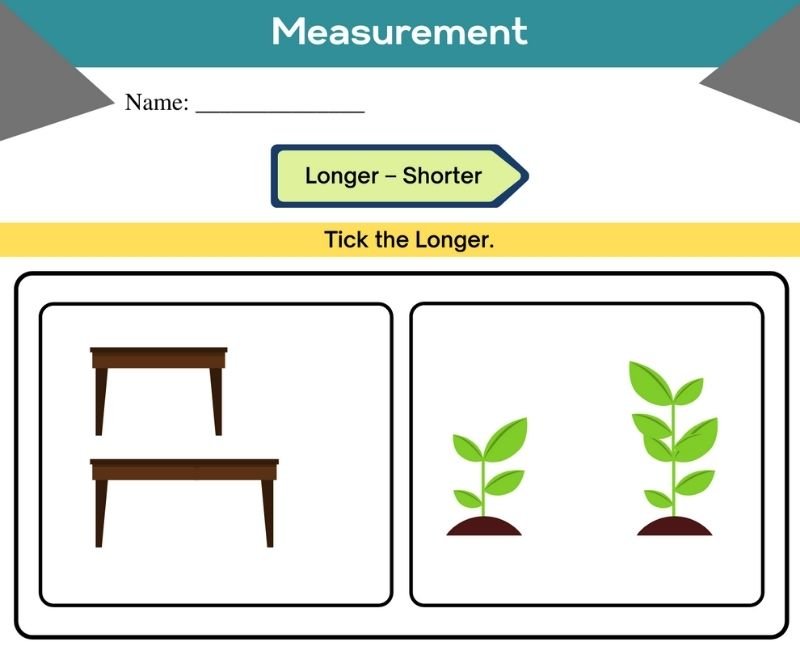
Measurement Makers: Compare, Build and Test! ⚖️🫗
Explore a measurement online quiz, 10 interactive games and activities, and five practice sets. Align strips, lay measuring blocks, balance a parcel and fill containers.
📝 Measurement Online Quiz for Class 1
Question 1 of 20 • Answered: 0/20
Both strips start at the same line. Which strip is longer?
🎮 Measurement Online Games for Class 1
Align starting points, build a unit row, match tower heights, balance a mystery parcel and explore full and half full.
1. ↔️ Align the Ribbon Starts
Move the green ribbon until its left end lines up with the purple ribbon. Then record which ribbon is longer.
Ready to play!
2. 🚃 Build the Measuring Row
Lay equal blue blocks under the strip. Cover its exact length from the starting line without extending past it. Record the count.
Ready to play!
3. 🏗️ Match the Tower Height
The left tower has six blocks. Add or remove identical blocks on the right until both towers have equal height.
Ready to play!
4. 📦 Balance the Mystery Parcel
Add equal weight blocks to the right pan until the balance is level. The hidden parcel weight is fixed in this model.
Weight blocks added: 0
Ready to play!
5. 🫗 Half-Full and Full Station
This model vessel holds six equal cupfuls. First make it half full; then fill it completely.
Make it half full. Cupfuls added: 0
Ready to play!
🧠 Length, Weight and Capacity Online Activities
Repair gaps, test container capacities, sort measurement questions, compare unit sizes and construct a nine-unit bridge.
6. 🔧 Repair the Gapped Measure
Five equal blocks have gaps between them. Close the gaps so the blocks touch, then record the strip’s length.
Ready to play!
7. 🥤 Test the Container Capacities
Fill both containers with the same cup unit. Stop at full, then choose the container with greater capacity.
Cupfuls poured • Tall: 0 • Wide: 0
Ready to play!
8. 🏷️ Sort the Measurement Missions
Choose a mission, then the feature you would measure.
Ready to play!
9. 🔍 Small Units, Large Units
Measure the SAME strip using small units and then large units. Count the units in each displayed row.
Ready to play!
10. 🌉 Build a Nine-Unit Bridge
Choose THREE different planks whose lengths total nine equal units. Several sets work. Tap a selected plank to remove it.
Ready to play!
✏️ Measurement and Comparison Practice
1. 📏 Read a Unit Measurement
The yellow strip exactly matches this row of touching equal blocks. Record its length.
Ready to explore.
2. ↕️ Compare Tower Heights
Both towers use identical blocks and share a base. Record how many blocks taller the left tower is.
Ready to explore.
3. 🧠 Arrange a Fair Measuring Method
Tap the three cards in a sensible measuring order.
Ready to explore.
4. 🫙 Compare Capacity and Contents
This model vessel holds eight cupfuls when full and contains three now. Record both quantities.
Ready to explore.
5. 📝 Make a Measurement Plan
Choose an object and a feature to explore. Create a plan, then check it with suitable real objects and adult support. This plan is not marked right or wrong.
Ready to explore.
💡 Measurement Learning Tips
👩🏫 Five Parent and Teacher Tips
- Name the feature being compared: length, height, weight or capacity.
- Align starting ends or base levels for direct comparisons.
- Use equal units without gaps or overlaps.
- Separate predictions from measurements checked with suitable tools.
- Use the same cup and filling level for capacity comparisons.
🌟 Six Tips for Students
- Say what you are measuring.
- Check where the object starts and ends.
- Choose units of the same size.
- Place units end to end, touching without overlapping.
- Record the number and the unit.
- Use a test when appearance alone is not enough.
📄 Measurement Worksheet for Class 1
📖 Read the Measurement Worksheet Learning Guide
📏 Compare one feature at a time
A measurement worksheet for Class 1 introduces ways to compare length, height, weight and capacity. Begin with familiar objects and precise words: longer, shorter, taller, heavier, lighter, holds more and holds less. The word bigger can hide the feature being discussed. An object may be longer without being heavier, so ask children to name what they are comparing and explain their evidence.
🧱 Align objects and repeat equal units
For a direct length comparison, line up one end of each object and inspect the other ends. Towers need a common base level when comparing their own heights. To measure with non-standard units, repeat identical blocks from one end to the other. Leave no gaps or overlaps. Count the units and record the unit name with the number. This connects the action of measuring with a meaningful written result.
🔍 Understand why unit size matters
Non-standard measurement uses familiar units such as blocks or handspans. A smaller unit must be repeated more times to cover the same length. Different people can record different handspan counts because their hands differ in size. Compare measurements made with the same unit, or consider the unit sizes before interpreting the numbers. When using a ruler, align the starting end with zero rather than assuming the ruler’s edge is the starting mark.
⚖️ Check weight and capacity
A simple equal-arm balance compares weight: the heavier side goes down and equal weights balance level in the model. Appearance alone does not settle which object is heavier. Capacity is how much a container can hold when full, rather than how much is inside now. Compare capacities using repeated full cupfuls from the same cup, filled to the same level. A shorter, wider vessel can hold more than a taller, narrower one.
🎮 Connect printable and interactive practice
Use the existing download option for the measurement worksheet PDF. The separate online quiz, games and practice sets provide fresh tasks for comparison, unit placement, capacity and reasoning. The interactive balances and vessels are simplified teaching models with stated unit relationships. Extend them with suitable real objects and adult-supported pouring or balance activities. Encourage children to predict, test, record and explain what they find.
💬 Measurement Worksheet FAQs
❓ How do I teach measurement to Class 1?
Start with direct comparisons of familiar objects. Name the attribute and use precise words before introducing repeated measuring units.
❓ What are non-standard units of measurement?
They are familiar units such as blocks or handspans, used instead of standard units such as centimetres. Consistent comparisons need units of the same size.
❓ Why must starting ends be aligned?
Different starting positions can make a shorter object appear to extend farther. Aligning one end helps compare the actual lengths.
❓ Why should measuring units have no gaps or overlaps?
Gaps leave some length unmeasured, while overlaps count some space more than once. Units should touch end to end.
❓ Why do smaller units give a larger count?
More small units are needed to cover the same length. Changing the unit changes the count, not the object’s length.
❓ How do children compare height fairly?
Place objects on the same base level and compare how far they extend upwards. A stand changes position without changing the height of the object itself.
❓ How does an equal-arm balance compare weight?
In the simple model, the heavier side goes down. A level balance indicates equal weights within the balance’s sensitivity.
❓ Is a bigger object always heavier?
No. Size and weight are different attributes. A comparison should be checked rather than decided only by appearance.
❓ What is capacity?
It is how much a container can hold when full. An empty container can still have a large capacity.
❓ Is the tallest container always the one that holds most?
No. Internal width and shape also matter. Compare capacities using the same measuring cup and filling level.
❓ How should a child start measuring with a ruler?
Align the starting end of a straight object with the zero mark and read the scale at the other end. Begin with simple examples and explain the unit intervals.
❓ Where are the PDF and online answers?
Use the existing page download option for the worksheet. Online quiz answers and explanations appear after End Quiz or timeout; games show their own feedback.
Choose a feature, measure fairly and explain your result.
Back to the Online Quiz ↑ Download