Shape Detectives! Look, Sort and Build 🔷
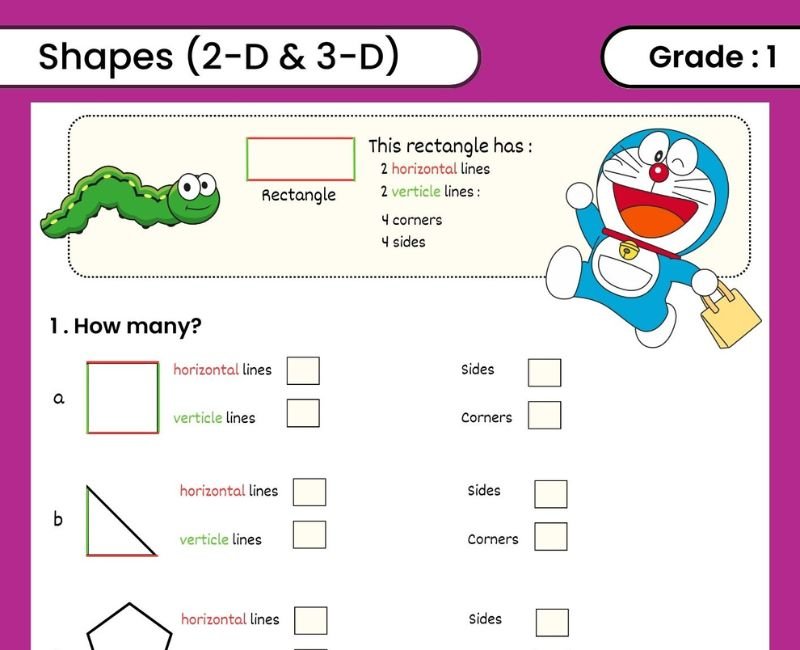
Explore this shapes worksheet for Class 1 with an online picture quiz, ten games and activities, and five practice sets. Identify 2D and 3D shapes, compare their features and build your own models.
📝 Shapes Online Quiz for Class 1
Question 1 of 20 • Answered 0/20
A painter cuts out this round label. Which flat shape is shown?
🎮 Shapes Online Games for Class 1
1. 🏛️ Sort the Museum Cards
Tap a picture card, then its shape family. Sort all six cards, including turned and smaller examples.
Ready to explore.
2. 🔎 Collect the Corner Marks
Tap every corner of the first outline, then check. Complete the next outline too. You can also Tab to a corner and press Enter.
Marked corners: 0
Ready to explore.
3. 📍 Build a Dot-Grid Triangle
Choose three different dots, then close your shape. The three dots must not lie on one straight line. Many triangles work.
Ready to explore.
4. 🃏 Shape Family Memory
Match three pairs by shape family. Colours, sizes and directions may differ. Reveal two cards at a time.
Ready to explore.
5. 🧵 Complete the Shape Ribbon
The ribbon repeats triangle, circle, square. Fill the next three spaces. Tap a shape, then a space.
Ready to explore.
🧠 2D and 3D Shapes Online Activities
6. 🧺 Sort Flat and Solid Models
Tap a picture, then place it in the flat-shape basket or solid-model basket. Sort all six.
Ready to explore.
7. 🔄 Turn the Marked Square
Turn the working square clockwise to match the target. Follow the red corner mark. Each button turn is 45 degrees.
Target
Your square
Ready to explore.
8. 🏠 Assemble a Shape House
Use a triangle roof, square wall, rectangular door and two circular windows. Tap a shape, then the house part.
Ready to explore.
9. 🔧 Repair the Solid Labels
The three solid-model labels are mixed up. Give each picture its correct name.
Ready to explore.
10. 🤖 Stamp a Shape Robot
Use exactly one square, one rectangle, one triangle and two circles. Choose a shape, then tap the board or use Add Selected Shape. The check counts parts; the layout is your choice.
Ready to explore.
✏️ Five Shapes Practice Sets
1. 🔎 Explore Shape Features
Choose a shape to view its model and a short description. This is open exploration.
Ready to explore.
2. ✍️ Trace a Triangle
Trace the guide using a black or red pen. Then compare your outline with the guide. Drawing is not automatically scored.
Ready to explore.
3. 🔢 Record a Corner Count
A maker needs a fastener at each corner of this rectangular panel. How many fasteners are needed?
Ready to explore.
4. 📦 Name the Box Face
Look at the highlighted front face of this long box. Write the name of that flat shape, not the whole solid.
Ready to explore.
5. 🤝 Find Shared Features
Select every statement that is true for BOTH the square and the long rectangle.
Ready to explore.
💡 Shape Learning Tips
Five Parent and Teacher Tips
Use clear models. Discuss features rather than colour alone. Turn shapes into different positions. Distinguish a solid from one of its faces. Ask children to explain their sorting decisions.
Six Tips for Students
Look at the whole shape. Check whether it is closed. Count straight sides. Point to corners. Decide whether it represents a flat shape or a solid. Explain your answer.
📄 Shapes Worksheet for Class 1
Read the 2D and 3D Shapes Learning Guide
Connect shape names with features
A shapes worksheet for Class 1 helps children recognise, compare and describe figures. Look at straight and curved boundaries and where sides meet. Colour and size can help organise a collection, but they do not determine the mathematical shape family.
Explore flat shapes
Circle, triangle, square, rectangle and oval are common 2D shapes for early practice. A triangle is closed and has three straight sides; its sides need not have the same length. When counting, mark a starting point so a side or corner is not counted twice.
Compare squares and rectangles
Squares and rectangles have four right-angle corners. A square also has four equal sides, so it is a special rectangle. Turning a shape changes its orientation, not its identity. Show different sizes and turned examples to build reliable recognition.
Distinguish solids and their faces
Cube, cuboid, sphere, cylinder and cone describe 3D forms. A flat face can have a 2D shape: a cube has square faces, while a cylinder has circular flat ends. A drawing represents a solid; a real solid has depth. Everyday objects usually resemble these ideal models approximately.
Build and explain
Sort with a clear rule, construct pictures from pieces and draw outlines. The online shape games provide different actions from the quiz. Use the existing download option for printable practice. The language selector translates this interactive section, not the downloaded PDF.
💬 Shapes Worksheet FAQs
How do I teach shapes to Class 1?
Use clear examples, explore their features and compare shapes in different sizes and orientations.
What are 2D shapes?
They are flat mathematical shapes with two dimensions, such as circles and triangles.
What are 3D shapes?
They have three dimensions and describe solid forms, such as cubes and spheres.
Can a triangle have sides of different lengths?
Yes. It must be closed and have three straight sides.
Is a square also a rectangle?
Yes. It has four right angles and also has four equal sides.
Is a turned square still a square?
Yes. Turning it does not change its sides or corners.
How many straight sides does a circle have?
None. It has a curved boundary and no corners.
What is the difference between a circle and a sphere?
A circle is flat; a sphere is a solid form.
How are cubes and cuboids related?
A cube is a special cuboid whose six faces are equal squares.
Why can a cylinder’s circular end look oval in a drawing?
The drawing shows it at an angle. The ideal flat face is circular.
How can children practise shapes at home?
Sort cards and describe the whole form of an object separately from the shapes of its faces.
Where are the worksheet and quiz answers?
Use the existing worksheet download option. End Quiz opens the online answer review.
 Download