Time Explorers: Set, Match and Plan! ⏰🌈
Try a time online quiz, 10 interactive games and activities, and five practice sets. Set clock hands, match time labels and put a story day in order.
📝 Time Online Quiz for Class 1
Question 1 of 20 • Answered: 0/20
Read the time on this clock.
🎮 Telling Time Online Games for Class 1
Set clocks, deliver matching time labels, order a timetable and explore half an hour.
1. 🔧 Set the Workshop Clock
Set 4:00 first, then 9:30. Changing the minutes also moves the hour hand to its correct position.
Set the clock to 4:00.
Ready to play!
2. 📮 Deliver Digital Time Labels
Choose a clock envelope, then deliver its matching digital label. Match all three.
Ready to play!
3. 🎟️ Order the Morning Tickets
In this story morning: snack is at 10:00, art at 10:30 and story time at 11:00. Tap the tickets from earliest to latest.
No tickets placed
Ready to play!
4. 🚂 Half-Hour Station Journey
The clock starts at 8:00. Advance to the first station at 8:30, check it, then reach the next station at 9:00.
Next station: 8:30
Ready to play!
5. 🌗 Watch Half an Hour Grow
Start at 7:00. Move forward in five-minute steps until the minute hand reaches 6. Record how many minutes have passed.
Five-minute steps taken: 0
Ready to play!
🧠 Time and Daily Routine Online Activities
Sort a story routine, repair an hour hand, build a half-hour schedule and solve a two-clue clock challenge.
6. 🌅 Sort a Story Day
Sort these events in a simple sunrise-to-night story. This is a story timetable, not a rule for every family.
Ready to play!
7. 🛠️ Repair Half Past Two
The target is 2:30. The minute hand is already correct at 6. Move the hour hand halfway between 2 and 3.
Ready to play!
8. 🧩 Build the After-Noon Schedule
Begin at noon, 12:00. Place the next three labels in order, moving forward thirty minutes each time.
Start: 12:00 noon
Ready to play!
9. 🕰️ Line Up the Morning Clocks
All three clocks show times on the same morning. Tap them from earliest to latest.
No clocks placed
Ready to play!
10. 🔐 Solve Two Time Clues
Show a time later than 3:00 and earlier than 5:00 on the same afternoon. Use whole-hour or half-hour times. Several answers work.
Ready to play!
✏️ Clock Reading and Time Practice
1. 🔎 Explore O’clock and Half Past
Choose an hour and minute label. Notice how both hands change.
1:00 • o’clock
Ready to explore.
2. ✏️ Read Two Fresh Clocks
Read one clock at a time and enter its hour and minutes.
Clock 1 of 2
Ready to explore.
3. 🧠 Build a Time Phrase
The minute hand is at 6 and the hour hand is halfway between 9 and 10. Tap three word cards to name the time.
Ready to explore.
4. 🌞 Same Clock, Different Context
This clock shows 7:30. Explore two possible stories with the same hand positions.
Choose a story context.
Ready to explore.
5. 🎨 Make Your Own Routine Card
Choose an activity, a clock time and a part of the day. This personal routine card is not marked right or wrong.
Ready to explore.
💡 Learning to Tell the Time
👩🏫 Five Parent and Teacher Tips
- Connect time language with events in the child’s own routine.
- Identify the hour and minute hands before reading a clock.
- Begin with whole hours, then introduce half past.
- Move the hour hand between numbers at half past.
- Specify the part of the day when comparing twelve-hour times.
🌟 Six Tips for Students
- Find the shorter hour hand.
- Find the longer minute hand.
- At o’clock, check that the minute hand points to twelve.
- At half past, notice the hour hand between two numbers.
- Read the whole digital label, including its minutes.
- Use the story to decide morning, afternoon, evening or night.
📄 Time Worksheet for Class 1
📖 Read the Time Worksheet Learning Guide
🌅 Connect time with daily events
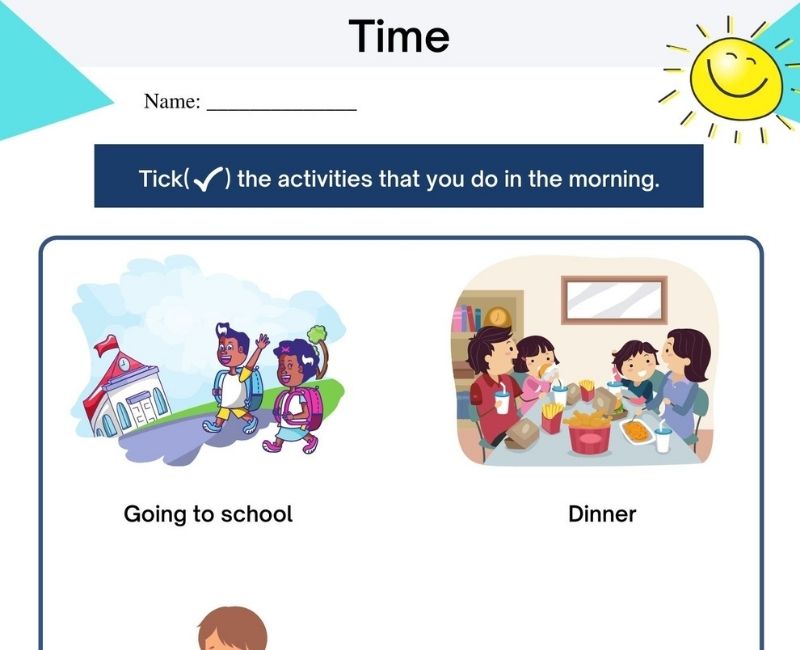
A time worksheet for Class 1 helps children connect clock labels with familiar events and their order. Begin with first, next, before and after. Let children describe their own routine rather than assuming every household follows an identical schedule. Morning, afternoon, evening and night provide useful context when talking about a day.
🕒 Identify the clock hands
An analogue teaching clock uses a numbered face and hands. In these activities, the shorter blue hand shows the hour and the longer orange hand shows the minutes. Colours are a learning aid; real clocks use different designs. Read the hands by their roles and lengths as well as colour. A digital clock records the hour and minutes with digits separated by a colon.
⏰ Read o’clock and half past
For an o’clock time, the minute hand points to twelve and the hour hand points to its hour number. Half past means thirty minutes after an hour. The minute hand reaches six, halfway around the face, while the hour hand moves halfway towards the next hour number. At 4:30, for example, the hour hand belongs between four and five rather than exactly on four.
↔️ Compare times with clear context
Telling time activities should distinguish reading a clock from deciding when an event happens. The same hand positions can occur twice in a day. When comparing times, state that the events belong to the same morning or afternoon, or supply another clear context. Follow the complete hour-and-minute label rather than comparing only the digits after the colon. Two half-hour periods together make one hour.
🎮 Practise with clocks and paper
Use the existing download option for the time worksheet PDF. The separate online quiz and interactive clock games provide fresh examples for matching, setting hands, ordering events and reasoning. Introduce a few whole-hour examples before moving to half past. Ask children to explain how both hands support their answer. Paper clock models and short routine stories extend this practice away from the screen.
💬 Time Worksheet FAQs
❓ How do I teach time to a Class 1 child?
Begin with daily events and their order. Introduce the clock face and the two main hands, then practise whole hours before half past.
❓ Which hand shows the hour?
On these teaching clocks, the shorter blue hand shows the hour. Real clocks may use other colours or designs.
❓ Which hand shows the minutes?
The longer orange hand shows the minutes on these models. Identify its role and length rather than relying only on its colour.
❓ What does o’clock mean?
It names an exact whole hour. The minute hand points to twelve, and the hour hand points to the hour number.
❓ What does half past mean?
It means thirty minutes after the named hour. The minute hand points to six and the hour hand is halfway towards the next hour.
❓ Why is the minute hand at six for half past?
One complete turn represents sixty minutes. Half a turn represents thirty minutes and reaches six on the clock face.
❓ Where does the hour hand go at half past?
It goes halfway between the hour just passed and the next hour. It should not remain exactly on the earlier hour number.
❓ What is the difference between analogue and digital time?
An analogue clock shows time with hands on a clock face. A digital clock shows the hour and minutes as digits, such as 4:00 or 4:30.
❓ Can a clock face alone tell morning from evening?
A usual twelve-hour clock face cannot. The same hand positions occur twice in a day, so the routine, words or other information supply the context.
❓ How do children compare two times?
Use a clear context, such as the same morning. Compare the hour and then the minutes, and place the events in order.
❓ Should every child use the same daily timetable?
No. Families and school schedules vary. Use a stated story timetable for a marked task and let children describe their own routines in personal activities.
❓ Where are the PDF and online quiz answers?
Use the existing page download option for the worksheet. Online answers and explanations appear after End Quiz or timeout; games provide their own feedback.
Read both hands, connect the time and explain your thinking.
Back to the Online Quiz ↑ Download