Addition Adventure: Join, Jump and Discover! 🌈
Explore these addition worksheets for Class 1 with an online quiz, ten interactive games and activities, and five practice sets. Colour sums, hop along a number line, complete number bonds and build addition stories.
📝 Addition Online Quiz for Class 1
Question 12 of 20 • Answered: 0/20
9 + 1 makes 10
To solve 9 + 7 by making ten first, how should seven be split?
🎮 Addition Online Games for Class 1
Colour a sum mosaic, plan a five-hop journey, discover number partners, assemble a story equation and balance equal totals.
1. 🎨 Colour the Sum Mosaic
Choose a colour key, then tap the sum tiles with that total. Key: 4 = Mint, 6 = Lavender, 8 = Peach. Colour every tile.
Ready to play!
2. 🐸 Plan a Five-Hop Journey
Start at eight. Reach seventeen in exactly FIVE hops using only +1 and +2. Different hop orders can work.
Hops used: 0 of 5 • Current number: 8
Ready to play!
3. 🌉 Discover Three Eleven-Partners
Find three different pairs of whole numbers that add to eleven. Reversing a saved pair is the same pair. Zero is allowed.
Ready to play!
4. 🐚 Assemble the Shell Story
A box contains nine shells. Six more shells are added. Tap the number cards in this order: starting group, added group, total.
□ + □ = □
Ready to play!
5. ⚖️ Match the Two Addition Bars
The top bar represents 4 + 9. The lower bar starts with eight units. Add the missing units so both bars have equal total length.
Ready to play!
🧠 Addition Online Activities for Class 1
Complete a sum grid, make ten, load a target train, deliver sum cards and repair calculation mistakes.
6. 🧩 Complete the Addition Grid
Fill the two empty cells. Each row must total its right-hand target, and each column must total its bottom target.
Ready to play!
7. 🔟 Move One Group to Make Ten
There are nine counters in the first group and four in the second. Transfer counters until the first group has exactly ten. Record the final total without adding or removing counters.
First group: 9 • Second group: 4
Ready to play!
8. 🚂 Load Three Tickets to Make Twenty
Choose exactly THREE different number tickets whose total is twenty. Several sets work. Tap a selected ticket to unload it.
Tickets: • Total: 0
Ready to play!
9. 📮 Deliver the Sum Cards
Choose a sum card, then send it to the mailbox showing its total.
Ready to play!
10. 🔧 Repair the Addition Machine
The machine’s totals are incorrect. Replace each total and check all three sums.
2 + 9 = □
13 + 4 = □
15 + 3 = □
Ready to play!
✏️ Addition Practice with Pictures and Number Facts
1. 🟣 Read a Picture Sum
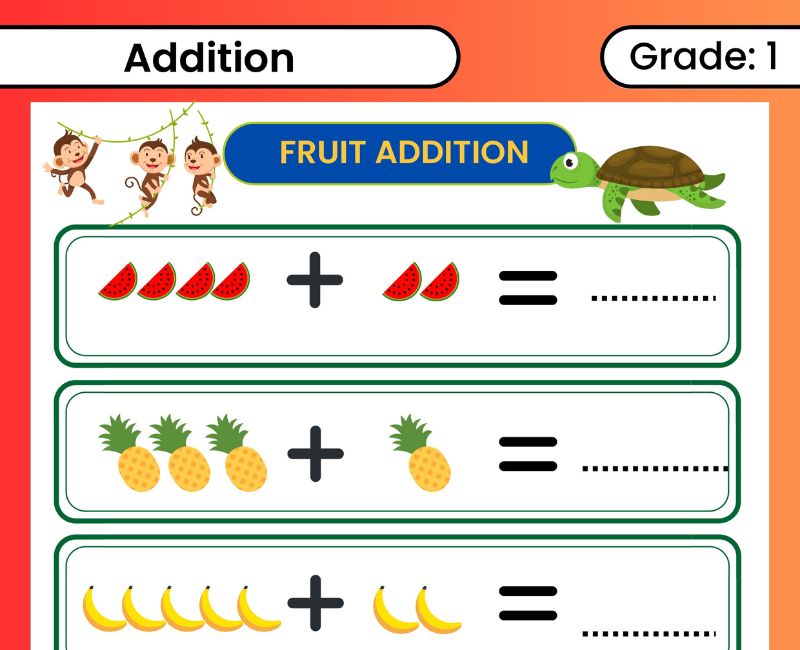
Count the purple and green groups and record their combined total.
Ready to explore.
2. 👯 Use a Double to Find a Near Double
Three plus three is six. One more counter is added to the second group. Find the new total for 3 + 4.
Ready to explore.
3. 🧩 Find Two Missing Addends
Complete each equation and check that both sides have equal value.
12 + □ = 20
□ + 6 = 19
Ready to explore.
4. 🧠 Plan a Counting-On Method
Tap the three steps in a useful order.
Ready to explore.
5. ✨ Create an Addition Model
Choose two groups from zero to ten. Create the model and explain the matching addition sentence. This exploration is not graded.
Ready to explore.
💡 Addition Learning Tips
👩🏫 Five Parent and Teacher Tips
- Connect each addend with a visible group.
- Move from counting all objects to counting on when appropriate.
- Use clear start points and count movements on number lines.
- Explore doubles and complete groups of ten with counters.
- Ask children to explain and check the complete equation.
🌟 Six Tips for Students
- Read both numbers and the plus sign.
- Identify which quantities are joining.
- Count each object once.
- Count extra steps after the starting number.
- Use a known fact or a full ten when it helps.
- Check that both sides of the equals sign have the same value.
📄 Addition Worksheets for Class 1
📖 Read the Addition Worksheets Learning Guide
➕ Connect addition with joining
Addition worksheets for Class 1 help children connect groups of objects with written number sentences. Begin with two separate quantities, join them and find how many there are altogether. Point to the two addends and the total as the child explains the action. The plus sign indicates addition, while the equals sign states that both sides have equal value.
🟣 Build understanding through pictures
Simple dots or counters can represent the groups without distracting detail. Children can count all objects at first, then keep one quantity in mind and count on for the other. Different drawings can model the same sum. Moving counters between the two groups can preserve the combined total when no counter is added or removed.
🐸 Count on with accurate jumps
On a number line, mark the starting quantity before making the additional moves. The starting point is not the first added step. When the child understands why the order of two addends can change without changing the total, starting with the larger addend can reduce the amount of counting needed. Ask the child to show both the moves and the landing number.
🧩 Use number relationships
Doubles, near doubles and pairs that complete ten can make addition more efficient. Adding zero leaves the quantity unchanged. A missing-addend question asks for the part needed to reach a stated total. Keep the whole equation visible, encourage children to test the proposed number and accept different valid strategies for the same calculation.
🎮 Combine printable and online practice
Use the existing page download option for the printable addition worksheets. The online quiz offers separate questions, while the games involve colouring, constructing, matching, planning and repairing. Follow with short paper practice chosen for the child’s current understanding. The goal is accurate reasoning about quantities, rather than completing a large number of sums without explanation.
💬 Addition Worksheets FAQs
❓ How do I teach addition to Class 1?
Start by joining small groups of objects. Connect the action with a drawing and a written addition sentence.
❓ What is picture addition?
It represents addends using pictures or simple marks so children can count the quantities and find their total.
❓ What is the difference between counting all and counting on?
Counting all starts with one and counts the complete collection. Counting on keeps a starting quantity in mind and counts the additional objects.
❓ Why does my child get one less when counting on?
They may be counting the starting number as the first extra step. Mark the start, then count only the additional moves.
❓ Can children start with the larger addend?
Yes. Swapping the order of two addends does not change their sum, and starting with the larger can reduce counting.
❓ What happens when zero is added?
The starting quantity stays unchanged. Zero adds no extra objects.
❓ What are doubles in addition?
A double adds a number to itself. Two equal groups provide a clear model.
❓ How does making ten help with addition?
Children can move part of one group to complete ten, then combine ten with the remaining amount.
❓ How do children find a missing addend?
Identify the known part and the total, then find the extra amount needed. Insert it into the equation to check.
❓ Does the equals sign mean the answer always comes next?
It means both sides have equal value. An equation can place a total on either side.
❓ Are games and quiz questions the same on this page?
No. The quiz checks selected answers, while the separate games use construction, colouring, matching, routes and repairs.
❓ Where are the worksheet and online answers?
Use the existing page download option for the printable resource. Quiz answers appear after End Quiz or timeout; activities provide their own checking feedback.
Join the groups, explain your method and check the total.
Back to the Online Quiz ↑ Download