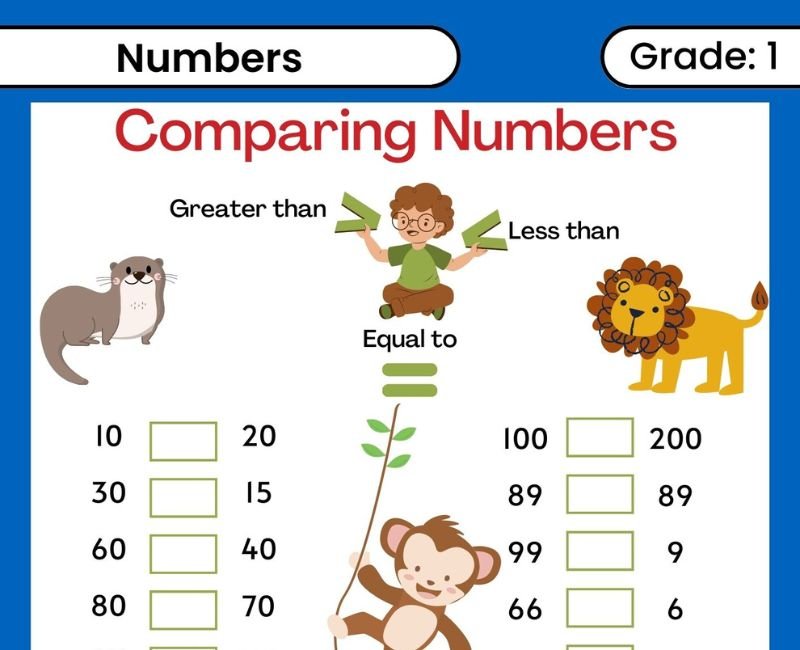
Comparing Numbers Worksheet for Class 1
Which number is greater: 12 or 18? Do two groups of five pencils have the same number of pencils? This comparing numbers worksheet for Class 1 gives children an opportunity to practise an important early maths skill: recognising when one quantity is greater than, less than or equal to another.
Use the worksheet available on this page for number comparison practice. The explanations, activities and additional questions below provide further support for classroom learning, homework and revision. Begin with small numbers and familiar objects, then introduce two-digit comparisons when your child is ready.
Greater Than, Less Than and Equal To
Comparing numbers means deciding how their values relate to each other. Children can first say the comparison in words before writing its symbol. Read each statement from left to right.
Greater than (>): 9 > 4 means “nine is greater than four.” A group of nine counters contains more counters than a group of four.
Less than (<): 3 < 7 means “three is less than seven.” A group of three counters contains fewer counters than a group of seven.
Equal to (=): 6 = 6 means “six is equal to six.” Both groups contain the same number of objects.
How to Choose the Correct Comparison Sign
The open side of the greater than or less than sign faces the greater number. The pointed end faces the smaller number. For example, in 8 > 2, the open side faces 8. In 2 < 8, the open side still faces 8.
Ask your child to identify the greater number first, place the sign, and read the complete comparison aloud. If both numbers have the same value, use the equal sign. This routine helps children connect the symbol with its meaning instead of guessing its direction.
Compare Numbers Using Objects and a Number Line
Place four buttons in one row and seven buttons in another. Match one button from the first row with one from the second. Three buttons remain unmatched in the second row, showing that seven is greater than four. Use objects of a similar size so children compare the number of objects rather than their appearance.
A number line offers another useful method. On a number line with values increasing from left to right, the greater number lies farther to the right. For example, 16 is to the right of 11, so 16 > 11. Encourage children to locate both numbers before choosing the sign.
Comparing Two-Digit Numbers Using Tens and Ones
Compare the tens digits first. In 42 and 28, four tens are greater than two tens, so 42 > 28. The ones digit does not change that result.
When the tens digits are equal, compare the ones digits. In 35 and 39, both numbers have three tens. Five ones are fewer than nine ones, so 35 < 39.
Take care with reversed digits. Although 24 and 42 use the same digits, their values differ. The number 24 has two tens, while 42 has four tens. Comparing place values helps children explain why 24 < 42.
Extra Comparing Numbers Questions with Answers
These additional online practice questions can be completed in a notebook. For questions 1 to 8, fill each blank with >, < or =. Try answering before opening the answer section.
- 7 ___ 4
- 3 ___ 9
- 8 ___ 8
- 12 ___ 17
- 20 ___ 14
- 36 ___ 32
- 45 ___ 54
- 60 ___ 60
- Choose the greatest number: 18, 11, 15.
- Choose the smallest number: 27, 20, 25.
- Arrange 9, 4 and 7 from smallest to greatest.
- Arrange 31, 38 and 34 from greatest to smallest.
- Riya has 6 crayons and Aman has 10 crayons. Who has more crayons?
- Two baskets each contain 5 oranges. Are their numbers of oranges greater, less or equal?
View answers to the extra practice questions
1. >; 2. <; 3. =; 4. <; 5. >; 6. >; 7. <; 8. =; 9. 18; 10. 20; 11. 4, 7, 9; 12. 38, 34, 31; 13. Aman, because 10 > 6; 14. Equal, because 5 = 5.
A Simple Number Comparison Activity
Write numbers from 1 to 20 on small cards. Pick two cards and ask your child to read both numbers, identify the greater number and write the correct comparison. Include a second card with the same number occasionally to practise equality.
For extra support, let children build each quantity using counters. For a further challenge, choose three cards and arrange them in ascending or descending order. Keep sessions short and ask children to explain one answer in their own words.
Related Class 1 Maths Worksheets
Build counting confidence, revise place value and apply comparison skills to simple data with these related resources.
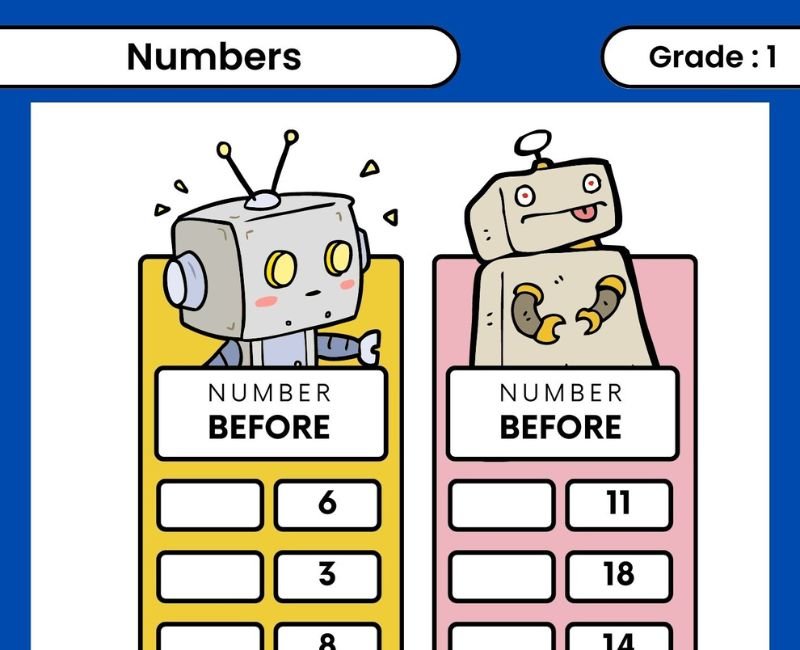
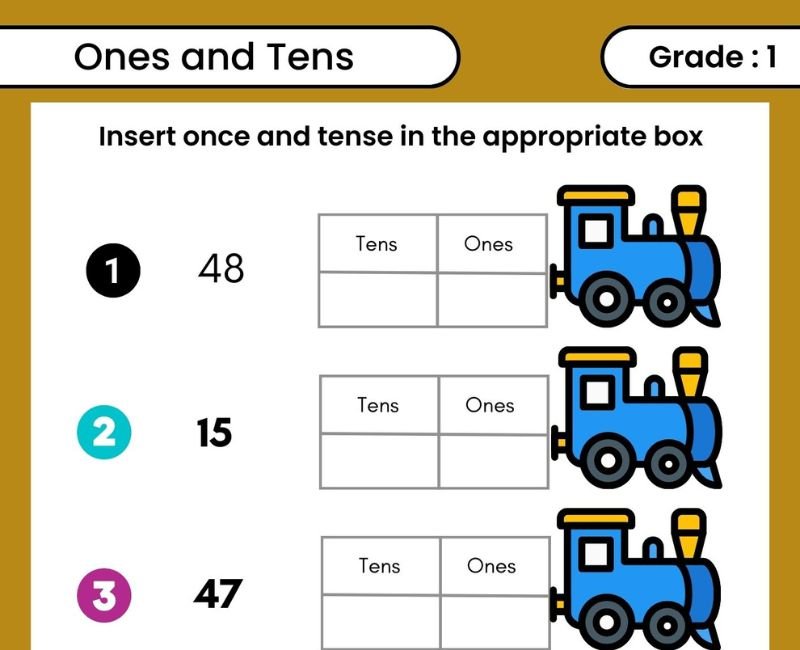
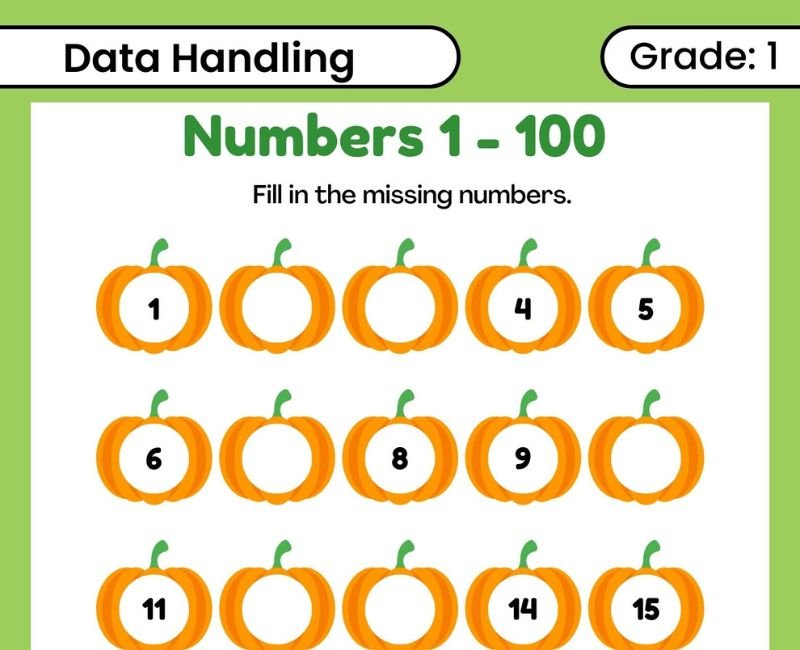
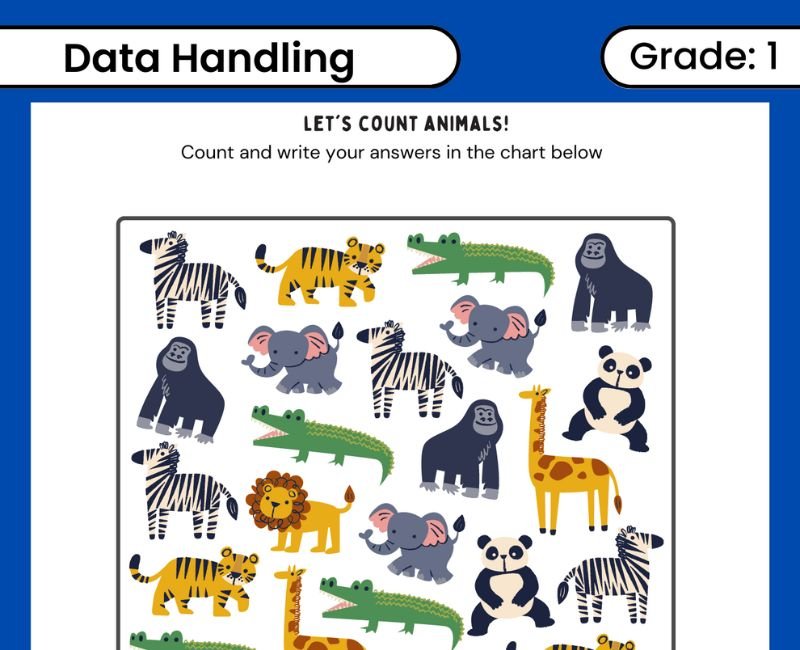
Numbers 1 to 9 Worksheet: Practise recognising and counting small quantities. Before and After Numbers Worksheet: Strengthen number order and sequencing. Tens and Ones Worksheet: Understand the place values used to compare two-digit numbers. Data Handling Worksheet: Count groups and compare more, fewer and equal quantities. Browse Class 1 Maths Worksheets: Explore more topics for regular practice.Frequently Asked Questions
What does comparing numbers mean?
It means checking whether one number is greater than, less than or equal to another. For example, 10 is greater than 6, while 4 is less than 9.
How do I teach greater than and less than to Class 1 children?
Start with two groups of objects. Count and compare them, say the comparison aloud, then introduce the symbol. Move to written numbers once children understand more, fewer and equal quantities.
Which way does the greater than or less than sign face?
The open side faces the greater number and the pointed end faces the smaller number. Always read the statement from left to right to check its meaning.
How do children compare numbers with the same tens digit?
Compare their ones digits. For example, 26 and 29 both have two tens, but six ones are fewer than nine ones. Therefore, 26 < 29.
What is the difference between comparing and ordering numbers?
Comparing checks the relationship between numbers. Ordering arranges a group of numbers from smallest to greatest or greatest to smallest, using those comparisons.
Can zero be used in number comparison practice?
Yes. An empty group has zero objects. Comparing it with a group of three objects shows that 0 < 3. Two empty groups have equal quantities: 0 = 0.
Are answers available for the extra questions on this page?
Yes. Open the answer section below the additional online practice questions to check each response. These answers correspond to the questions in this description.
 Download