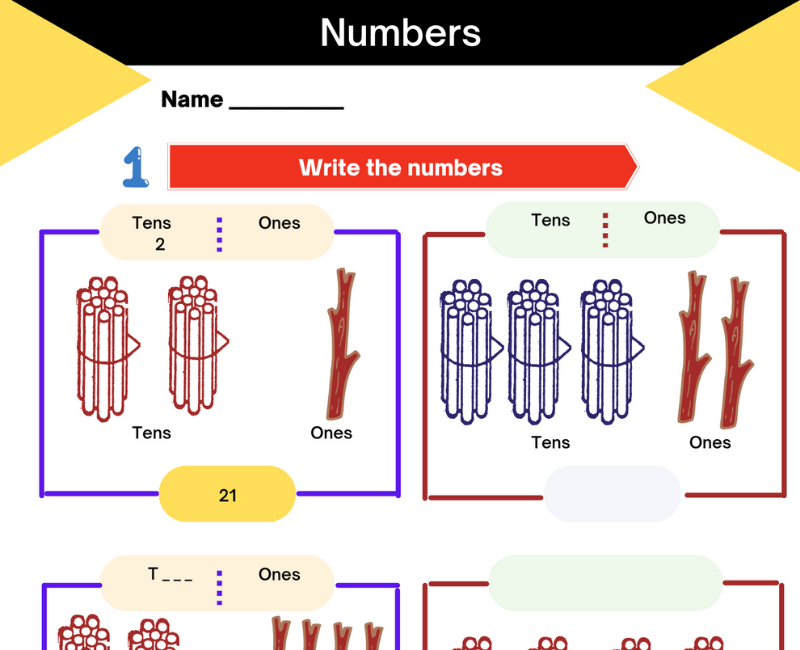
Grouping Tens and Ones Worksheet for Class 1
How many groups of ten can your child make from a collection of objects? This grouping tens and ones worksheet for Class 1 helps children connect counting with place value. Use it to practise making complete groups of ten, counting the objects left over and writing the number represented by the collection.
Pair worksheet practice with blocks, counters or craft sticks. Children can build the groups themselves, explain what they have made and check their answer by counting again. This practical approach helps them understand why a bundle of ten represents one ten.
What Does Grouping Objects into Tens and Ones Mean?
Grouping means arranging a collection into complete sets of ten. Each complete set is called one ten. The individual objects that remain are called ones. The total number of objects stays the same when we rearrange them into groups.
Example: 23 objects
Make two complete groups of ten. Three objects remain outside the groups.
2 tens and 3 ones = 20 + 3 = 23
A useful question is, “How many objects are inside each group?” Children should recognise that every ten-group contains exactly ten objects, even when they begin counting each group as a single unit.
How to Count and Group Objects
- Count ten objects: Touch or move each object once as you count from one to ten.
- Make one group: Circle those ten objects on paper or place them together when using counters.
- Continue grouping: Make another complete group whenever ten ungrouped objects remain.
- Count the leftover ones: Stop making groups when fewer than ten objects remain.
- Write the total: Record the number of tens and ones, then write the numeral.
Each object should belong to only one group. Avoid overlapping circles or counting an object again after it has already been grouped.
Counting Bundles of Ten and Leftover Ones
Once the groups are ready, count their value in tens: ten, twenty, thirty and so on. Then count on in ones for the remaining objects. This avoids recounting every object individually.
Worked example: 3 bundles and 4 loose sticks
Each bundle contains ten sticks. Count the bundles: 10, 20, 30.
Count on for the loose sticks: 31, 32, 33, 34.
Total: 34 sticks, or 3 tens and 4 ones.
Encourage children to say “three tens and four ones” rather than simply “three and four.” Naming the units helps them understand the value of each part.
What Happens When There Are No Leftover Ones?
Some collections make complete groups of ten with nothing left over. For example, twenty objects make two groups of ten and zero ones. We write this number as 20. The zero shows that there are no individual ones outside the groups.
7 objects: 0 tens and 7 ones
10 objects: 1 ten and 0 ones
20 objects: 2 tens and 0 ones
40 objects: 4 tens and 0 ones
If ten loose ones remain, another complete ten-group can be made. For instance, two tens and ten loose ones can be regrouped as three tens and zero ones. Both arrangements represent thirty objects.
Extra Grouping Tens and Ones Questions with Answers
Use these additional questions for oral practice or notebook work. Build the collections with counters when your child needs support.
- How many ones make one ten?
- Group 14 objects. How many tens and ones are there?
- Group 27 objects. How many complete ten-groups can you make, and how many ones remain?
- Write the number: 3 tens and 2 ones.
- Write the number: 4 tens and 0 ones.
- How many objects are in five complete groups of ten?
- Write 18 as tens and ones.
- Write 36 as tens and ones.
- There are two bundles of ten sticks and five loose sticks. How many sticks are there?
- There are 29 counters. After making complete groups of ten, how many counters remain ungrouped?
- Can eight objects make a complete group of ten?
- Regroup 1 ten and 10 ones into complete tens. What do you get?
- Which collection has more objects: 2 tens and 8 ones, or 3 tens and 1 one?
- A child circles nine objects and calls it one ten. What should they correct?
Answers: 1. 10 ones; 2. 1 ten and 4 ones; 3. 2 ten-groups and 7 ones; 4. 32; 5. 40; 6. 50; 7. 1 ten and 8 ones; 8. 3 tens and 6 ones; 9. 25; 10. 9; 11. No; 12. 2 tens and 0 ones; 13. 3 tens and 1 one, because 31 is greater than 28; 14. Include one more object so the group contains exactly ten.
A Hands-On Bundling Activity for Home or School
Give your child a collection of craft sticks and ask them to arrange ten sticks together. An adult can secure each completed bundle. Leave the remaining sticks loose, then ask your child to describe the collection and write its total.
Try the activity in reverse too. Say “twenty-four” and ask your child to build two bundles of ten and four loose sticks. This checks whether they can connect a written or spoken number with a grouped quantity.
To check understanding, open one bundle and spread out its ten sticks. Ask whether the total has changed. The arrangement has changed, but the number of sticks remains the same. Let your child count to confirm their answer.
More Class 1 Maths Worksheets to Explore
Continue with these related activities to connect grouping, counting and place value.
Tens and Ones Worksheet for Class 1Extend grouping practice to reading numbers and identifying place value. Numbers 1 to 20 Worksheet for Class 1
Strengthen counting and number recognition before working with larger collections. Skip Counting Worksheets for Class 1
Practise counting in equal steps, including counting groups in tens. Comparing Numbers Worksheets for Class 1
Use tens and ones to explain which two-digit number is greater or smaller. Browse All Class 1 Maths Worksheets
Find more practice for numbers, addition, subtraction, measurement and shapes.
Frequently Asked Questions
How do you teach grouping into tens and ones?
Start with real objects. Count ten, place them together and call the group one ten. Repeat, then count the leftover ones and write the total.
How many ones make one ten?
Ten ones make one ten. A bundle containing ten sticks represents the same quantity as ten loose sticks.
How do you group 26 objects into tens and ones?
Make two complete groups of ten. Six objects remain, so 26 is 2 tens and 6 ones.
Why should each group contain exactly ten objects?
Each group represents one ten, so every group must have the same value of ten. A group of nine or eleven cannot be counted as one ten without adjusting it.
What does zero in the ones place mean?
It means there are no leftover ones after making complete tens. For example, 30 represents 3 tens and 0 ones.
Why does my child count two bundles and three objects as five?
They may be treating each bundle as one object without considering its contents. Open a bundle to show its ten objects, then count the collection as ten, twenty, twenty-one, twenty-two, twenty-three.
 Download