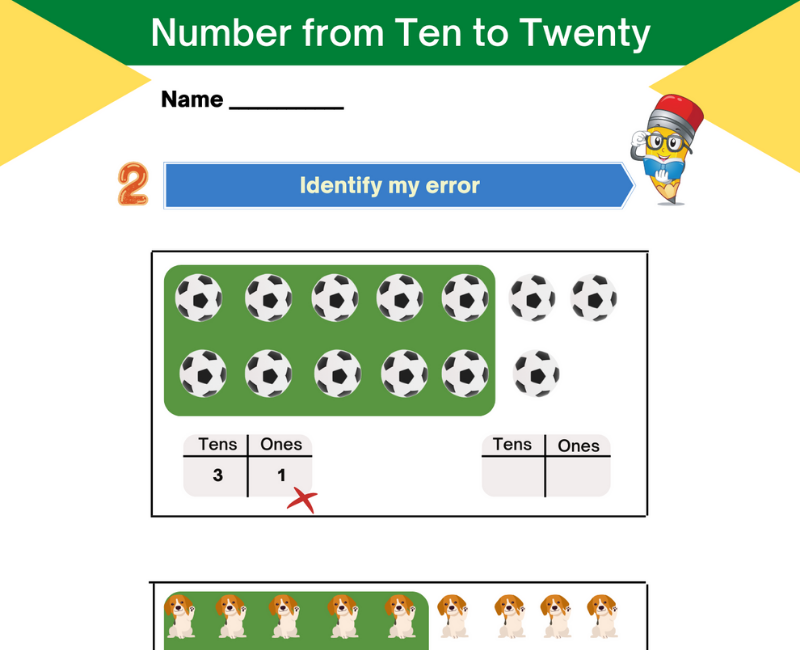
Number Adventure: Count, Build and Explore 1–20! 🌈
Explore this numbers 1 to 20 worksheet for Class 1 with an online quiz, ten interactive games and activities, and five practice sets. Build quantities, organise a group of ten and connect numerals with number names.
📝 Numbers 1 to 20 Online Quiz for Class 1
Question 1 of 20 • Answered: 0/20
Count the filled spaces in these two frames. Which number records the total?
🎮 Numbers 1 to 20 Online Games for Class 1
Build a quantity, count each object once, order number tiles, group beads and match number names.
1. 🟣 Build Seventeen
Tap empty spaces to place counters. Tap filled spaces to remove them. Make seventeen counters across the two ten frames.
Counters placed: 0
Ready to play!
2. 🌟 Count Each Star Once
Tap each star once to stamp it as counted. A counted star cannot be counted twice. When every star is stamped, record the total.
Ready to play!
3. 🚂 Order the Number Carriages
Tap all six carriage numbers from smallest to largest. Undo a tile if you want to change the order.
Tap your first tile.
Ready to play!
4. 📿 Bundle the Beads
Eighteen loose beads are on the tray. Select exactly ten beads and bundle them into one ten. Then record the loose beads left.
Eighteen loose beads.
Ready to play!
5. 🏷️ Deliver Number-Name Labels
Choose a number-name parcel, then its numeral mailbox. Match all three. An adult can read the names aloud.
Ready to play!
🧠 Counting Numbers 1 to 20 Online Activities
Launch a countdown, repair a counting label, share counters, follow a number route and solve a quantity puzzle.
6. 🚀 Build the Countdown
Arrange all six launch tiles by counting backwards from twenty to fifteen.
Tap your first tile.
Ready to play!
7. 🔧 Repair the Counting Label
The quantity stays fixed. The label says sixteen, but the frames show a different amount. Count the counters and repair the numeral label.
Label: 16
Ready to play!
8. ⚖️ Share Without Changing the Total
The purple tray starts with twelve counters and the green tray with eighteen. Move counters from one tray to the other until the quantities are equal. No counters leave the trays.
Purple tray: 12
Green tray: 18
Ready to play!
9. 🤖 Follow the Teen-Number Route
The robot starts at eleven. Tap the next neighbouring number by counting on one. Reach twenty along the winding path.
Ready to play!
10. 🚌 Fill the Empty Bus Seats
A bus has twenty seats. Twelve seats are already occupied. Tap empty seats to place passengers until the bus is full. Record how many passengers you added.
Ready to play!
✏️ Numbers 1 to 20 Practice for Class 1
1. 🔎 Explore a Number
Choose any number from one to twenty. Compare its numeral, name and ten-frame model.
1 — one
0 tens and 1 ones
Ready to explore.
2. ✏️ Match Names to Numerals
Record the numeral for each name. An adult can read the names aloud.
Ready to explore.
3. 🧠 Plan a Careful Count
Tap the three actions in a useful order.
Ready to explore.
4. 🧩 Complete Number Tracks
Fill each gap by following the direction of its track.
5, 6, □, 8
13, □, 15, 16
12, 11, □, 9
Ready to explore.
5. 🎨 Make a Number Card
Choose a number and a picture theme. Create a card, read it aloud and build the same quantity with real counters. This is an ungraded creative task.
Ready to explore.
💡 Counting Numbers Learning Tips
👩🏫 Five Parent and Teacher Tips
- Connect each spoken number with one object.
- Ask the total after the child finishes counting.
- Use a complete group of ten to explore teen numbers.
- Mix number cards so recognition does not depend on reciting from one.
- Ask children to explain why moving objects does not change the quantity.
🌟 Six Tips for Students
- Touch or move each object once.
- Say one counting word for each object.
- Use the last number to name the total.
- Look for a group of ten before counting extra ones.
- Read a two-digit number in the correct digit order.
- Check your quantity against its numeral.
📄 Numbers 1 to 20 Worksheet for Class 1
📖 Read the Numbers 1 to 20 Learning Guide
🔢 Connect numerals and quantities
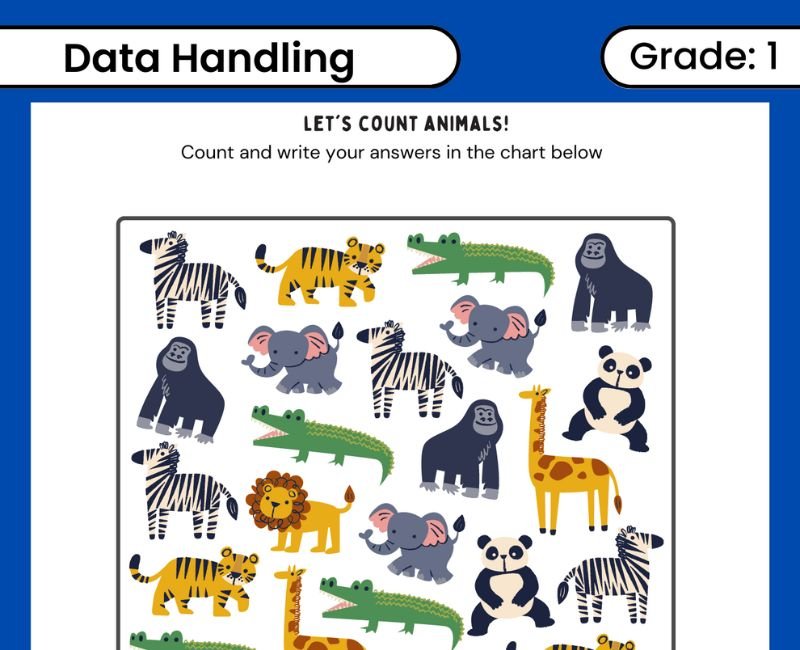
A numbers 1 to 20 worksheet for Class 1 helps children connect a spoken number, a written numeral and a collection of objects. Reciting a number sequence is useful, but counting a real group also requires matching one number word to each object. Ask the child to move each counter once and state how many there are when the count is finished.
🟣 See ten and the extra ones
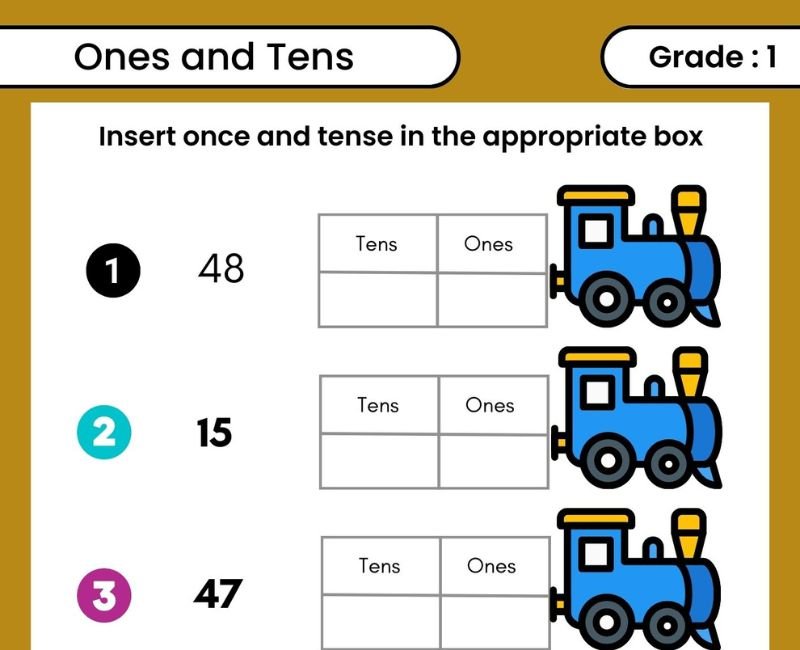
Ten frames make the structure of numbers visible. Each frame has ten spaces arranged in two rows of five. A complete frame and four extra counters represent fourteen. Two full frames represent twenty. Building quantities in this way supports counting on and introduces tens and ones without relying only on memorised digit patterns.
🚂 Explore number order
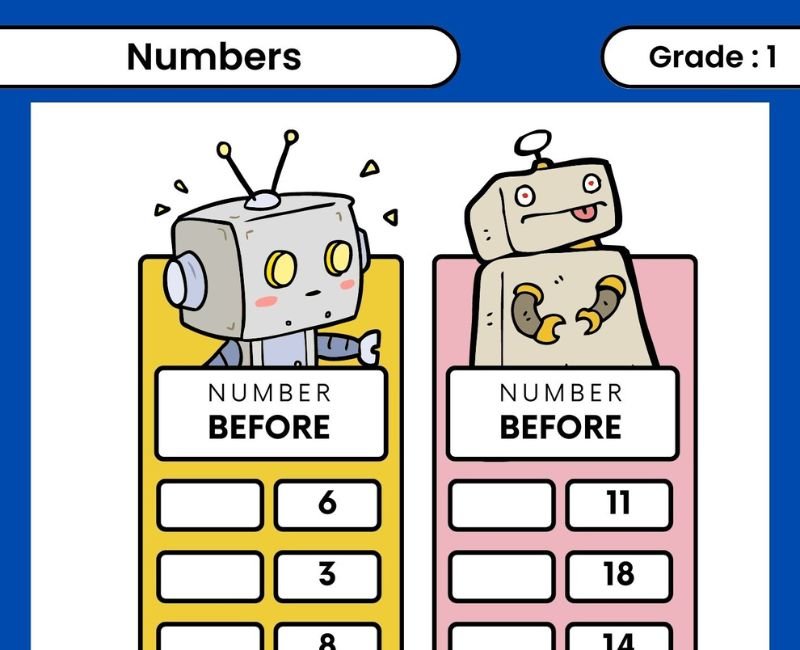
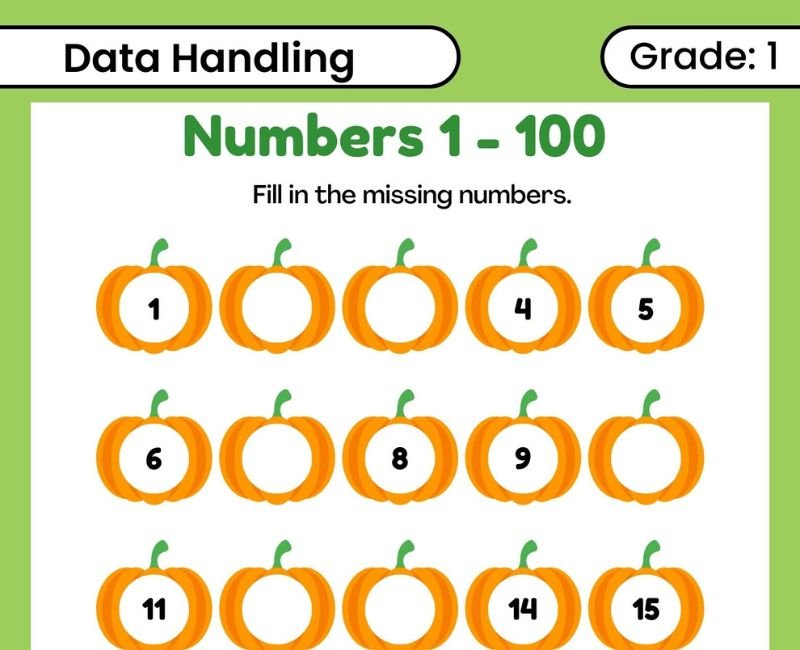
Practise counting numbers from 1 to 20 forwards and backwards, then begin from different points. Use a number track to locate neighbours and missing numbers. Ordering a few mixed cards encourages children to compare the numbers themselves. Keep the steps short and ask the child to explain how they know which number comes next.
🏷️ Read and record number names
Match familiar spoken names to numerals before expecting independent reading of every written number word. Pay attention to eleven, twelve and the teen names, whose forms are less predictable. Encourage children to build a quantity, say its name and write its numeral. Follow the classroom handwriting model for digit formation and give brief, focused practice.
🎮 Use printable and online practice together
Use the existing download option for the printable numbers 1 to 20 worksheet. The online quiz checks recognition and reasoning, while the separate games offer building, ordering, matching and counting tasks. Extend the digital models with buttons or blocks. Rearrange a counted set without adding or removing objects, and invite children to predict and check whether the total remains the same.
💬 Numbers 1 to 20 Worksheet FAQs
❓ How can I teach numbers 1 to 20 to Class 1?
Connect spoken names, numerals and real quantities. Start with a comfortable range and extend it gradually to twenty.
❓ Why can a child recite numbers but struggle to count objects?
Reciting uses a remembered sequence. Counting objects also needs one-to-one matching and an understanding that the final count states the total.
❓ What is one-to-one correspondence in counting?
It means matching one counting word to each object, without skipping an object or counting one twice.
❓ What is a ten frame?
It is an arrangement of ten spaces in two rows of five. Two frames can represent quantities up to twenty.
❓ How do you explain numbers 11 to 19?
Build one group of ten and add the extra ones. Read the numeral alongside the quantity.
❓ How is twenty represented in tens and ones?
Twenty is two tens and zero individual ones. Two full ten frames show this clearly.
❓ How can children practise counting backwards from twenty?
Use a visible number track, move back one position at a time and say each number. Begin with short sections before using the full range.
❓ Should number names be taught with numerals?
Connect spoken names with numerals and quantities. Introduce written name matching with reading support as needed.
❓ Does spreading counters out make the number bigger?
No. Moving the same counters changes their arrangement but does not change the total when none are added or removed.
❓ How can children stop counting objects twice?
Move counted objects into a separate area, or mark each one once. Keep the counted and uncounted groups clear.
❓ What helps with reversed digits or digit order?
Show a clear classroom model, connect the numeral with its quantity and offer short practice without rushing.
❓ Where are the worksheet and online quiz answers?
Use the existing page download option for the printable resource. Online quiz answers appear after End Quiz or timeout. Games provide their own feedback.
Count carefully, build a group of ten and explain your number.
Back to the Online Quiz ↑ Download