Count, Build and Discover 1–9! 🎒✨
Explore a numbers 1 to 9 online quiz, 10 interactive games and activities, and five practice sets. Pack orders, serve a picnic and solve counting mysteries.
📝 Numbers 1 to 9 Online Quiz for Class 1
Question 1 of 20 • Answered: 0/20
Count the purple dots on this number card. Which numeral records the total?
🎮 Numbers 1 to 9 Online Games for Class 1
Fill orders, serve one item per plate, match quantities, arrange number cards and investigate a hidden group.
1. 📦 Fill the Counter Orders
Use Add and Remove to pack the exact order: first 6, then 3, then 8 counters.
Order 1: 6 counters
Ready to play!
2. 🍽️ Serve the Picnic
Give exactly one strawberry to each of the five plates. Tap an empty plate to serve it; tap a filled plate to take the fruit back.
Ready to play!
3. 🔗 Match the Quantity Locks
Choose a numeral key, then the dot lock with the same quantity. Open all three locks.
Ready to play!
4. 🪜 Build the Number Stair
Tap all nine number cards in counting order from 1 to 9. Use Undo to change your plan.
Empty stair
Ready to play!
5. 🪟 Hidden Counter Window
There are 9 counters altogether. Four are visible; the rest are behind the cover. Enter the hidden count, then open the cover.
Ready to play!
🧠 Counting Numbers 1 to 9 Online Activities
Swap misplaced labels, record a toy collection, balance trays, colour number parts and count scattered treasures.
6. 🔧 Swap the Mixed Labels
The labels should read 1 to 9 from left to right across the rows. Tap two positions to swap their cards.
Ready to play!
7. 🎒 Record the Toy Bag
Count each kind of toy in the mixed display. Record all three quantities.
Ready to play!
8. ⚖️ Make Two Equal Trays
Eight counters are split between two trays: seven on the left and one on the right. Move counters until the trays have equal counts.
Ready to play!
9. 🎨 Colour Nine Counter Parts
Tap counters to switch orange to blue or blue to orange. First make 2 blue counters; then make 5 blue counters. The total stays nine.
Make 2 blue counters. Other counters stay orange.
Ready to play!
10. 💎 Stamp the Treasure Map
Tap every treasure once to stamp it, then enter the total. Tapping a stamped treasure cannot count it again.
Ready to play!
✏️ Numbers 1 to 9 Interactive Practice
1. 🔢 Explore a Number Card
Choose a number to connect its numeral, name and quantity.
1 — one
Ready to explore.
2. ✍️ Count a Fresh Collection
Count the counters and enter their total.
Ready to explore.
3. ↔️ Read Two Short Strips
Complete one forward strip and one backward strip.
Ready to explore.
4. 🧠 Keep the Count
Count this collection, then change its arrangement. Enter its count after the change.
Ready to explore.
5. 🌟 Make Your Own Counting Card
Choose a number and a collection word to create your own counting card. Explain how you would show that many objects.
Ready to explore.
💡 Counting and Number Recognition Tips
👩🏫 Five Parent and Teacher Tips
- Connect the spoken number, written numeral and matching collection.
- Encourage one point or move for each object counted.
- Ask for the total after counting, without requiring a recount.
- Show numerals in mixed order as well as a counting sequence.
- Change an arrangement and invite children to explain what stays the same.
🌟 Six Tips for Students
- Look at every object in the collection.
- Say one number for each object.
- Count each object once.
- Remember that your last number tells the total.
- Check that the numeral label matches the collection.
- Use objects or a number strip when you need help.
📄 Numbers 1 to 9 Worksheet for Class 1
📖 Read the Numbers 1 to 9 Learning Guide
🔢 Connect numerals and quantities
A numbers 1 to 9 worksheet for Class 1 helps children link a written symbol with a spoken number name and a quantity. Reciting a counting sequence is useful, but recognising a numeral on its own is a separate skill. Show mixed number cards and ask children to create the matching collections. Begin with manageable groups and increase the quantity as counting becomes more accurate.
👆 Count each object once
Count-and-match activities work best when children coordinate their words with pointing or moving. Each object receives one count word. Encourage a clear route through a picture so objects are neither skipped nor counted again. Once counting finishes, ask how many objects there are altogether. The final count word represents the size of the whole collection.
🧺 Build and adjust collections
Number recognition practice should include making a collection from a numeral, as well as naming a collection that is already shown. Children can use counters, blocks or simple drawn marks. If a collection does not match its label, decide whether the objects or the label should change according to the task. Rearranging objects without adding or removing them preserves their number, even if the group looks longer or wider.
↔️ Explore order, matching and parts
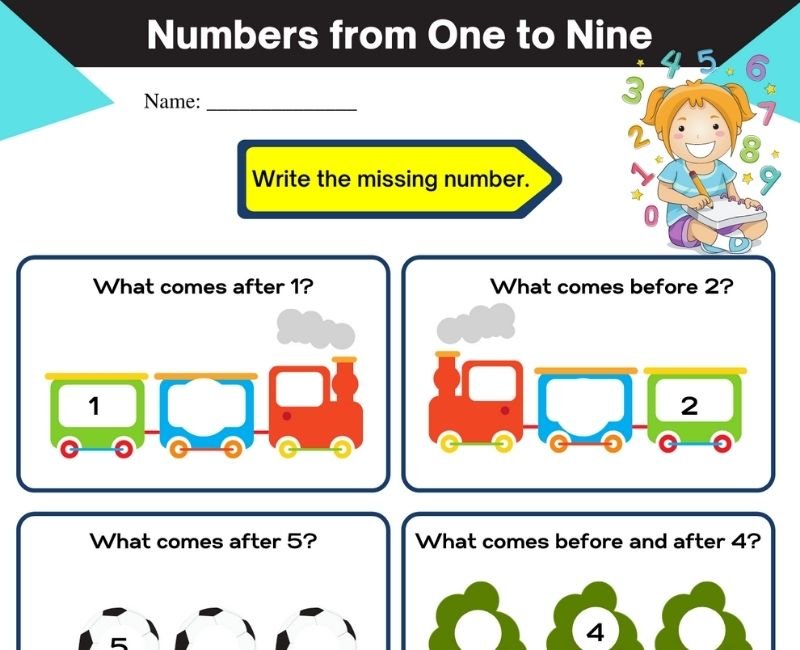
The number sequence from one to nine supports before, after and missing-number activities. Practise beginning at different points and reading a short sequence backwards. Match groups one to one to compare quantities, then notice any unpaired objects. Split one collection into two visible parts and put it together again. These experiences build early number sense before children depend on written calculation rules.
🎮 Use printable and online practice together
Use the existing download option for the numbers 1 to 9 worksheet PDF. These separate online counting games, quiz questions and practice sets extend number recognition, quantity matching and reasoning with fresh examples. Number names are one, two, three, four, five, six, seven, eight and nine. Ask children to explain their counting method and check a collection in another arrangement. Continue to numbers 1 to 20 when these early connections are secure.
💬 Numbers 1 to 9 Worksheet FAQs
❓ How do I teach numbers 1 to 9 to Class 1?
Connect number names, written numerals and real collections. Ask children to read a card, build its quantity and count to check.
❓ What is the difference between counting and numeral recognition?
Counting finds how many objects there are. Numeral recognition identifies the written symbol. Children need practice linking both skills.
❓ What does count and match mean?
Count the objects in a collection and connect the total with the appropriate numeral or another collection of equal size.
❓ Why does my child count an object twice?
Coordinating pointing and saying numbers takes practice. Moving each object into a counted area or following a clear route can help.
❓ Why is the last number important when counting?
When each object has been counted once, the last count word tells how many objects are in the complete collection.
❓ How can children learn number names from one to nine?
Read each numeral with its spoken name and a matching quantity. Revisit mixed cards through short matching games instead of relying only on reciting the list.
❓ How do I teach missing numbers within 1 to 9?
Read the known numbers and continue the sequence through the gap. Use movable cards or a number strip to check the order.
❓ Does spreading objects apart make the number larger?
No. Rearranging the same collection keeps its quantity unchanged when no objects are added or removed.
❓ How can children compare two collections?
Match one object in the first collection to one in the second. Extra unpaired objects show which collection has more.
❓ Should children write numerals before they can count objects?
Connect writing with number meaning. Build secure counting and recognition, then practise formation using the handwriting model taught in class.
❓ How do numbers 1 to 9 prepare children for addition?
Joining, separating and comparing small collections helps children understand totals, parts and changes before formal written sums.
❓ Where are the printable worksheet and online answers?
Use the existing page download option for the PDF. Online quiz answers and explanations appear after End Quiz or timeout; games give their own feedback.
Count carefully, build a collection and explain your answer.
Back to the Online Quiz ↑ Download