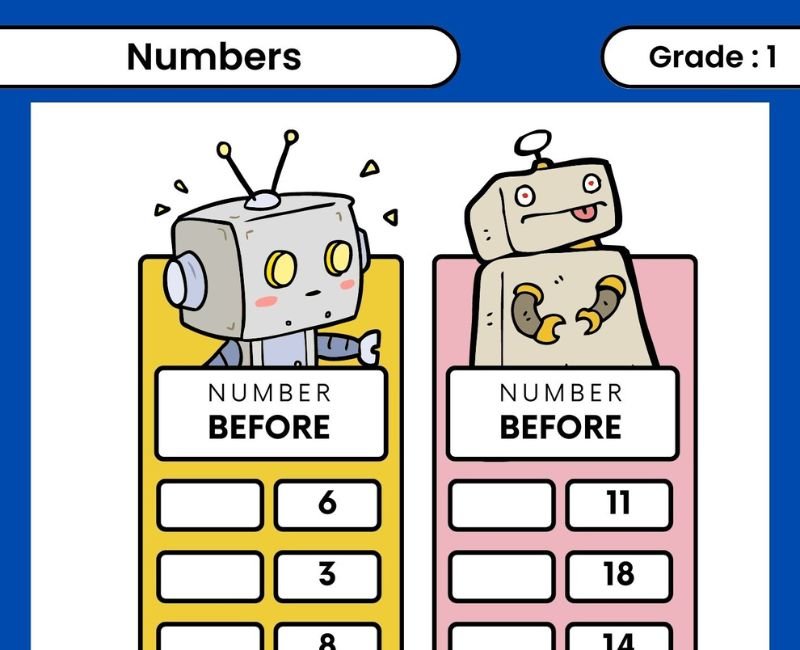
Before and After Numbers: Neighbourhood Adventures! 🚇🐸
Travel along a number route, deliver neighbour mail, repair a bridge and exchange ones for a ten. Try a quiz, 10 interactive tasks and five practice sets.
📝 Before and After Numbers Online Quiz for Class 1
Question 1 of 20 • Answered: 0/20
🔐 … → 26
Which number belongs immediately before locker 26?
🎮 Before and After Numbers Online Games for Class 1
Build routes, deliver cards, move a frog and repair a missing-number bridge. Select one game at a time.
1. 🚇 Open the Metro Route
Station 33 is open. Tap the remaining tickets in increasing steps of one to reach station 38.
🚇 33
Ready to play!
2. 📮 Deliver Neighbour Mail
The centre address is 54. Deliver the previous and next number cards to the two labelled mailboxes. Tap a card, then a box.
Centre address: 54
Ready to play!
3. 🐸 Frog Hop Mission
Start at 76. First reach 78; then travel back to 75. Each button moves exactly one number.
Mission 1: reach 78.
Ready to play!
4. 🌉 Repair the Hundred Bridge
Complete the bridge in steps of one. Select a spare plank, then tap an empty position. You may replace a plank.
Ready to play!
5. 🃏 Neighbour Clue Memory
Match each clue with its number. Turn over two cards at a time.
Find four clue pairs.
🧠 Before and After Numbers Online Activities
Repair number neighbours, cross a ten, unlock a number safe, create a riddle and connect a constellation.
6. 🤖 Repair the Label Robot
The robot swapped every before-and-after label. Edit the boxes so each row reads one less, centre, one more.
Ready to play!
7. 🧱 One More, One New Ten
Start with 4 tens and 9 ones. Add one, exchange the ten loose ones for a ten, then take one away to return to the start.
4 tens + 9 ones= 49
Ready to play!
8. 🔐 Unlock the Neighbour Safe
Each dial holds the number between its two neighbours. Set all three dials, then open the safe.
Ready to play!
9. 🕵️ Create a Hidden-Number Riddle
Choose a before number and an after number between 0 and 100. Leave exactly one whole number between them. Make a riddle for a partner.
Your riddle will appear here.
Ready to play!
10. 🌌 Connect the Number Constellation
Start at 11. Tap the next counting number each time until 16. The stars are scattered, so follow the labels rather than their position.
Ready to play!
✏️ Before, After and Between Numbers Practice for Class 1
Explore number neighbours and try five short practice sets.
1. 🔍 Explore Any Number’s Neighbours
Choose a whole number from 1 to 99. Reveal its immediate neighbours.
Choose a number, then explore.
Ready to explore.
2. 🧱 Build a Maths Explanation
Arrange the three sentence pieces to explain just after.
Build your explanation.
Ready to explore.
3. ⬅ Rebuild a Backward Strip
Arrange 91, 90, 89 and 88 in counting-back order. Choose cards to build the strip.
Your strip is empty.
Ready to explore.
4. 🔢 Count What Lies Strictly Between
List the whole numbers strictly between 46 and 50. Do not include the endpoints. Then enter how many there are.
46 → ? → ? → ? → 50
Ready to explore.
5. 📝 Keep a Number-Neighbour Record
Choose a whole number from 2 to 98. Write its neighbours and check your own example.
Your checked record will appear here.
Ready to explore.
💡 Tips for Learning Number Neighbours
👩🏫 Parent and Teacher Tips
- Begin within a number range the child can already recognise.
- Use three consecutive cards to connect before, given number and after.
- Read the instruction before choosing a direction.
- Use tens and ones when the sequence crosses a new ten.
- Ask the child to explain a move, rather than only naming an answer.
🌟 Six Tips for Students
- Find the given number first.
- For just before, count back one.
- For just after, count on one.
- Read all three numbers to check a neighbour pair.
- Notice whether a strip counts forwards or backwards.
- Use Undo, a number strip or a small hint when you need support.
📄 Before and After Numbers Worksheet for Class 1
📖 Read the Number Neighbours Learning Guide
🔢 Connect position with quantity
A before and after numbers worksheet for Class 1 links counting order with one less and one more. Use a small collection of objects alongside written numerals: remove one object, replace it and add one. Then describe the change using the appropriate number word. This helps children connect a neighbouring position with a change in quantity, rather than remembering a rule without understanding it.
↔️ Make the counting direction visible
In an increasing number sequence, the immediate neighbours sit one step apart. Read the whole strip before covering a label. For example, 54, 55 and 56 can be explored as a three-card group. Turn the strip around only if you explicitly change its direction: the meaning of “one less” does not change when a different layout is used. Check the number values rather than relying only on left and right.
🔟 Investigate a new ten
Before and after numbers practice can be extended to transitions such as 49 to 50. Use four groups of ten and nine loose ones; adding one completes another group. In the online workshop, children make that exchange and then reverse it. The written digits change together because the grouping changes. The quantity has increased by just one, even though the numeral looks different.
🧩 Use both clues for between
Before, after and between numbers worksheets support checking from two directions. To fill one gap between consecutive neighbours, find a number that is one more than the first endpoint and one less than the last. Wider intervals may contain several whole numbers, so “between” does not always mean one answer. State whether the endpoints are included and whether children should list or count the numbers.
🎮 Combine printable and interactive practice
Use the existing worksheet download option for written work. The online quiz is separate practice, with explanations after submission. Games and activities use different tasks: sequencing tickets, moving along a number strip, repairing labels and creating a number riddle. Start with familiar values and gradually increase the range. The online examples do not specify the exact questions or number range in the downloadable PDF. Continue with tens and ones and missing numbers to 100 when appropriate.
💬 Before and After Numbers FAQs
❓ What do “just before” and “just after” mean in numbers?
Just before means one less than the given whole number. Just after means one more. These words refer to immediate neighbours in counting order.
❓ How can I teach before and after numbers to Class 1?
Show three consecutive number cards. Identify the middle card and connect each neighbour with a backward or forward count of one. Use objects or a number strip if needed.
❓ What is the difference between before and between?
Before identifies an earlier position in the counting sequence; just before identifies the immediate previous number. Between refers to values inside an interval, which may contain one number or several.
❓ Why does a child confuse the number before with the number after?
Check the instruction words, counting direction and ability to recognise the given numeral. Model one move on a short number strip, then ask the child to explain the direction.
❓ How can I explain the number after a number ending in 9?
Use tens and ones. Add one to the nine loose ones, exchange the ten ones for one ten and read the new numeral. The total changes by one.
❓ Should children practise to 20 or to 100 first?
Start with a range the child can count and recognise comfortably. Extend gradually, including transitions between tens when the child is ready.
❓ Are predecessor and successor the same as before and after?
For whole numbers, predecessor means the number immediately before and successor means the number immediately after. Introduce the simpler words first if they are more familiar.
❓ Does a number square always show the next number on the right?
No. At the end of a row, the next counting number begins the next row. Check the labels and the layout rather than assuming the same physical direction always works.
❓ Can there be more than one whole number between two numbers?
Yes. If the endpoints are more than two apart, several whole numbers can lie strictly between them. The activity should state whether to find, list or count those values.
❓ How can I make before and after practice engaging?
Use movable tickets, numbered locations, object collections and missing labels. Ask children to construct or repair a sequence as well as answer spoken questions.
❓ When are the online quiz answers shown?
Correct answers and explanations appear after End Quiz or when the timer finishes. Numbered buttons allow children to revisit their selections before ending the quiz.
❓ Where can I download the worksheet PDF?
Use the worksheet download option already provided on this page. The online questions and games are supplementary practice, rather than an answer key for the PDF.
Try a number-neighbour challenge, explain one move and return to practise another day.
Back to the Online Quiz ↑ Download