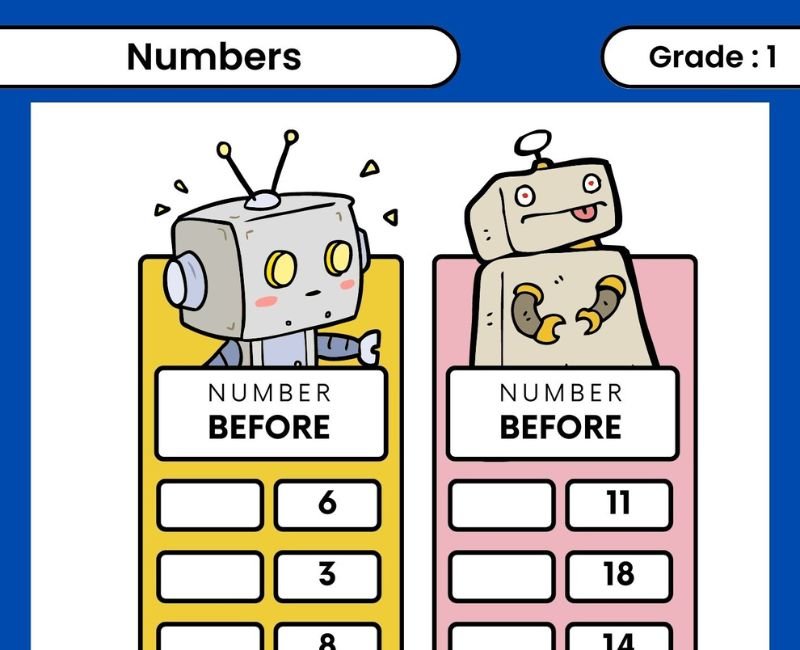
Before and After Numbers Worksheet for Class 1
Help children understand number order with this before and after numbers worksheet for Class 1. Finding the number just before or just after a given number connects counting with the position of numbers in a sequence.
This general Grade 1 maths resource can support classroom practice and home revision. Use number cards, counters or a number strip to explain the idea before children complete written questions. The original examples and practice questions with answers below provide additional activities alongside the worksheet available on this page.
What Number Comes Before?
The number just before a given whole number is one less than that number. In the counting sequence 6, 7, 8, the number just before 7 is 6.
Before 9 comes 8.
Before 15 comes 14.
Before 30 comes 29.
Ask the child to find the given number on an increasing number strip and move one position back. Read the neighbouring numbers aloud to check. Start with familiar numbers before practising across a new ten, such as finding the number before 20 or 40.
What Number Comes After?
The number just after a given whole number is one more than that number. In the sequence 11, 12, 13, the number just after 12 is 13.
After 6 comes 7.
After 18 comes 19.
After 29 comes 30.
Use counters to show what changes. Begin with eight counters and add one more. There are now nine, so nine comes just after eight. Connect the objects with the written sequence: 8, 9, 10.
Find the Number Between
Between-number practice helps children connect the numbers on both sides of a gap. In 14, blank, 16, the missing number is 15. It comes after 14 and before 16.
For questions asking for one whole number between two others, use endpoints that are two apart. There is one whole number between 8 and 10: 9. Between 8 and 12, however, there are three whole numbers: 9, 10 and 11.
Ask children to read the complete sequence after filling the gap. This checks both the answer and the direction of counting.
See Before, Given Number and After Together
Use these examples to connect all three positions. Each row shows consecutive whole numbers in increasing order.
| Before | Given Number | After |
|---|---|---|
| 8 | 9 | 10 |
| 19 | 20 | 21 |
| 34 | 35 | 36 |
Cover one entry and ask the child to identify it. Then cover the middle number and use the two neighbours to find the missing value.
Practise Across a New Ten
Children may find sequences such as 28, 29, 30 or 39, 40, 41 more challenging because the tens digit changes. Build the sequence with number cards and read it slowly.
For 29 followed by 30, use two groups of ten and nine extra counters. Adding one more counter makes another complete group of ten. There are now three tens and no extra ones.
Choose a number range the child understands. Begin within 10 or 20, then extend to larger numbers when the child can identify neighbours confidently. The examples below are supplementary practice and do not specify the number range of the downloadable worksheet.
Original Before and After Practice with Answers
Find the number just before, just after or between the given numbers. Use a number strip if needed.
- What number comes just before 8?
- What number comes just after 12?
- What number comes just before 20?
- What number comes just after 29?
- Complete: 14, ______, 16.
- Complete: ______, 25, 26.
- Complete: 38, 39, ______.
- What number comes just before 50?
- What number comes just after 60?
- Complete: 72, ______, 74.
- Write the number just before and just after 35.
- Arrange 19, 17 and 18 in increasing order.
Show Practice Answers
1. 7
2. 13
3. 19
4. 30
5. 15
6. 24
7. 40
8. 49
9. 61
10. 73
11. Before: 34; after: 36
12. 17, 18, 19
A Simple Number-Card Activity
Prepare three consecutive number cards, such as 21, 22 and 23. Shuffle them and ask the child to arrange them in increasing order. Point to the middle card and ask for its before and after numbers.
Remove one card and let the child identify the missing number. Repeat with another short sequence. Ask the child to explain the answer by reading the completed sequence aloud.
For an additional challenge, let the child create a missing-number question for an adult or classmate. This checks whether the child understands how neighbouring numbers fit together.
How to Use This Grade 1 Maths Worksheet
Use the worksheet download option on this page for written practice. Read each instruction aloud if needed and check whether it asks for the number before, after or between.
Practise a few questions at a time. If a child writes the wrong neighbour, return to a short counting sequence rather than simply supplying the answer. Ask the child to locate the given number and move one position in the correct direction.
Parents can use number cards at home, while teachers can organise a short number-order station. The answers above apply to the original practice questions displayed here. Answers to the downloadable worksheet depend on its actual questions.
Related General Class 1 Maths Worksheets
Build counting confidence and continue with related topic-based practice.
Numbers 1 to 9 Worksheet for Class 1Practise recognising and counting small numbers. Numbers 1 to 20 Worksheet for Class 1
Continue counting and recognising numbers up to twenty. Comparing Numbers Worksheets for Class 1
Explore greater, smaller and equal numbers. Browse All Class 1 Maths Worksheets
Find more general topic worksheets and separately labelled textbook resources.
Before and After Numbers FAQs
What is the number just before a given number?
It is one less than the given number. For example, the number just before 16 is 15.
What is the number just after a given number?
It is one more than the given number. For example, the number just after 16 is 17.
How do I teach before and after numbers to Class 1?
Begin with a short increasing number strip. Find the given number, then move one position back for before or one position forward for after.
What number comes between 24 and 26?
The number is 25. The complete sequence is 24, 25, 26.
Why does my child confuse before and after?
Check the meaning of each instruction using three consecutive number cards. Ask the child to locate the middle number and identify each neighbour before answering independently.
How can I explain the number after 29?
Read 28, 29, 30, 31 aloud or use tens and ones. Adding one to two tens and nine ones gives three tens, which is 30.
Which number range should children practise first?
Start with a range the child can count and recognise confidently, such as numbers within 10 or 20. Extend the range gradually.
Does between always mean one missing number?
No. There is one whole number between 8 and 10, but three whole numbers between 8 and 12. Read the endpoints and instructions carefully.
Are answers available for the practice questions?
Yes. Expand Show Practice Answers to check the twelve original questions on this page.
 Download