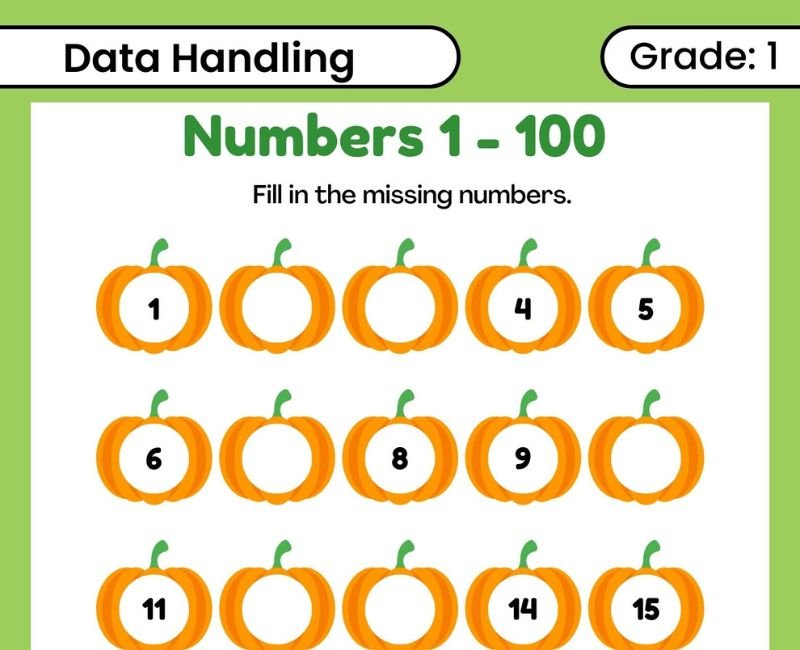
Missing Numbers 1 to 100 Worksheet for Class 1
Help children build counting confidence with this missing numbers 1 to 100 worksheet for Class 1. Finding missing numbers encourages children to recognise number order, identify neighbouring numbers and complete counting sequences.
This general Grade 1 maths topic is suitable for classroom practice and home revision. Begin with a familiar number range, then gradually extend towards 100. The original examples and practice questions with answers below provide additional activities for understanding how numbers fit together.
What Are Missing Numbers?
A missing-number activity leaves one or more spaces in a number sequence. Children use the surrounding numbers and the stated counting rule to fill those spaces.
21, 22, ______, 24, 25
The missing number is 23. It comes just after 22 and just before 24. Read the completed sequence aloud to check: twenty-one, twenty-two, twenty-three, twenty-four, twenty-five.
Encourage children to explain their answer rather than guess. Knowing why a number belongs in a space helps them apply the same idea to another sequence.
Start with Short Counting Sequences
Children do not need to complete a full 1 to 100 chart immediately. Start with short sequences containing one missing number. Once these become comfortable, introduce two or more gaps.
5, 6, ______, 8 → Missing number: 7
32, ______, 34, 35 → Missing number: 33
61, ______, ______, 64 → Missing numbers: 62 and 63
Use a number strip when needed. Ask the child to locate the first number, follow the sequence and identify the spaces. Gradually reduce support as the child becomes more confident.
Check the Counting Direction
Read the instruction before filling a gap. A sequence may count forward or backward. In a sequence counting forward in ones, each number increases by one. When counting backward in ones, each number decreases by one.
Forward: 46, 47, ______, 49 → 48
Backward: 49, 48, ______, 46 → 47
Ask children to describe whether the numbers are getting larger or smaller. Keep backward-counting examples short at first, especially when the child is still learning the number names.
Practise Across Tens Boundaries
Sequences such as 28, 29, 30, 31 can be more challenging because the tens digit changes. Practise these transitions separately before combining them with longer missing-number activities.
Use tens and ones to explain the change. Twenty-nine has two tens and nine ones. Adding one more one creates another complete ten, making thirty.
Try examples such as 39, blank, 41 and 68, 69, blank, 71. Near the end of the range, practise 98, 99, 100. Explain that 100 is one hundred, or ten complete groups of ten.
Use a 1 to 100 Number Chart
A standard hundred chart arranges numbers in ten rows, beginning with 1 to 10 in the first row, 11 to 20 in the second and continuing to 91 to 100.
Within a row, each number to the right is one greater. Moving directly down one row increases the number by ten. These relationships can help children check missing entries.
For example, the number directly below 24 is 34, and the number directly above 56 is 46. Explain that these are chart positions: the number just after 24 in ordinary counting is 25.
Cover a few entries with small paper squares. Ask the child to find the hidden numbers using the visible neighbours, then uncover them to check.
Original Missing-Number Practice with Answers
For Questions 1 to 10, count forward in ones. For Questions 11 and 12, count backward in ones.
- 7, 8, ______, 10
- 14, ______, 16, 17
- 23, 24, ______, 26
- 28, 29, ______, 31
- 38, ______, 40, 41
- 47, 48, ______, 50
- 59, ______, 61, 62
- 72, ______, ______, 75
- 87, 88, ______, 90
- 97, ______, 99, ______
- 35, 34, ______, 32
- 64, ______, 62, 61
Show Practice Answers
1. 9
2. 15
3. 25
4. 30
5. 39
6. 49
7. 60
8. 73, 74
9. 89
10. 98, 100
11. 33
12. 63
A Simple Number-Card Activity
Prepare five consecutive number cards, such as 41, 42, 43, 44 and 45. Arrange them in order and ask the child to read the sequence.
Remove one card while the child looks away. Ask which number is missing and how they know. Repeat with a different position, then remove two cards when the child is ready.
Let the child create a missing-number challenge for an adult or classmate. Check that the cards follow a clear counting rule and that the completed sequence is correct.
How to Practise Missing Numbers in Grade 1
Read the counting instruction aloud when needed. Ask children to look at the numbers on both sides of each gap before answering.
If a child makes a mistake, return to a short number strip and read the complete sequence together. Check whether the difficulty involves recognising a numeral, remembering a number name or following the counting direction.
Practise a few examples at a time and include oral counting, number cards and written work. The answers above apply to the original questions displayed here. Answers to a separate worksheet depend on its actual questions.
Related General Class 1 Maths Worksheets
Before and After Numbers WorksheetPractise neighbouring numbers and number order. Tens and Ones Worksheet for Class 1
Understand how two-digit numbers are built. Numbers 1 to 20 Worksheet
Build confidence with a smaller counting range. Comparing Numbers Worksheets
Explore greater, smaller and equal numbers. Browse All Class 1 Maths Worksheets
Find general topic practice and separately labelled textbook resources.
Missing Numbers 1 to 100 FAQs
How do children find a missing number?
Read the counting rule, check the surrounding numbers and complete the sequence. Then read the whole sequence aloud to verify it.
Should children start with the full range from 1 to 100?
Begin with a range they recognise confidently, such as 1 to 10 or 1 to 20. Extend gradually towards 100.
What number comes between 39 and 41?
The number is 40. The complete sequence is 39, 40, 41.
How can a hundred chart help?
A standard hundred chart shows number order in rows of ten. Children can use neighbouring entries to identify and check hidden numbers.
What is the difference between moving right and moving down on a hundred chart?
Within a row, moving one place right adds one. Moving directly down one row adds ten.
Why are numbers such as 30, 40 and 50 sometimes difficult?
These transitions change the tens digit. Use number cards and groups of ten to connect the written sequence with the quantities.
Can missing-number questions count backward?
Yes. Check the instruction and direction. In 25, 24, blank, 22, counting backward in ones gives 23.
How do I help a child who guesses answers?
Ask the child to read the sequence aloud, point to a number strip and explain the counting rule before filling the gap.
Are answers provided for the practice questions?
Yes. Expand Show Practice Answers to check the twelve original questions on this page.
 Download