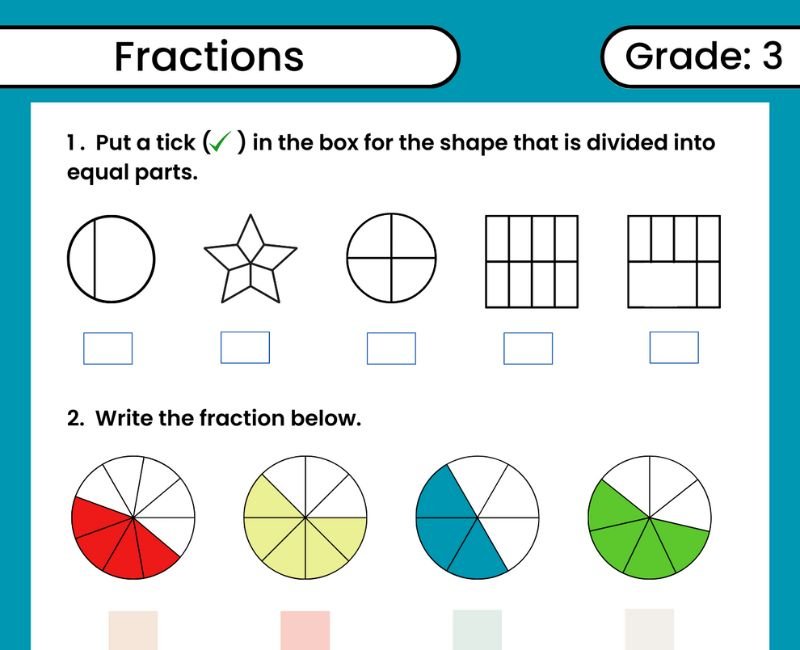
Fractions Worksheet for Class 3Equal parts. Whole new discoveries.
Explore equal parts, shade fractions and discover how smaller pieces make a whole.
Explore WitKnowLearn’s fractions worksheet for Class 3 with online quiz and online activities. Read and shade fractions, identify numerators and denominators, compare matching wholes and locate fractions on a number line. Explore halves, thirds, quarters, equivalent fractions and fractions of a collection through visual models and learning games.
0 of 20 answered
1. What fraction of this whole strip is coloured?
You can return to any question and change your answer.
Fraction Painter
Learning goal: Represent a fraction by selecting equal parts.
- The whole strip has five equal parts. Tap part buttons to select or clear them.
- Show exactly 35, then check. Any three parts are accepted.
Explore the model and explain what each number means.
Four Fraction Discoveries
Learning goal: Connect fractions with time, money and everyday measures.
- Open all four discovery cards.
- Give an everyday example of one of the fraction connections.
Half an hour
One hour has 60 minutes. Half an hour is 30 minutes, and a quarter of an hour is 15 minutes.
A quarter of a year
A year has twelve months. One quarter of twelve months is three months. The months do not all contain the same number of days.
Half a rupee
One rupee equals 100 paise. Half a rupee is 50 paise. A fraction can describe an amount of money.
Same fraction does not always mean same amount
Half of a long ribbon can be longer than half of a short ribbon. Identify the whole before comparing actual amounts.
Explore the model and explain what each number means.
Fractions for Class 3 Meaning Types and Examples
A fraction is a number that can describe equal parts of a whole. For example, if one strip is divided into four equal areas and three are coloured, the coloured fraction is 34, read as three quarters. This fractions worksheet for Class 3 connects pictures, number names, fraction notation and everyday sharing.
Find the whole first
The whole may be one shape, one length or one collection. In a shape model, equal parts have equal area. In a collection model, equal groups contain the same number of objects.
Equal parts matter
A sheet cut into two unequal areas does not show two halves. Counting pieces is not enough: they must be equal parts of the chosen whole.
Numerator and denominator
| Part | Meaning | Example |
|---|---|---|
| Numerator | How many equal parts are selected or counted | 3 selected parts |
| Denominator | How many equal parts make one whole | 4 equal parts in all |
| Fraction bar | Separates the numerator and denominator; a/b also means a divided by b | 34 means three quarters |
Halves thirds quarters and eighths
One half is one of two equal parts. One third is one of three equal parts. One quarter, also called one fourth, is one of four equal parts. One eighth is one of eight equal parts.
| Equal parts | One part | All parts together |
|---|---|---|
| 2 | 12 | 22 = 1 |
| 3 | 13 | 33 = 1 |
| 4 | 14 | 44 = 1 |
| 8 | 18 | 88 = 1 |
Types of fractions with examples
Start with unit and proper fractions. Improper fractions and mixed numbers below are an introduction for learners ready to extend their understanding.
| Type | Meaning | Example |
|---|---|---|
| Unit fraction | Has numerator 1 | 15 |
| Proper fraction | Numerator is smaller than its positive denominator | 35 is less than one whole |
| Improper fraction | Numerator is equal to or greater than its positive denominator | 55 = 1 and 74 is greater than 1 |
| Mixed number | A whole number written with a proper fraction | 1 12 means one and a half |
| Equivalent fractions | Different fraction names with the same value | 12 = 24 = 48 |
These names can overlap. For example, 14 is both a unit fraction and a proper fraction. Equivalent fractions describe a relationship between fractions rather than a separate amount.
How to shade a fraction
- Identify the whole shape.
- Divide it into the number of equal parts shown by the denominator.
- Shade the number of parts shown by the numerator.
To show 25, make five equal parts and shade any two. The shaded sections do not have to touch. For an unshaded-fraction question, count the parts that are not coloured: if 25 is coloured, 35 is uncoloured.
Fractions on a number line
Mark zero and one, then divide the distance between them into equal intervals. Four intervals create quarter-steps: 0, 14, 24, 34 and 1. Count the intervals rather than all the tick marks. The midpoint 24 is also 12.
Comparing fractions for Class 3
Use the same-sized whole. A fraction tells us a share of its whole; half of a small cake need not be larger than a quarter of a much larger cake.
When denominators match, the equal parts have the same size. More parts means more of the whole: 58 > 38. For unit fractions of the same whole, fewer equal parts give larger individual pieces: 12 > 14. Use fraction strips to explain the comparison rather than comparing denominators alone.
Equivalent fractions using pictures
Colour one half of a strip. Split each half into two equal parts without changing the strip. The same coloured area now contains two quarters, so 12 = 24. Splitting each quarter in half gives four eighths: 12 = 24 = 48.
Fractions of a collection
To find one quarter of 16 counters, share 16 equally among four groups. Each group has 4 counters, so 14 of 16 = 4. To find three quarters, take three of those groups: 3 × 4 = 12. The denominator tells us the equal-group count and the numerator tells us how many groups to take.
Fraction word problems with answers
A ribbon is cut into five equal lengths. Two are used. What fraction is used?
25 of the ribbon is used. The whole has five equal lengths and two are selected.
What fraction completes 34 to one whole?
14. Four quarters make one whole and three quarters are already present.
What is half of 18?
18 ÷ 2 = 9. Half of 18 is 9.
What is three quarters of 16?
One quarter is 16 ÷ 4 = 4. Three quarters are 3 × 4 = 12.
Common fraction mistakes
| Mistake | Correction |
|---|---|
| Call any two pieces halves | Check that the areas are equal |
| Swap the numerator and denominator | Say selected parts out of all equal parts |
| Think 18 is larger than 14 because eight is larger | Compare matching wholes; eighths are smaller pieces |
| Count number-line marks instead of spaces | Count equal intervals between zero and one |
| Compare coloured areas from different-sized wholes | Match the wholes before comparing shares |
Use the printable fractions worksheet on this page for written practice, then explore the separate online quiz and online activities. The quiz reports one mark per correct answer out of 20.
Frequently Asked Questions
What is a fraction for Class 3?
A fraction is a number that can describe equal parts of a whole. In 23, the whole has three equal parts and two are counted.
What are the numerator and denominator?
The numerator is the top number and counts selected equal parts. The denominator is the bottom number and counts all equal parts in one whole.
Why must fraction parts be equal?
Each part must represent the same share of the whole. Unequal pieces cannot all be named as the same unit fraction.
What is the difference between a half and a quarter?
A half is one of two equal parts. A quarter is one of four equal parts. For the same whole, a half is twice as large as a quarter.
What is a unit fraction?
A unit fraction has numerator 1, such as 12, 13 or 18. It represents one equal part.
What is a proper fraction?
A proper fraction has a numerator smaller than its positive denominator. For example, 34 is less than one whole.
What are equivalent fractions?
Equivalent fractions have the same value. For example, one half and two quarters name the same amount: 12 = 24.
How do you compare fractions with the same denominator?
Use the same whole. The fraction with the larger numerator is larger because it counts more equal-sized parts.
Why is one half larger than one quarter?
When the same whole is split into two equal shares, each share is larger than when it is split into four. One half contains two quarters.
How do you find a fraction of a number?
Divide the number by the denominator to find one equal group, then multiply by the numerator. For 34 of 12, calculate 12 ÷ 4 = 3 and 3 × 3 = 9.
How do you show fractions on a number line?
Split the distance from zero to one into equal intervals. With four intervals, each step is 14. The third step represents 34.
Can a fraction be equal to or greater than one?
Yes. Four quarters equal one whole: 44 = 1. Five quarters are one whole and one quarter: 54 = 1 14.
Content references
Original questions and diagrams developed around equal parts, unit fractions, number lines and visual comparisons.
 Download