CLASS 2 MATHS • THE MULTIPLICATION MAKER LAB
Multiplication Worksheets for Class 2
with Online Activities and Quiz
Build equal groups, grow an array and jump in equal steps. Discover multiplication with pictures, optional listening and puzzles that make you think.
Build and Explore
Build equal groups, arrange rows and jump to a product.
See Hear and Do
Rotate arrays, explore doubles and tap equal groups.
Think It Through
Find missing factors, repair errors and discover different arrays.
Multiplication Class 2 Online Quiz
Question 1 / 20 • Easy
Three groups have two counters each. How many counters?
Tap an answer to continue.
Quiz and listening guide
Try 10 easy, five average and five thinking questions. The 20-minute timer starts with the first answer or question-navigation action. Read-aloud alone does not start it. Answers advance except at the final question. Review using the question numbers. Submission or timeout shows every explanation. Restart clears answers and pauses the timer. Speech depends on the browser and available voices; all questions and instructions remain visible.
Five Multiplication Adventure Games
Tap the raised selector to choose a game. Each one has five challenges.
Equal Group Garden
Choose a basket, then add one counter at a time. Every basket must be full.
Explore 3 groups of 2. Find the total.
There are 3 equal groups. Each contains 2.
Five Hands-On Online Multiplication Activities
Use a model, listen if you wish and explain why the groups must be equal.
Multiplication Reasoning and Extra Practice
Little Multiplication Stories
Read for equal groups, then write the total with its meaning.
Four plates have three biscuits each. How many biscuits altogether?
There are 4 equal groups. Each contains 3.
How the activity sets work
Five games, five activities and five extra-practice sets provide 75 tasks, separate from the quiz. Games and activities share one active main workspace. Extra practice is independent. Switching sets keeps progress while this page stays open. Use Reset options for one task or its whole set. Work in short sessions. Read-aloud, diagrams, counters and physical suggestions are optional ways to explore the same idea.
Eight Multiplication Tips for Children
- Count the groups and the objects in each group separately.
- Check that every group has the same size.
- Read 3 × 4 here as three groups of four.
- Use repeated addition to explain a multiplication fact.
- On a number line, start at zero and count the equal jumps.
- Rows run across an array; columns run down it.
- Multiplying by one keeps the number; multiplying by zero gives zero.
- Explain your answer with objects, a drawing or words.
Five Tips for Parents and Teachers
- Use buttons, bottle caps or blocks to make equal groups before table recall.
- Ask what each number in the multiplication sentence represents.
- Keep pictures and text available when reading a question aloud.
- Try clapping groups or stepping along a floor number line with adult supervision.
- Offer different ways to explore, without assigning children fixed learning-style labels.
Multiplication Worksheets for Class 2 Guide Examples and Thinking Questions
Why does 3 × 4 give twelve rather than seven? How can a picture help a child remember a multiplication fact? These multiplication worksheets for Class 2 connect equal groups, repeated addition, skip counting and arrays. Use the printable worksheets available on this page alongside the online activities for short, purposeful practice.
This is a general topic resource. It is not presented as a particular NCERT chapter. Start with the models and facts that match the child's school sequence. The main focus is multiplication with small whole numbers, especially the 2, 5 and 10 tables, with gentle 3 and 4 table challenges.
What Is Multiplication?
Multiplication finds a total when equal groups are combined. In this resource, 3 × 4 is read as three groups of four. Count 4 + 4 + 4 = 12, so 3 × 4 = 12. The two numbers being multiplied are factors; the answer is the product. The sign × means multiplied by, and = means both sides have the same value.
Different classrooms may read the order of the factors differently. Always explain what each factor represents in the model. Although 3 × 4 and 4 × 3 have the same product, three plates with four biscuits each and four plates with three biscuits each describe different arrangements.
Equal Groups Multiplication Worksheets
Three bags with five marbles in every bag make fifteen marbles. Write 5 + 5 + 5 = 15 and 3 × 5 = 15. If the bags contain five, five and four, the groups are unequal. Their total is fourteen, but that collection cannot be represented as three equal groups of five.
Ask children to point to one complete group, count how many groups there are, and then count the objects in each. This separates the group count from the total, a common early source of confusion.
Multiplication as Repeated Addition for Class 2
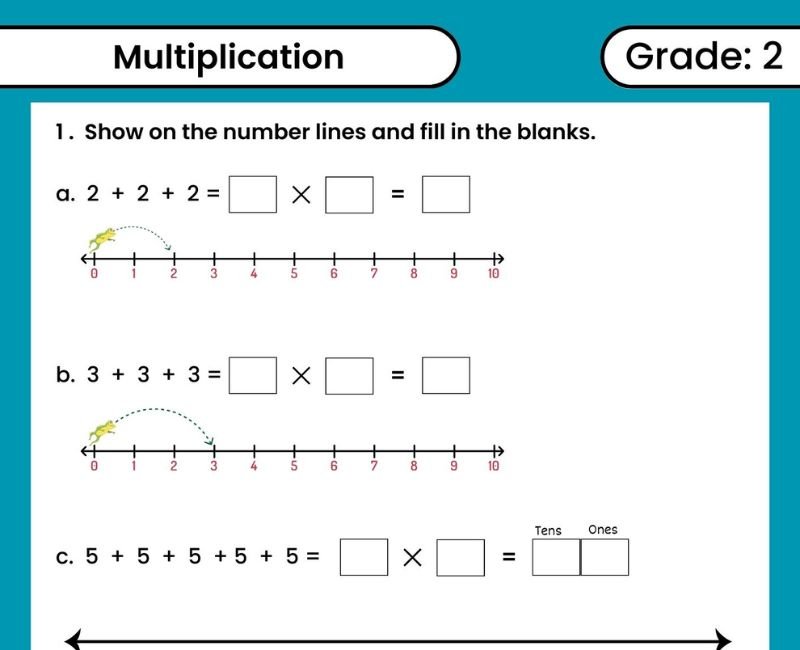
Repeated addition uses the same addend several times. For 4 × 2, write 2 + 2 + 2 + 2 = 8. There are four equal addends, each worth two. Multiplication records this repeated structure in a shorter sentence.
Five boxes have three crayons each. Repeated addition is 3 + 3 + 3 + 3 + 3 = 15. The multiplication sentence is 5 × 3 = 15.
Adding the factors gives a different answer: 5 + 3 = 8. That adds one group of five and one group of three, rather than five groups of three. Build both models to explain why the operations differ.
Multiplication Arrays Rows and Columns
An array arranges objects into equal rows and columns. Three rows of four objects contain twelve objects. Count four objects in each of the three horizontal rows. The same rectangle has four vertical columns with three objects in each column.
Rotating the array gives four rows of three. No objects are added or removed, so 3 × 4 = 4 × 3 = 12. The Array Builder and Rotate and Compare activities make the factors and dimensions visible together.
Skip Counting and Number Line Multiplication
To model 4 × 5 using this page's convention, start at zero and make four jumps of five. Land on 5, 10, 15 and 20. The answer is twenty. Count the jumps rather than counting zero as the first jump.
All jumps must have the same size for this simple multiplication model. A number line keeps one consistent scale so a jump of five covers five number units.
Multiplication Tables for Class 2
Build understanding before asking for rapid recall. The 2 table connects to doubles, the 5 table to groups of five and the 10 table to groups of ten. The table below gives the first ten positive multiples for these three useful starting tables.
| Number | 2 times | 5 times | 10 times |
|---|---|---|---|
| 1 | 2 × 1 = 2 | 5 × 1 = 5 | 10 × 1 = 10 |
| 2 | 2 × 2 = 4 | 5 × 2 = 10 | 10 × 2 = 20 |
| 3 | 2 × 3 = 6 | 5 × 3 = 15 | 10 × 3 = 30 |
| 4 | 2 × 4 = 8 | 5 × 4 = 20 | 10 × 4 = 40 |
| 5 | 2 × 5 = 10 | 5 × 5 = 25 | 10 × 5 = 50 |
| 6 | 2 × 6 = 12 | 5 × 6 = 30 | 10 × 6 = 60 |
| 7 | 2 × 7 = 14 | 5 × 7 = 35 | 10 × 7 = 70 |
| 8 | 2 × 8 = 16 | 5 × 8 = 40 | 10 × 8 = 80 |
| 9 | 2 × 9 = 18 | 5 × 9 = 45 | 10 × 9 = 90 |
| 10 | 2 × 10 = 20 | 5 × 10 = 50 | 10 × 10 = 100 |
When a fact is forgotten, use a known neighbour. For 6 × 5, start with 5 × 5 = 25 and add one more group of five to get thirty. For 4 × 3, double 2 × 3 = 6 to get twelve.
Multiplication by Zero and One
One group of seven contains seven objects, so 1 × 7 = 7. Four groups with zero objects in each contain no objects, so 4 × 0 = 0. Zero groups also contain no objects. Multiplication by zero does not keep the other factor unchanged.
Missing Number Multiplication Questions
In 3 × □ = 15, ask how many objects belong in each of three equal groups to make fifteen. Five in each group works. Check 3 × 5 = 15. In □ × 5 = 20, count how many groups of five are needed: four groups.
Use counters, skip counting or a known table fact to find the missing factor. The missing box can occur in either position. Read the full sentence before answering.
Multiplication Word Problems for Class 2 with Solutions
Four plates hold three biscuits each. How many biscuits are there?
There are four equal groups of three. 4 × 3 = 12 biscuits.
A room has five rows of four chairs. How many chairs are there?
5 × 4 = 20 chairs. Draw five rows with four dots in every row.
Three pencils cost ₹5 each. What is the total cost?
3 × 5 = 15. The total cost is ₹15.
Six children each have two shoes. How many shoes altogether?
6 × 2 = 12 shoes. There are six pairs.
Decide whether the story contains equal groups. Words such as “altogether” also occur in addition stories, so a keyword alone does not decide the operation.
Multiplication Reasoning Questions with Answers
-
Are 3 × 5 and 5 × 3 equal?
Yes. Both give fifteen. Their group arrangements differ, but an array shows that the total stays unchanged when rows and columns swap.
-
What happens when one more group of four is added?
The total increases by four, not by one. For example, 3 × 4 = 12 and 4 × 4 = 16.
-
Can twelve objects make different arrays?
Yes. Examples include two rows of six, three rows of four and four rows of three. The open puzzles accept any dimensions within the stated limits that produce the required total.
-
A child writes 3 × 4 = 7. What went wrong?
The factors were added. Three groups of four give 4 + 4 + 4 = 12.
-
Can groups of two make an odd total?
No, when there is a whole number of complete groups. Each group contributes a pair, so the total is even.
-
Why does doubling the group count double the total?
Each original group has one matching extra group of the same size. For example, two groups of five make ten, and four groups of five make twenty.
Common Multiplication Mistakes
Check for unequal groups, counting the starting zero as a number-line jump, confusing rows with objects in each row, and adding the two factors. Ask the child to explain a model before correcting a written answer. A product alone can be right even when the labels on an array are reversed, so check both the model and the sentence.
Learning with Pictures Listening and Movement
Children can build arrays, listen to a question, read a visible explanation, tap digital objects or use real counters. These are flexible ways to participate. They do not define fixed types of learners. The read-aloud feature uses available browser speech, and every question remains visible if speech is unavailable.
Try placing three counters in each of four cups, clapping four sets of three beats, or stepping four equal jumps on a floor number line. Use safe space and adult guidance. Ask a partner to describe the groups without recounting every object.
Using Printable Multiplication Worksheets with Online Activities
Start with a model, write its repeated addition sentence and then write the multiplication fact. After a few written questions, use an online challenge to test the same idea in a different arrangement. The untimed activity sets suit exploration, while the quiz provides optional timed practice and explanations.
Use the quiz review to discuss methods rather than only scores. This resource offers general topic practice and does not claim guaranteed examination questions or a mandatory school syllabus sequence.
More Class 2 Maths Practice
Frequently Asked Questions
What do multiplication worksheets for Class 2 cover?
Equal groups, repeated addition, arrays, skip counting, early tables, missing factors and simple word problems, with online reasoning activities.
How do I explain multiplication to a Class 2 child?
Make equal groups with real objects. Three groups of four make twelve. Write 4 + 4 + 4 = 12 and 3 × 4 = 12.
What is repeated addition in multiplication?
It adds the same amount several times. Four groups of five can be written as 5 + 5 + 5 + 5 = 20 or 4 × 5 = 20.
Which multiplication tables should we start with?
The activities emphasise 2, 5 and 10, with smaller 3 and 4 challenges. Follow the order used by the child’s school and keep models available.
How do multiplication arrays work?
Arrange equal rows. Three rows of four have twelve objects. Rows run across and columns run down.
How do I use a number line for multiplication?
Start at zero and make equal jumps. For four groups of five, make four jumps of five and land on twenty.
What is the difference between 3 + 4 and 3 × 4?
Three plus four joins those two amounts to make seven. Three groups of four make twelve.
Why does multiplying by zero give zero?
There are no objects in zero groups, and groups containing zero objects also have total zero.
How can I teach missing factors?
Build equal groups or skip count to the total. In □ × 5 = 20, four groups of five are needed.
Do the games accept more than one answer?
The open array puzzles accept every pair within the stated limits whose product matches the target. Other tasks check their particular conditions.
Can children hear the questions and use tap controls?
Yes, when browser speech is available. All text stays visible, and controls use tapping, clicking, typing or keyboard operation rather than requiring dragging.
Is this a particular NCERT chapter worksheet?
No. It is a general multiplication topic resource. Choose practice that matches the child’s current learning sequence.
 Download