CLASS 2 MATHS • THE ADD AND SUBTRACT COLOUR QUEST
Addition and Subtraction Worksheets for Class 2
with Online Activities and Quiz
Add a group, take a jump and discover how numbers connect. Explore addition and subtraction with bright models, fact-family puzzles and thoughtful little challenges.
Build and Explore
Join and remove counters, hop on number lines and match results.
See Hear and Do
Exchange tens and ones, build fact families and bridge through ten.
Think It Through
Solve two-step stories, repair mistakes and test different solutions.
Addition and Subtraction Class 2 Online Quiz
Question 1 / 20 • Easy
What is 6 + 5?
Tap an answer to continue.
Quiz and listening guide
Try 10 easy, five average and five thinking questions. The 20-minute timer starts with the first answer or question-navigation action. Read-aloud alone does not start it. Answers advance except at the final question. Review using the question numbers. Submission or timeout shows every explanation. Restart clears answers and pauses the timer. Speech depends on the browser and available voices; all questions and instructions remain visible.
Five Add and Subtract Adventure Games
Tap the raised selector to choose a game. Each one has five challenges.
Join or Take Away Counter Lab
Move every extra counter for addition, or choose counters to cross out for subtraction.
Model 7 + 6 and find the result.
Join the new amount with the starting amount.
Five Colourful Number Labs
Use a model, listen if you wish and explain what changes and what stays equal.
Addition and Subtraction Reasoning and Extra Practice
Mixed Word Problem Studio
Read the whole situation and enter its answer.
A shelf has 24 books and receives 13 more. How many books are there?
Track every event and decide what the question asks.
Choose a model. Explain the whole, the parts and the change.
How the activity sets work
Five games, five activities and five extra-practice sets provide 75 tasks, separate from the quiz. Games and activities share one active main workspace. Extra practice is independent. Switching sets keeps progress while this page stays open. Use Reset options for one task or its whole set. Work in short sessions. Read-aloud, diagrams and practical suggestions are optional ways to explore the same idea.
Eight Tips for Young Number Explorers
- Read the whole question before choosing an operation.
- Add to join groups; subtract to take away or compare.
- Count jumps rather than counting the starting number.
- Keep tens and ones in their correct places.
- Ten ones can be exchanged for one ten, and one ten for ten ones.
- Check a subtraction by adding the difference and the amount removed.
- In a missing-number sentence, the box may stand for the starting amount.
- Explain your answer with a picture, blocks or words.
Five Tips for Parents and Teachers
- Begin with counters and small numbers, then introduce place-value models.
- Ask what each number represents in the situation.
- Model regrouping as an equal-value exchange before using a written carry or borrowing mark.
- Offer pictures, optional listening, discussion and safe practical number-line movement.
- Use short sessions and flexible participation choices without fixed learning-style labels.
Addition and Subtraction Worksheets for Class 2 Guide Examples and Reasoning
Why do 8 + 7 and 15 − 7 belong together? How can one ten become ten ones without changing the amount? These addition and subtraction worksheets for Class 2 connect counting, place value and reasoning. Use the printable worksheets offered on this page alongside the online activities to build, check and explain number sentences.
This is a general topic resource rather than a named NCERT chapter. Practice includes mixed sums within 20, two-digit addition and subtraction, missing numbers, fact families, regrouping and short word problems. Choose tasks that fit the child’s current classroom sequence.
Addition and Subtraction Meaning
Addition can join quantities or increase an amount. Subtraction can remove an amount, compare quantities or find a missing part. In 7 + 5 = 12, seven and five are parts and twelve is the whole. The related sentence 12 − 5 = 7 recovers one part from the whole.
The equal sign means both sides have the same value. It is not merely an instruction to write a final answer. For example, 9 + 4 = 8 + 5 is true because both sides equal thirteen.
Mixed Addition and Subtraction within 20
Use counters, known facts, doubles and make-ten strategies. For 8 + 7, split seven into two and five. Eight plus two makes ten, then ten plus five makes fifteen. For 14 − 6, remove four to reach ten, then two more to reach eight.
These strategies preserve the original amount added or removed. Do not remove the full six again after already removing four. The Bridge Through Ten lab tracks every step.
Number-Line Addition and Subtraction
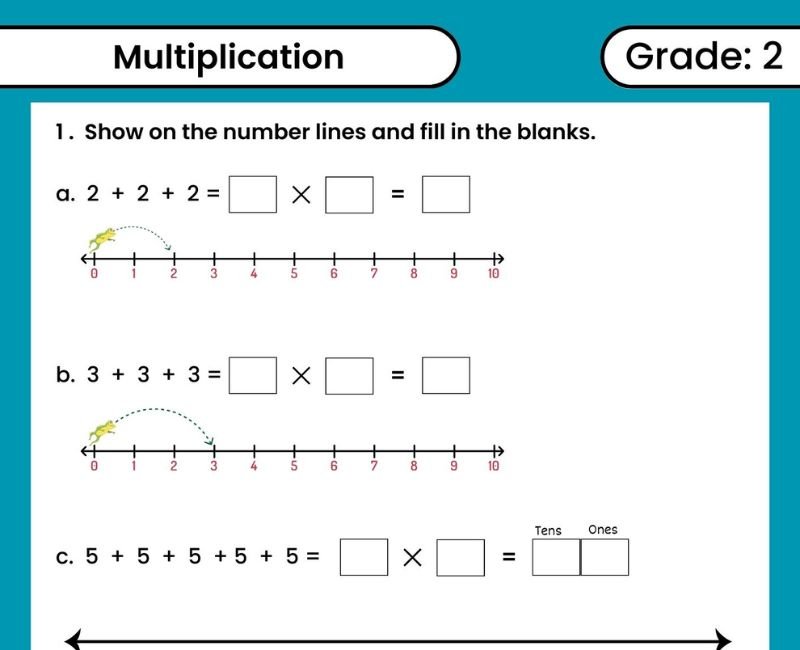
Start at the first number. For addition, move right by the amount added. For subtraction, move left by the amount removed. In 32 + 14, a jump of ten followed by four one-jumps lands at forty-six. In 46 − 14, the same distances in reverse return to thirty-two.
Ten-jumps and one-jumps use the same scale. Count the distance travelled, not the number of labels you see or the starting point as an extra step.
Two-Digit Addition without Carrying
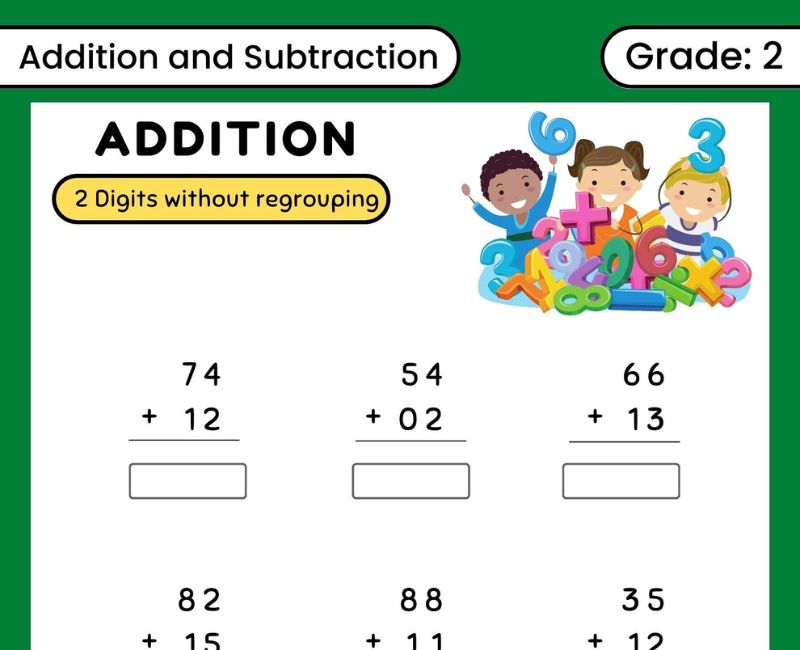
Line up tens and ones. For 23 + 14, three ones plus four ones make seven ones, and two tens plus one ten make three tens. The sum is 37. No exchange is needed because the ones total is less than ten.
Addition with Carrying or Regrouping
For 26 + 18, six ones and eight ones make fourteen ones. Exchange ten ones for one ten, leaving four ones. Two tens plus one ten plus the exchanged ten make four tens. The total is 44.
The small carried 1 represents one ten, not one extra object. Regrouping changes the representation of the same quantity. The addition lab shows the total before and after the exchange.
Two-Digit Subtraction without Borrowing
For 58 − 23, subtract three ones from eight ones to leave five ones, then subtract two tens from five tens to leave three tens. The difference is 35. Aligning the columns keeps ones separate from tens.
Subtraction with Borrowing or Regrouping
For 43 − 17, three ones are not enough to remove seven ones. Exchange one ten from four tens. The same forty-three is now three tens and thirteen ones. Remove one ten and seven ones. Two tens and six ones remain, so the answer is 26.
Exchanging does not increase the starting number. In the subtraction lab, children exchange, remove tens and ones, and see the remaining value after each step. Whole-ten examples such as 80 − 45 follow the same principle.
Addition and Subtraction Fact Families
For the three numbers 6, 9 and 15, the related facts are 6 + 9 = 15, 9 + 6 = 15, 15 − 6 = 9 and 15 − 9 = 6. Addition joins the two parts; subtraction finds a part from the whole.
If 27 + 16 = 43, then 43 − 16 = 27 and 43 − 27 = 16.
The game accepts either valid order for the two addition facts and either valid order for the two subtraction facts. Each fact must be different. Families with equal parts have fewer distinct sentences; the game uses different positive parts to practise four distinct facts.
Missing Numbers in Addition and Subtraction
In 27 + □ = 45, find the amount needed to reach forty-five: eighteen. In □ − 16 = 29, the missing starting number is forty-five because 29 + 16 = 45. In 63 − □ = 28, the missing amount removed is thirty-five.
The same box can represent different roles. Read the complete sentence and check it after filling the box. Do not apply one rule to every missing-number position.
Choosing Addition or Subtraction in Word Problems
Look at the relationships, not just a keyword. Joining twelve red counters and seven blue counters asks for a total. Comparing twelve red counters with seven blue counters asks for a difference. Both stories mention two groups, but the questions are different.
A shelf has 24 books and receives 13 more. There are 24 + 13 = 37 books.
A box contains 42 crayons. Seventeen are used. There are 42 − 17 = 25 left.
One team has 28 points and another has 19. The difference is 28 − 19 = 9 points.
Two-Step Addition and Subtraction Problems
Find the intermediate amount before the final amount. If a bus begins with 15 passengers, eight get on and six get off, first calculate 15 + 8 = 23, then 23 − 6 = 17. Each change applies to the current amount.
The Two-Step Journey lab makes both stages visible. The child completes the joining stage before the removal stage and records the intermediate result as well as the final result.
Checking Answers with Inverse Operations
Addition and subtraction undo each other when the matching amount is used. Check 52 − 27 = 25 by calculating 25 + 27 = 52. An addition check can subtract either addend from the total to recover the other.
Swapping addends keeps a sum unchanged. Swapping the starting number and amount removed does not generally preserve a subtraction result. Discuss examples rather than assuming both operations follow the same rules.
Reasoning Questions with Answers
-
What happens when zero is added or subtracted?
The number stays the same. For example, 18 + 0 = 18 and 18 − 0 = 18.
-
What is a number minus itself?
Zero, because the whole amount is removed.
-
If both numbers in a subtraction increase by two, what happens to the difference?
It stays the same. For example, 15 − 7 and 17 − 9 both equal eight.
-
Can one total have different fact families?
Yes. Twelve can be made from five and seven or from four and eight. The open lab accepts any pair meeting its stated conditions.
-
A robot writes 28 + 16 = 34. What was missed?
Eight plus six makes fourteen ones. The exchanged ten must join the tens. The correct sum is 44.
Learning with Pictures Listening and Movement
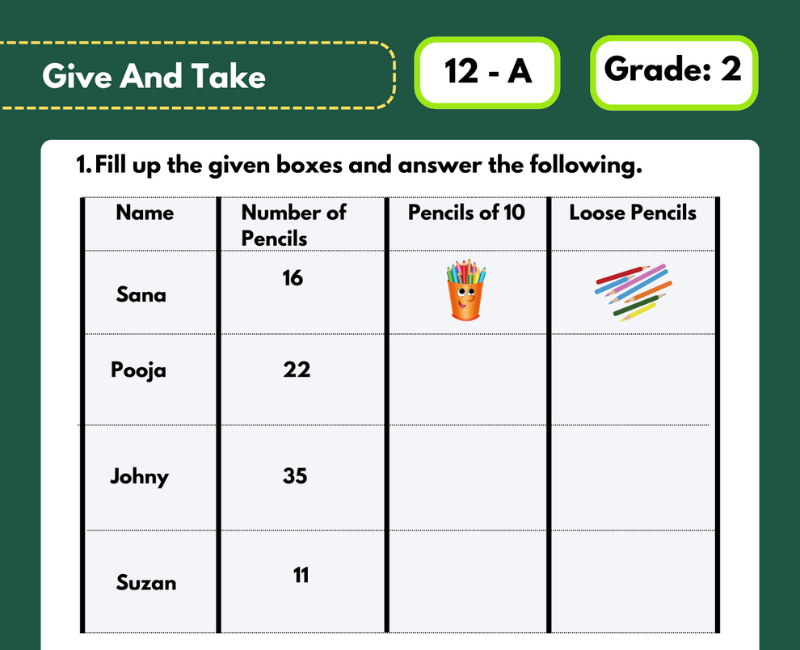
Children can join counters, cross out objects, exchange blocks, listen to a question, type an answer or explain a method to a partner. These are flexible ways to participate rather than fixed learner labels. Every task remains visible if browser speech is unavailable.
For practical work, use a bundle of ten sticks and loose sticks for exchanges. Place number cards on a safe floor space and step forward or backward. Ask a partner to check the return journey.
Using Printable Worksheets with Online Activities
Explore a model, solve a few written questions and use a different model to check. Use quiz explanations to discuss the method, not only the score. Keep practice short enough for children to reason carefully and revisit concepts when needed.
More Class 2 Maths Practice
Frequently Asked Questions
What do addition and subtraction worksheets for Class 2 cover?
Mixed sums, two-digit calculations, carrying and borrowing, number lines, fact families, missing numbers and simple one- and two-step stories.
How do children decide whether to add or subtract?
Read what happens and what is unknown. Joining can ask for a total; taking away or comparing can ask for a difference. Keywords alone are not enough.
What is carrying in addition?
It records an equal-value exchange. Ten ones become one ten. The carried 1 in the tens column represents one ten.
What is borrowing in subtraction?
It is regrouping one ten as ten ones when more ones are needed. The starting quantity stays unchanged until something is removed.
How do number-line games show both operations?
Addition moves right and subtraction moves left. The size and number of jumps must match the amount added or removed.
What is an addition and subtraction fact family?
It links a whole with its parts. For 6, 9 and 15, the facts include 6 + 9 = 15 and 15 − 9 = 6.
How can children find a missing starting number?
Use the inverse relationship. In □ − 8 = 17, add 17 and 8 to find 25, then check 25 − 8 = 17.
How do children solve two-step word problems?
Track the events in order, find the intermediate amount, then apply the next change.
How can subtraction be checked using addition?
Add the difference and the amount removed. Their sum should equal the starting number.
Do the open puzzles accept more than one answer?
Yes. The number-bond lab accepts every positive, unequal pair within its limits that makes the requested total and passes the subtraction check.
Can children listen and play without dragging?
Yes, when browser speech is available. Text remains visible. Controls use tapping, clicking and typing without requiring dragging.
Is this a particular NCERT chapter worksheet?
No. It is a general addition and subtraction resource. Choose tasks according to the child’s classroom sequence.
 Download