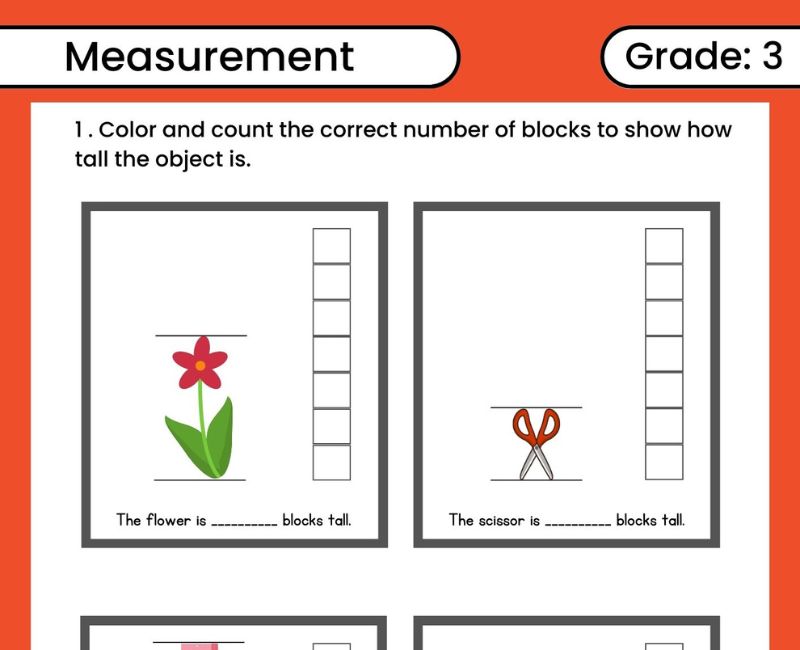
Class 3 Mathematics
Measurement Class 3 Worksheet with Online Activities & Quiz
Read rulers, jugs and weighing scales, then change between metres, centimetres, kilograms, grams, litres and millilitres.
Explore WitKnowLearn’s measurement worksheet for Class 3 with online quiz and online activities. Measure length with a ruler, read weight on a dial scale, find how much a jug holds, and change between units such as metres and centimetres. Every activity uses a ruler, jug, scale or balance you can tap.
Measurement Online Quiz for Class 3
How long is the pencil?
Measurement Online Activities for Class 3
0 / 15 explored
Learning games
Maths workshops
Extra challenges
Ruler Reader
Learning goal: Read the length of an object on a ruler.
How to play: Tap the mark where each object ends, then press Check.
Round 1 of 3: Tap the number where the crayon ends.
Nothing chosen yet.
Measurement for Class 3: complete topic guide
What is measurement?
Measurement means finding out how long, how heavy or how much liquid something is, using a unit. Always write the unit with the number. 7 cm and 7 m are very different.
Standard units and what they measure
| What you measure | Small unit | Big unit | Example |
|---|---|---|---|
| Length and distance | Centimetre (cm) | Metre (m) and kilometre (km) | Pencil in cm, room in m, road in km. |
| Weight (mass) | Gram (g) | Kilogram (kg) | Paper clip in g, rice in kg. |
| Capacity (liquid) | Millilitre (ml) | Litre (l) | Medicine spoon in ml, bucket in l. |
Measuring length with a ruler
Put the start of the object at 0 on the ruler. Read the number at the other end. If the object starts at another mark, subtract: end mark − start mark. A pencil from 2 cm to 9 cm is 9 − 2 = 7 cm long.
Some older books also use inches and feet. They measure length too, but the activities on this page use centimetres and metres.
Changing units
| Fact | Use it to |
|---|---|
| 1 m = 100 cm | Multiply metres by 100 to get centimetres. |
| 1 km = 1000 m | Multiply kilometres by 1000 to get metres. |
| 1 kg = 1000 g | Multiply kilograms by 1000 to get grams. |
| 1 l = 1000 ml | Multiply litres by 1000 to get millilitres. |
Half amounts are easy too. 12 m = 50 cm, 12 kg = 500 g and 12 l = 500 ml.
Reading weight
A balance tips down on the heavier side and stays level when both sides weigh the same. A dial scale shows weight with a needle. Count the small marks between two numbers to read the in-between values.
Reading a measuring jug
Look at the top of the water and read the nearest mark. Check how much each small mark is worth before you read it. A jug that holds 1 l is the same as a jug that holds 1000 ml.
Comparing and adding measures
Change both amounts to the same unit before you compare or add. Then use <, > or =.
Solved examples
Common mistakes
| Mistake | Correction |
|---|---|
| Adding 2 m and 50 cm as 52 | Change to one unit first: 200 cm + 50 cm = 250 cm. |
| Reading the ruler from the start mark instead of subtracting | Take the start mark away from the end mark. |
| Saying a heavier object is always bigger | A balloon is big but light. A coin is small but heavier. |
| Writing 1 kg = 100 g | 1 kg = 1000 g. |
| Using the wrong unit, such as kg for a pencil | Pick the unit that suits the size of the thing. |
| Reading a jug without checking each mark’s value | Find the value of one small step first. |
Measurement in daily life
Tailors measure cloth in metres, shops sell rice in kilograms, cooks measure milk in litres and runners measure races in kilometres.
Related Maths Worksheets
- Measurement Long and Short worksheet for Class 3Compare lengths
- Filling and Lifting worksheet for Class 3Capacity and weight
- Time and Calendar worksheet for Class 3Another kind of measurement
- Perimeter and area worksheet for Class 3Measure around and inside shapes
- Geometry Class 3 worksheet with online activities and quizShapes, lines and angles
- Fractions worksheets for Class 3Halves and quarters of units
- Measurement of length worksheet for Class 2Revise length
- Capacity worksheets for Class 2 with online activitiesRevise litres and jugs
- Comparing heavy and light objects worksheet for Class 2Revise weight
- Measurement worksheets for Class 2Revise measuring basics
- Measurement worksheet for Class 4Extend to bigger measures
- How Heavy How Light worksheet for Class 4Extend weight skills
Frequently Asked Questions
What is measurement for Class 3?
Measurement is finding how long, how heavy or how much liquid something is, using units such as centimetres, kilograms and litres.
Which unit measures length?
Length is measured in centimetres, metres and kilometres.
Which unit measures weight?
Weight is measured in grams and kilograms.
Which unit measures liquid?
Liquid is measured in millilitres and litres. This is called capacity.
How many centimetres are in a metre?
There are 100 centimetres in 1 metre.
How many grams are in a kilogram?
There are 1000 grams in 1 kilogram.
How many millilitres are in a litre?
There are 1000 millilitres in 1 litre.
How do I measure with a ruler?
Put the start of the object at 0. Read the number at the other end. If it starts at another mark, subtract the start from the end.
How do I change metres to centimetres?
Multiply the number of metres by 100. For example, 3 m = 3 × 100 = 300 cm.
How do I read a measuring jug?
Look at the top of the water and read the nearest mark. First find how much each small mark is worth.
What does a balance show?
The heavier side goes down. If the pans stay level, both sides weigh the same.
Can I add 2 m and 50 cm directly?
No. Change them to the same unit first. 2 m = 200 cm, so 200 + 50 = 250 cm.
 Download