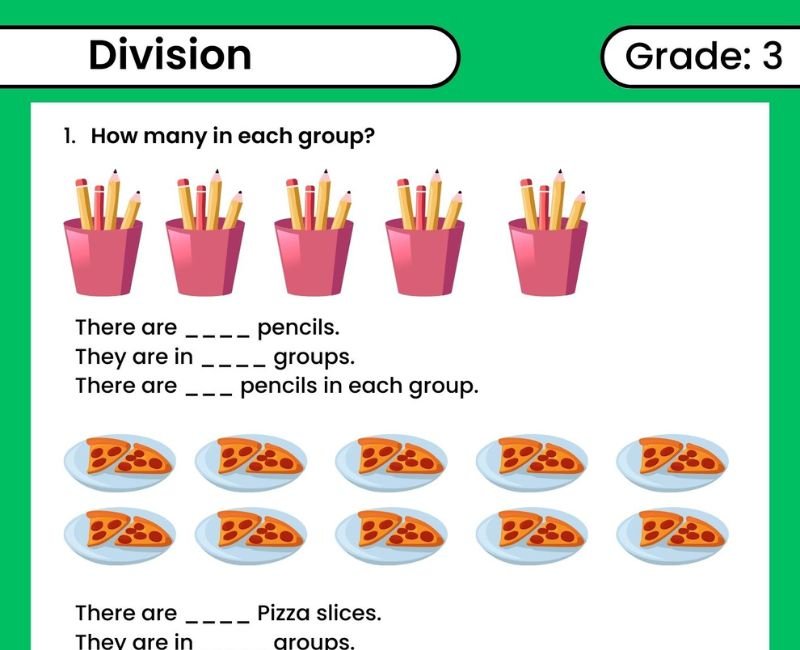
Division Worksheet for Class 3Little groups. Big discoveries.
Discover equal sharing, build division facts and turn everyday stories into maths.
Explore WitKnowLearn’s division worksheet for Class 3 with online quiz and online activities. Build equal groups, interpret arrays and connect division facts with multiplication. Practise repeated subtraction, two-digit division, regrouping, division word problems and remainders through clear models and learning games.
0 of 20 answered
1. 12 counters are shared equally into 3 groups. How many counters are in each group?
You can return to any question and change your answer.
Share the Counters Fairly
Learning goal: Share a total fairly among a known number of groups.
- Share 12 counters among three plates by tapping the plate buttons.
- Use every counter, then check whether all plates have equal amounts. Undo a move if needed.
Counters left to share: 12
Explore the model and explain what each number means.
Four Division Discoveries
Learning goal: Connect division with useful facts and number rules.
- Open all four discovery cards.
- Say or write your own example for each idea.
Seven days make a week
28 days contain four groups of seven days: 28 ÷ 7 = 4 weeks. A calendar month does not always have exactly four weeks.
Zero and one behave differently
0 ÷ 3 = 0, but 12 ÷ 1 = 12. Dividing by zero is not defined.
The remainder has a limit
In whole-number division the remainder is zero or greater, but always smaller than the positive divisor. Otherwise another full group can be made.
A leftover changes the story answer
A leftover counter can stay outside full groups. A person needing a seat cannot be left behind, so a transport problem may need an extra vehicle.
Explore the model and explain what each number means.
Division for Class 3 Meaning Methods and Examples
What is division?
Division finds how a total is shared into equal groups. Sometimes we know the number of groups and find the amount in each group. Sometimes we know the size of each group and find the number of groups. The symbol ÷ means divided by.
This division worksheet for Class 3 develops equal sharing, equal grouping, arrays, division facts, repeated subtraction, two-digit division and simple remainders. Division sums and division word problems become easier when children connect each number to its role in the situation.
Equal sharing
Share 18 crayons equally among 6 children. The number of groups is known: six children. Find the amount in each group.
18 ÷ 6 = 3 crayons each. Every child receives the same number.
Equal grouping
Pack 18 crayons into boxes of 3. The size of each group is known: three crayons. Find the number of groups.
18 ÷ 3 = 6 boxes. Count how many full groups can be made.
Dividend divisor quotient and remainder
| Term | Meaning | Value |
|---|---|---|
| Dividend | The total being divided | 38 |
| Divisor | The number we divide by | 5 |
| Quotient | The whole-number answer | 7 |
| Remainder | The amount left after making full equal groups | 3 |
Checking rule: divisor × quotient + remainder = dividend.
For this example: 5 × 7 + 3 = 38. With a positive divisor, the remainder must be zero or greater and smaller than the divisor. If enough remains for another full group, continue dividing.
Division without and with a remainder
Exact division: 42 ÷ 6 = 7. All items fit into full equal groups, so the remainder is zero.
Division with a remainder: 29 ÷ 4 = 7 remainder 1. Seven groups of four use 28 items, leaving one item. Here we are counting whole items without cutting them into smaller parts.
How arrays show division
An array arranges objects in equal rows and columns. If 30 counters make 5 equal rows, each row contains 6 counters. This gives 30 ÷ 5 = 6. If every row contains 6, then 30 ÷ 6 = 5 tells us the number of rows. Always label what the quotient represents.
Use multiplication to solve division
Ask which multiplication fact makes the dividend. For 56 ÷ 8, think “8 times what equals 56?” Since 8 × 7 = 56, the quotient is 7. The related fact is 56 ÷ 7 = 8. Multiplication and division undo each other.
Repeated subtraction and number-line jumps
To find 24 ÷ 4, subtract four repeatedly: 24 → 20 → 16 → 12 → 8 → 4 → 0. Six equal steps reach zero, so 24 ÷ 4 = 6. The quotient counts the steps, not the size of each step.
Two-digit division and regrouping
Split a dividend into convenient parts when possible. For 65 ÷ 5, use 50 ÷ 5 = 10 and 15 ÷ 5 = 3. Add the partial quotients: 10 + 3 = 13.
Example with an exchange: 96 ÷ 4. Share 9 tens among four groups. Each group gets 2 tens, using 8 tens. Exchange the remaining ten for 10 ones. With the original 6 ones, there are 16 ones. Each group gets 4 ones. Therefore 96 ÷ 4 = 24. Check: 4 × 24 = 96.
Read the remainder in context
If 19 children need vehicles holding at most 6 children each, three vehicles hold only 18 children. A fourth vehicle is needed for the last child. The calculation is 19 ÷ 6 = 3 remainder 1, but the question asks for enough vehicles for everyone, so the answer is 4 vehicles.
If the question asks only for full teams of six from 19 children, the answer is 3 full teams with 1 child left. The same calculation can lead to differently worded answers because the questions differ.
Special rules for zero and one
- A number divided by 1 stays the same: 14 ÷ 1 = 14.
- A non-zero number divided by itself equals 1: 14 ÷ 14 = 1.
- Zero divided by a positive number equals zero: 0 ÷ 4 = 0.
- Division by zero is not defined. Do not write 14 ÷ 0 = 0.
Common mistakes and corrections
| Mistake | Correction |
|---|---|
| Make unequal shares | Every complete equal group must have the same size |
| Confuse group size with group count | Label what is known and what the question asks |
| Leave a remainder larger than the divisor | Make another full group |
| Ignore a leftover when everyone needs a place | Decide whether an extra container or vehicle is needed |
| Lose a ten when regrouping | Exchange it for ten ones and keep the total value unchanged |
Practice questions with explanations
What is 63 ÷ 7?
63 ÷ 7 = 9, because 7 × 9 = 63.
What are the quotient and remainder in 50 ÷ 6?
The quotient is 8 and the remainder is 2. Check: 6 × 8 + 2 = 50. Two is smaller than six.
42 divided by a missing number equals 7. What is the divisor?
The divisor is 6 because 6 × 7 = 42.
26 balls go into boxes holding at most 6 each. How many boxes hold every ball?
Four full boxes hold 24 balls. The remaining two need another box, so five boxes are needed.
The separate online quiz awards one mark per correct answer and reports marks out of 20. The activities use different examples to practise building, checking and explaining division.
Frequently Asked Questions
What is division for Class 3?
Division finds how a total is shared into equal groups or how many groups of a given size can be made.
What is the difference between sharing and grouping?
Sharing gives the number of groups and asks how much goes in each group. Grouping gives the group size and asks how many groups can be made.
What do dividend divisor and quotient mean?
The dividend is the total being divided, the divisor is the number we divide by, and the quotient is the answer.
How does multiplication help with division?
Use a known multiplication fact. Since 8 × 7 = 56, both 56 ÷ 8 = 7 and 56 ÷ 7 = 8 are true.
How do you divide using repeated subtraction?
Subtract the same divisor repeatedly. Count the subtractions until zero or a smaller leftover is reached. That count is the whole-number quotient.
What is a remainder?
A remainder is the amount left after making as many full equal groups as possible when counting whole items.
Can a remainder be larger than the divisor?
Not in a completed whole-number division with a positive divisor. The remainder must be smaller; otherwise another full group can be made.
How do you check division with a remainder?
Multiply the divisor by the quotient and add the remainder. The result should equal the dividend.
How do you divide a two-digit number by one digit?
Use multiplication facts, split into convenient parts or share the tens and ones. Exchange a remaining ten into ten ones when needed.
What happens when a number is divided by one?
The number stays the same. For example, 14 ÷ 1 = 14.
Can zero be divided by another number?
Zero divided by a non-zero number equals zero. Division by zero is not defined, including 0 ÷ 0.
When does a remainder mean an extra box is needed?
When every item must be packed and each box has a maximum capacity, even a small leftover needs another box. Read the question before reporting the answer.
Content references
Original practice questions and diagrams informed by the worksheet topics and elementary division teaching resources.
 Download