
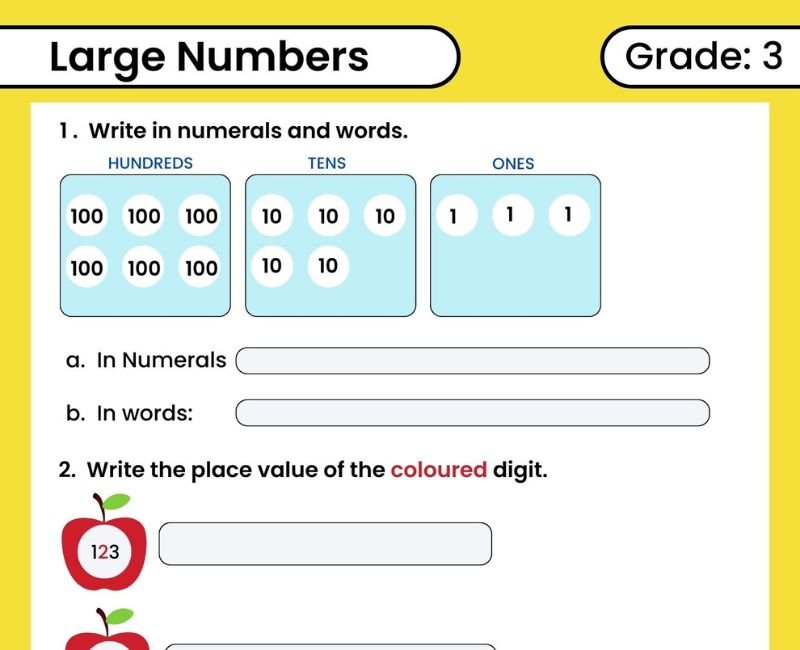
Place Value and Face Value Worksheet for Class 3
Build numbers. Exchange blocks. Discover digit values.
Explore hundreds tens ones and thousands with models you can change.
Explore WitKnowLearn’s place value and face value worksheet for Class 3 with online quiz and online activities. Read place value charts, build three-digit and four-digit numbers, use an abacus and base-ten blocks, write expanded form and standard form, and compare digit values. Practise zero placeholders, greatest and smallest numbers, and equal-value exchanges through clickable maths lab activities.
0 of 20 answered
Explore · Easy • Face value
1. What is the face value of 7 in 572?
You can return to any question and change your answer.
Build 436 on the Abacus
Learning goal: Build a number using hundreds tens and ones.
- Tap an abacus column to add one bead. After nine beads the next tap clears that column.
- Make 436. Each H bead is 100, each T bead is 10 and each O bead is 1.
Your number: 0 = 0 + 0 + 0
Explore the model and explain what changes.
Four Number Discoveries
Learning goal: Connect base ten to familiar quantities.
- Open all four discovery cards.
- Describe one connection between ten-based grouping and everyday quantities.
Ten is the next place
Our decimal number system groups in tens. Ten ones make a ten, ten tens make a hundred and ten hundreds make a thousand.
Money groups
₹100 has the same value as ten ₹10 amounts or one hundred ₹1 amounts. Different groupings can keep the same total.
A century
A century is one hundred years and a decade is ten years. Ten decades make a century.
A metre
One metre is one hundred centimetres. This gives a useful everyday connection with a group of one hundred.
Explore the model and explain what changes.
Place Value and Face Value for Class 3 Meaning Rules and Examples
Place value is the value a digit represents because of its position in a number. Face value is the digit itself. In 572, the digit 7 has face value 7 and place value 70 because it is in the tens place.
For a 4 in the hundreds place: 4 × 100 = 400. Its face value remains 4.
Hundreds tens ones and thousands
Read places from the right: ones, tens, hundreds and thousands. Ten ones make one ten, ten tens make one hundred, and ten hundreds make one thousand. Each place to the left has ten times the value of the place immediately to its right.
| Thousands | Hundreds | Tens | Ones |
|---|---|---|---|
| 2 | 4 | 3 | 6 |
| 2000 | 400 | 30 | 6 |
2436 = 2000 + 400 + 30 + 6. It has two thousands, four hundreds, three tens and six ones.
Difference between place value and face value
| Digit and position | Face value | Place value |
|---|---|---|
| 5 in hundreds | 5 | 500 |
| 7 in tens | 7 | 70 |
| 5 in ones | 5 | 5 |
The two 5s have the same face value but different place values. A digit’s face value does not change when it moves; its place value usually does. Zero has face value 0 and place value 0 in every position.
Expanded form and standard form
Expanded form writes a number as a sum of its place values: 486 = 400 + 80 + 6. Standard form writes the combined number: 500 + 30 + 9 = 539. In this page’s elementary place-value context, standard form means the usual numeral.
Zero-valued terms may be included or omitted: 704 = 700 + 0 + 4 = 700 + 4. Keep the zero in the numeral 704 because it marks the empty tens place.
Why zero matters
306 has three hundreds, no tens and six ones. It is different from 36, which has three tens and six ones. Zero contributes no amount in a place but preserves the position of the other digits. A leading zero does not create another digit place: 036 is still the number 36.
Using an abacus and base-ten blocks
On a labelled abacus, beads on different rods have different values. Four beads on H mean 400; four beads on T mean 40. Base-ten blocks show the same structure: a hundred flat contains a 10 by 10 arrangement of unit squares, a ten rod contains ten units, and a single cube represents one unit.
Grouping and regrouping
Different groupings can represent the same number. For example, 2 hundreds + 4 tens + 4 ones= 244. Exchanging one ten gives 2 hundreds + 3 tens + 14 ones, still 244. These are non-standard groupings of the same value.
| Exchange | Equal value |
|---|---|
| 10 ones ↔ 1 ten | 10 |
| 10 tens ↔ 1 hundred | 100 |
| 10 hundreds ↔ 1 thousand | 1000 |
Greatest and smallest numbers
When each given digit must be used once, make the greatest number by placing larger digits in larger places. With 7, 1 and 4, the greatest number is 741. To make the smallest three-digit number, put the smallest non-zero digit first, then arrange the remaining digits in increasing order. With 0, 3 and 8, the smallest three-digit number is 308.
Comparing numbers
Compare the greatest place first. For 604 and 640, the hundreds match. Compare tens next: 0 tens is less than 4 tens, so 604 < 640. If two positive whole numbers have different digit counts and neither has leading zeros, the one with more digits is larger.
Solved place value questions
What are the face value and place value of 8 in 381?
The face value is 8. The digit is in the tens place, so the place value is 8 × 10 = 80.
Write 605 in expanded form.
605 = 600 + 0 + 5, or 600 + 5. Zero keeps the tens place in the numeral.
What number has 4 hundreds 13 tens and 2 ones?
400 + 130 + 2 = 532. Regroup ten of the tens into an extra hundred.
What is the difference between the values of the two 4s in 442?
The values are 400 and 40. Their difference is 400 − 40 = 360.
Common mistakes and corrections
| Mistake | Correction |
|---|---|
| Give 6 as the place value of 6 in 362 | 6 is its face value; 60 is its place value |
| Write 72 instead of 702 | Keep zero in the empty tens place |
| Add digit faces to find the number | Add place values: 352 = 300 + 50 + 2 |
| Treat 12 tens as the digit 12 in a standard chart | Regroup ten tens into one hundred |
| Start a three-digit number with zero | Use a non-zero hundreds digit |
Use the printable place value worksheet on this page for written practice and the separate online quiz and online activities to build, inspect, exchange and explain numbers.
Frequently Asked Questions
What is place value for Class 3?
Place value is the value a digit represents because of its position. In 368, the 6 represents 60 because it is in tens.
What is face value?
Face value is the digit itself. The face value of 6 in 368 is 6.
How do you calculate place value?
Multiply the digit by its place. A 4 in hundreds has value 4 × 100 = 400.
What is the difference between place and place value?
Place names the position, such as tens. Place value gives the amount represented, such as 70 for seven tens.
What are hundreds tens and ones?
A hundred is 100 ones, a ten is 10 ones and a one is a single unit.
Why is zero important in a number?
It marks an empty place. In 405, zero keeps the tens position and separates four hundreds from five ones.
What is expanded form?
It writes a number as a sum of its place values. For example, 672 = 600 + 70 + 2.
What is standard form in place value?
It is the usual numeral for the number. For example, 600 + 70 + 2 is written as 672.
Can the same digit have different place values?
Yes. In 553, the first 5 means 500 and the second means 50. Both have face value 5.
What is the place value of zero?
Zero represents no amount in its position, so its place value is zero. Its placeholder role is still important.
How many tens make one hundred?
Ten tens make one hundred: 10 × 10 = 100.
How do you make the smallest number using zero?
Put the smallest non-zero digit in the first place, then arrange the remaining digits in increasing order. Using 0, 2 and 7 once each gives 207 as the smallest three-digit number.
 Download


