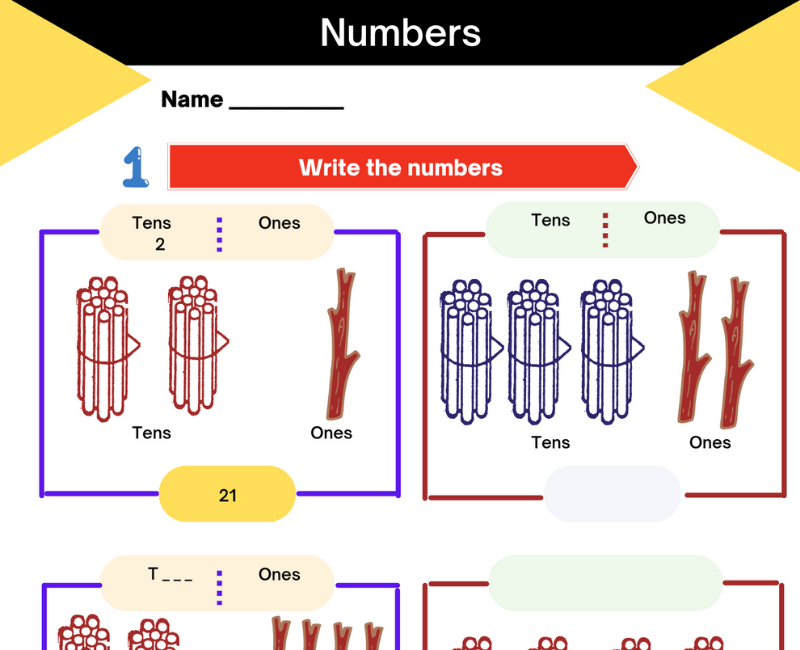
Bundle Builders: Ten Ones Make One Ten! 🧱
Explore this grouping tens and ones worksheet for Class 1 with an online quiz, ten interactive games and activities, and five practice sets. Make complete bundles, count leftover ones and test equal exchanges.
📝 Grouping Tens and Ones Online Quiz for Class 1
Question 1 of 20 • Answered: 0/20
🔘 Group all sixteen buttons
A tray contains 16 loose buttons. After making every possible complete ten-group, what remains?
🎮 Grouping Tens and Ones Online Games for Class 1
Bundle distinct counters, open a ten without changing its value, repair group sizes, pack an order and process new arrivals.
1. 📦 Bundle Thirty-Two Counters
Select exactly ten different loose counters, then bundle them. Repeat until fewer than ten loose counters remain.
Selected for the next bundle: 0
Ready to play!
2. 🔓 Open One Ten
This collection starts with three tens and four ones. Open exactly ONE ten into loose ones. Keep every object, then check the new grouping.
Ready to play!
3. 🧺 Repair the Three Groups
The baskets contain nine, eleven and ten counters. Move counters between baskets until EVERY basket contains exactly ten.
Ready to play!
4. 🚚 Pack a Forty-Two Order
The order needs forty-two items. Each purple pack holds ten; each green item is one. Pack the order using complete tens and fewer than ten loose ones.
Ready to play!
5. 🏭 Process New Arrivals
Three batches arrive: six, seven and eight objects. Receive each batch, bundle any complete tens, then approve its grouped record before the next batch.
Approved batches: 0 of 3
Ready to play!
🧠 Tens and Ones Grouping Online Activities
Inspect packs, repair labels, solve a quantity clue, count bundles before ones and create a grouping riddle.
6. 🔍 Inspect the Packs
Choose a pack card. Sort it by whether its stated contents make exactly one ten.
Ready to play!
7. 🔧 Repair the Total Labels
These grouping records are correct, but their total labels are wrong. Replace each label with the correct numeral.
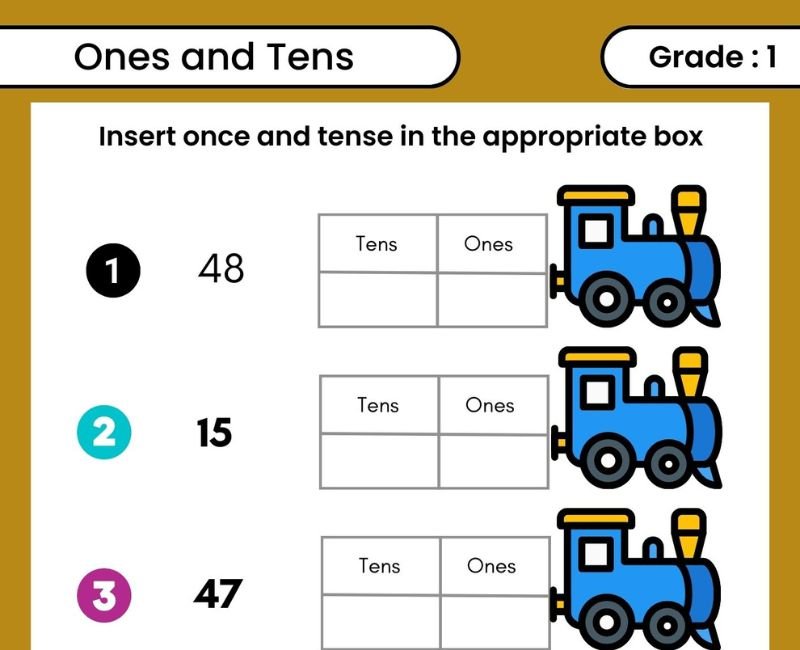
4 tens and 7 ones
6 tens and 0 ones
1 ten and 5 ones
Ready to play!
8. 🕵️ Build the Hidden Collection
The total is greater than seventy and less than eighty. After making complete tens, eight loose ones remain. Build the only collection that fits both clues.
Ready to play!
9. 🗣️ Count Bundles, Then Ones
The model shows five tens and three ones. Tap the counting labels in the order you would say them: count every bundle, then count on for the three loose objects.
Ready to play!
10. ✨ Make a Grouping Riddle
Choose a total from ten to ninety-nine. Create its grouped model with the numeral hidden, ask a partner to solve it, then reveal the number. This riddle maker is not graded.
Ready to play!
✏️ Grouping Tens and Ones Practice
1. 🧱 Read a Grouped Model
Every long rod contains ten unit squares. Record the complete tens, leftover ones and total.
Ready to explore.
2. 📦 Finish Grouping Twenty-Four
Twenty-four loose objects are grouped into every possible complete ten. Record the number of groups and the leftover ones.
Ready to explore.
3. 🔄 Check an Equal Exchange
Start with six tens and seven ones. One ten is opened. Record the tens and loose ones AFTER the opening.
Ready to explore.
4. 🧠 Arrange the Grouping Method
Tap the method cards in an order that makes complete groups before recording the total.
Ready to explore.
5. 📝 Plan a Real Grouping Task
Choose objects and a quantity to group away from the screen. This practical plan is not graded.
Ready to explore.
💡 Tens and Ones Grouping Tips
👩🏫 Five Parent and Teacher Tips
- Let children count ten distinct objects before making a bundle.
- Make the contents of each ten visible before using sealed packs.
- Name the units: three tens and two ones, rather than three and two.
- Exchange in both directions to show that the total stays unchanged.
- Stop forming complete tens when fewer than ten loose ones remain.
🌟 Six Tips for Students
- Count each object once.
- Make groups of exactly ten.
- Keep every object in just one group.
- Count bundles in tens.
- Count on in ones for the loose objects.
- Check that your grouped model and numeral have equal value.
📄 Grouping Tens and Ones Worksheet for Class 1
📖 Read the Grouping Tens and Ones Learning Guide
📦 Build the meaning of a ten
A grouping tens and ones worksheet for Class 1 connects counting objects with place value. Children first count ten individual objects, bring them together and name the completed group one ten. The bundle is one group, but its value remains ten objects. Keep the contents visible until children can explain why counting a bundle as a single piece does not give its numerical value.
🟣 Form complete groups and count leftovers
Continue making ten-groups while at least ten ungrouped objects remain. Each object must belong to one group only. The leftover objects are individual ones. For example, thirty-eight objects make three complete tens and eight loose ones. Count the bundles as ten, twenty, thirty, then continue thirty-one through thirty-eight for the extra objects.
🔄 Exchange without changing the total
Ten loose ones can be exchanged for one ten, and a ten can be opened into ten ones. Neither action adds or removes objects. Different grouped arrangements can therefore represent the same total. The usual tens-and-ones form has fewer than ten loose ones. Opening a bundle is useful for checking its contents and explaining equivalent representations.
✏️ Record the value accurately
Connect a grouped collection with its spoken name, tens-and-ones record and numeral. Zero in the ones position means there are no loose ones after complete tens are formed. Single-digit quantities have no complete ten. Watch for children who add the number of bundle pieces to the loose-object count instead of counting the value inside each bundle.
🎮 Move between models and paper
Use the existing page download option for the printable grouping tens and ones worksheet. The separate online games support selecting, bundling, exchanging, inspecting and recording collections. Extend the models with real counters or craft sticks. Ask children to predict a grouping, construct it and explain why its value matches the written number.
💬 Grouping Tens and Ones Worksheet FAQs
❓ How do you teach grouping into tens and ones?
Count ten real objects, put them together and call the group one ten. Make more complete tens, then count the leftover ones.
❓ How many ones make one ten?
Exactly ten individual ones make one ten. Both representations have the same value.
❓ Why must every ten-group have exactly ten objects?
The unit one ten has a fixed value of ten. A group of a different size needs correcting before it can be counted as a ten.
❓ When should children stop making groups of ten?
Stop when fewer than ten ungrouped objects remain. Those objects are the leftover ones.
❓ How do you count bundles and loose objects?
Count complete bundles in tens, then count on by one for each loose object.
❓ What does zero in the ones position mean?
In the usual grouped form, it means there are no loose ones after the complete tens are formed.
❓ Can a number have zero complete tens?
Yes. A single-digit quantity has fewer than ten objects, so it has no complete ten and only individual ones.
❓ Does opening a ten-bundle change the total?
No. The ten objects are still present. Only their arrangement has changed.
❓ Can two different groupings represent the same number?
Yes. Exchanging one ten for ten ones produces a different grouping with equal total value.
❓ Why does a child count bundles as individual objects?
They may be counting visible pieces without considering the ten objects inside each bundle. Open a bundle and count its contents together.
❓ How is grouping related to place value?
Grouping makes the base-ten structure visible. It helps children connect the tens and ones in a collection with the digits in a numeral.
❓ Where are the printable worksheet and online answers?
Use the existing page download option for the printable worksheet. Quiz answers appear after End Quiz or timeout. Each interactive task provides its own feedback.
Make complete tens, count leftover ones and explain the total.
Back to the Online Quiz ↑ Download