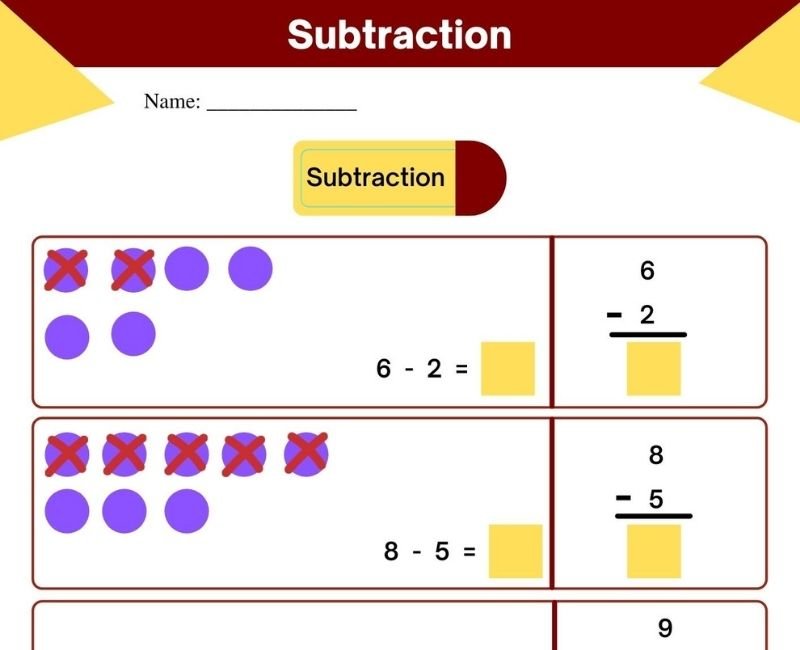
Subtraction Worksheet for Class 1
There are nine crayons in a box. Three are taken out. How many remain? Subtraction helps children understand situations like this by connecting numbers with taking away, finding what is left and comparing quantities.
Use this subtraction worksheet for Class 1 as part of regular maths practice. The explanations and additional questions below help children explore subtraction with objects, drawings and number lines. Start with small quantities, encourage children to explain their thinking and gradually introduce larger numbers when they are ready.
What Does Subtraction Mean?
Subtraction can represent removing part of a group. In 9 - 3 = 6, we start with nine objects, take away three and have six remaining. Read the number sentence as “nine minus three equals six.” The minus sign (-) represents subtraction, and the equal sign (=) shows that both sides have the same value.
Show it with objects: Place nine counters on a table. Move three aside. Count the six counters that remain, then write 9 - 3 = 6.
Keep the starting quantity, the quantity removed and the remaining quantity visible. This helps children understand what each number in the subtraction sentence represents.
Subtraction Using Pictures and Crossing Out
Drawing gives children a simple way to record a take-away problem. To solve 7 - 2, draw seven circles, cross out two and count the five circles that have not been crossed out. Write the answer as 7 - 2 = 5.
Encourage children to check their drawing before counting the answer. Did they draw the correct starting number? Did they cross out exactly the number being subtracted? Neat rows and clear marks make it easier to keep track of the objects.
Counting Backwards and Using a Number Line
Counting backwards is useful for subtracting a small number. For 10 - 3, start at ten and count back three steps: nine, eight, seven. The answer is seven. The starting number is the starting position; it is not counted as the first step.
On a number line with numbers increasing from left to right, subtraction can be shown by moving left. For 14 - 4, begin at fourteen and make four jumps to thirteen, twelve, eleven and ten. Mark each jump so your child can check both the direction and the number of steps.
Finding the Difference Between Two Groups
Subtraction also helps children find how many more or fewer objects one group has than another. Suppose one child has eight stickers and another has five. Arrange the stickers in two rows and match them one to one. Three stickers in the longer row remain unmatched.
The difference is three: 8 - 5 = 3. The first child has three more stickers, and the second child has three fewer. This example shows that subtraction is useful for comparison as well as taking objects away.
Zero, Equal Quantities and Missing Numbers
Subtracting zero leaves the starting quantity unchanged. For example, 6 - 0 = 6 because nothing has been removed. Subtracting all the objects leaves zero: 6 - 6 = 0.
Missing-number questions ask children to think about the whole relationship. In 8 - ___ = 5, begin with eight counters and remove counters until five remain. Three were removed, so the missing number is three.
For ___ - 2 = 6, think about the starting group. Six remain after two are removed, so the original group contained eight. Adding the removed objects back helps children check the answer.
Extra Subtraction Questions for Class 1 with Answers
Complete these additional practice questions in a notebook. Use counters, drawings or a number line to show your working. Open the answer section after trying the questions.
- 5 - 1 = ___
- 7 - 3 = ___
- 9 - 5 = ___
- 8 - 0 = ___
- 6 - 6 = ___
- 10 - 4 = ___
- 13 - 2 = ___
- 15 - 5 = ___
- 18 - 7 = ___
- 20 - 10 = ___
- 9 - ___ = 6
- ___ - 4 = 5
- A basket contains 12 apples. Five apples are taken out. How many remain?
- Arun has 9 toy cars and Neha has 6. How many more toy cars does Arun have?
- A child has 8 beads and gives all 8 away. How many beads remain?
- Is 10 - 3 equal to 3 - 10? Explain using a group of objects.
View answers to the extra practice questions
1. 4; 2. 4; 3. 4; 4. 8; 5. 0; 6. 6; 7. 11; 8. 10; 9. 11; 10. 10; 11. 3; 12. 9; 13. 7 apples; 14. 3 more toy cars; 15. 0 beads; 16. No. Ten objects with three removed leave seven. A group of three objects does not contain ten objects to remove. The order matters in subtraction.
A Simple Take-Away Activity for Home or School
Place ten counters in a tray. Ask your child to remove a chosen number, count what remains and write the matching subtraction sentence. Repeat with a different starting quantity. Let your child create a question for you as well.
Check understanding by asking, “What did we start with?”, “How many did we remove?” and “How many are left?” If an answer is incorrect, rebuild the starting group and repeat the action together. Focus on understanding the quantities before increasing speed.
Related Class 1 Maths Worksheets
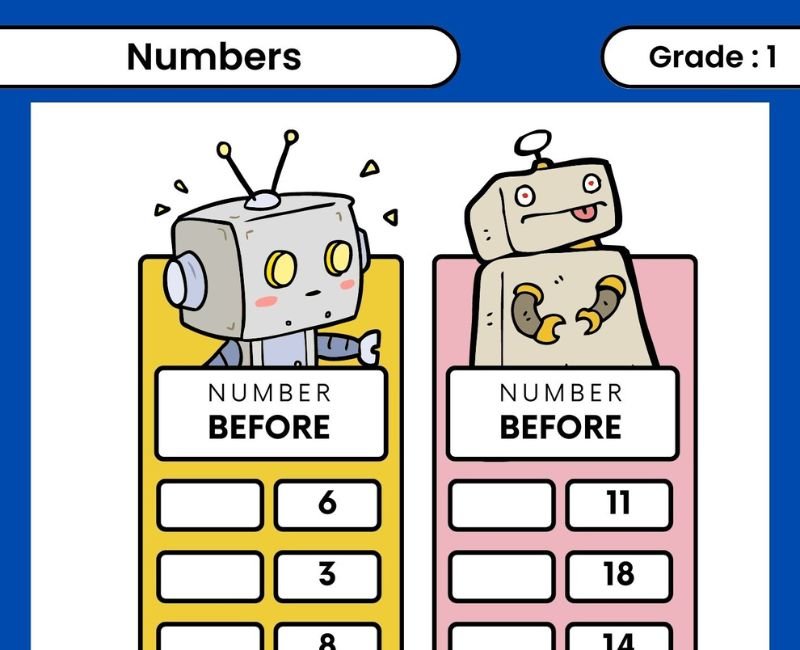
Addition and Subtraction Worksheets: Practise both operations and explore their relationship. Before and After Numbers Worksheet: Strengthen number order for counting backwards. Numbers 1 to 20 Worksheet: Build counting confidence for subtraction practice. Comparing Numbers Worksheet: Explore greater, smaller and equal quantities. Browse Class 1 Maths Worksheets: Find more topics for regular practice.Frequently Asked Questions
How do I introduce subtraction to a Class 1 child?
Begin with a small group of objects. Remove some, count what remains and write the matching number sentence. Let the child perform the action before solving written questions.
Why does my child count one extra step when subtracting?
The child may be counting the starting number as a step. For 8 - 2, start at eight, then count two movements: seven and six. Drawing two jumps on a number line can make this clearer.
How can addition help children check subtraction?
Add the removed quantity to the remaining quantity. For 11 - 4 = 7, check that 7 + 4 = 11. This rebuilds the original group.
Is subtraction only about taking away?
No. It can also find the difference between quantities or a missing part. For example, comparing eight pencils with five pencils gives a difference of three.
Should children solve subtraction mentally or use objects?
Use objects, pictures or number lines when they help the child understand. Encourage mental answers for familiar facts while allowing children to show or explain their method.
Are answers available for the extra questions?
Yes. Open the answer section beneath the additional practice questions in this description to check the corresponding answers.
 Download