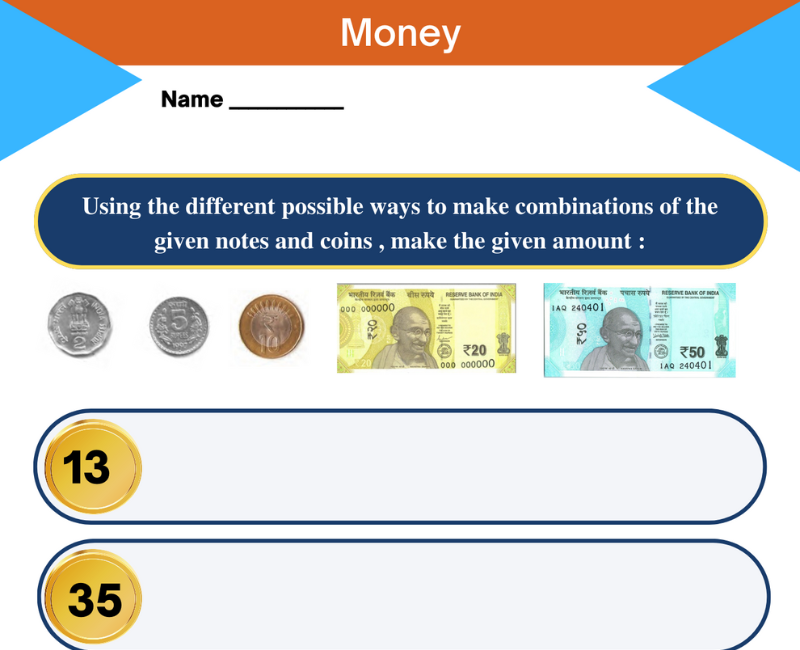
Money Worksheet for Class 1
Can two coins have the same total value as one coin? How much money is needed to buy an item priced at five rupees? Learning about money helps children connect counting, addition and subtraction with familiar shopping situations.
Use this money worksheet for Class 1 to practise recognising Indian coins and understanding their values. The explanations and extra activities below introduce counting rupees, making equal amounts, comparing money and finding simple change. Begin with small amounts and use clearly labelled play money to make each calculation easy to follow.
Recognising Indian Coins and Money Values
Start by looking at the value written on each coin or play-money card. Read the number aloud and include the unit: one rupee, two rupees, five rupees or ten rupees. The printed value tells children how much the money represents.
Do not rely only on colour, size or appearance to identify a value. Help children look for the denomination. For the activities in this description, amounts are written as “Rs.” followed by a number. For example, Rs. 5 means five rupees.
Counting Coins: Number of Coins and Total Value
The number of coins is not always the same as their total value. Three one-rupee coins make three rupees, but three two-rupee coins make six rupees. Ask children to count the coins first, then add their values.
Three one-rupee coins: Rs. 1 + Rs. 1 + Rs. 1 = Rs. 3.
Three two-rupee coins: Rs. 2 + Rs. 2 + Rs. 2 = Rs. 6.
One five-rupee coin and one two-rupee coin: Rs. 5 + Rs. 2 = Rs. 7.
For a mixed group, touch or move each coin once while adding its value. This helps children avoid counting the same coin twice.
Making the Same Amount in Different Ways
Different groups of coins can represent the same amount. Five rupees can be made with one five-rupee coin, five one-rupee coins or two two-rupee coins and one one-rupee coin.
Ask your child to make an amount, count it and find another way to make it. Use small totals at first. The aim is to recognise equal values even when the number of coins changes.
Comparing Money Amounts
To decide who has more money, compare the total values rather than the number of coins. A child with one five-rupee coin has more money than a child with three one-rupee coins, because five rupees is greater than three rupees.
Children can also compare a price with the money available. If a toy is priced at Rs. 8 in a classroom shop and a child has Rs. 6, the money is not enough. Two more rupees are needed.
Simple Shopping Sums and Change
Use pretend prices to explore buying two items. If a pencil is priced at Rs. 4 and an eraser at Rs. 3, their total cost is Rs. 7. Show the calculation with play money: 4 + 3 = 7.
Change is the money returned when the amount paid is greater than the price. If an item costs Rs. 6 and the customer pays Rs. 10, the change is Rs. 4 because 10 - 6 = 4.
Check by adding the price and the change: Rs. 6 + Rs. 4 = Rs. 10. Keep amounts small and let children act out the exchange before solving written questions. The prices used here are examples for practice.
Extra Money Questions for Class 1 with Answers
Try these additional questions with labelled play money or in a notebook. Write “rupees” or “Rs.” with each money answer.
- What is the total value of four one-rupee coins?
- What is the total value of three two-rupee coins?
- Add one five-rupee coin and one one-rupee coin.
- Add two five-rupee coins.
- How many one-rupee coins make Rs. 5?
- How many two-rupee coins make Rs. 4?
- Which is more: Rs. 7 or Rs. 9?
- Are two two-rupee coins equal in value to four one-rupee coins?
- In a pretend shop, a pencil costs Rs. 3 and an eraser costs Rs. 2. What is the total cost?
- An item costs Rs. 7. You pay Rs. 10. How much change should you receive?
- You have Rs. 5. An item costs Rs. 8. How much more money do you need?
- Riya has one five-rupee coin. Aman has four one-rupee coins. Who has more money?
- You have Rs. 12 and spend Rs. 4. How much remains?
- Make Rs. 5 using two two-rupee coins. Which extra coin do you need?
View answers to the extra practice questions
1. Rs. 4; 2. Rs. 6; 3. Rs. 6; 4. Rs. 10; 5. Five coins; 6. Two coins; 7. Rs. 9; 8. Yes, both make Rs. 4; 9. Rs. 5; 10. Rs. 3; 11. Rs. 3; 12. Riya, because Rs. 5 is greater than Rs. 4; 13. Rs. 8; 14. One one-rupee coin.
Set Up a Small Classroom Shop
Choose a few objects and attach pretend price labels from one to ten rupees. Give children labelled play money and let them take turns as the customer and shopkeeper. Begin with paying the exact amount before introducing change.
Ask the customer to explain how the chosen coins make the price. Ask the shopkeeper to count the payment and check it. Children can also practise choosing an item they can afford or keeping some play money for a later purchase.
Related Class 1 Maths Worksheets
Addition and Subtraction Worksheets: Practise calculating totals and amounts remaining. Subtraction Worksheet: Build the take-away skills used in simple change questions. Comparing Numbers Worksheet: Practise comparing greater, smaller and equal values. Numbers 1 to 20 Worksheet: Strengthen counting for small money amounts. Browse Class 1 Maths Worksheets: Explore more topics for regular practice.Frequently Asked Questions
How do I introduce money to a Class 1 child?
Start with clearly labelled play coins and small amounts. Read each value, combine a few coins and connect the total to a pretend price.
Does having more coins always mean having more money?
No. One five-rupee coin has a greater value than three one-rupee coins. Compare the total values rather than only counting the coins.
How can children practise counting mixed coins?
Read each coin’s value and add it to a running total. Move each counted coin aside to avoid counting it again. Begin with two or three coins.
What does change mean when buying something?
Change is the money returned when the payment is more than the price. Paying Rs. 10 for an item costing Rs. 8 gives Rs. 2 in change.
Can children make the same amount using different coins?
Yes. For example, two two-rupee coins and four one-rupee coins both represent Rs. 4. Making equal amounts helps children connect coin values with addition.
Are answers included for the extra money questions?
Yes. Open the answer section beneath the additional practice questions in this description to check their corresponding answers.
 Download