Time to Explore! Read, Build and Compare Clocks 🕰️
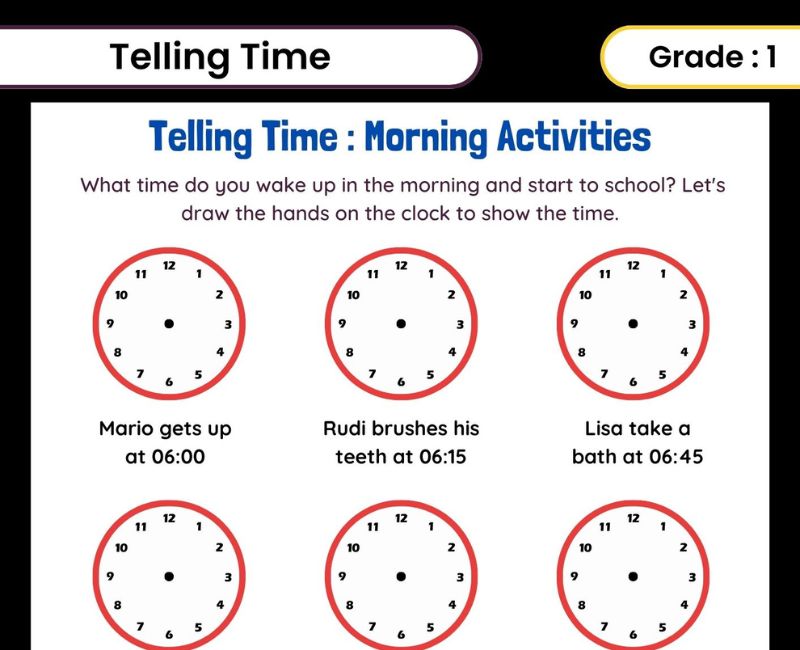
Explore these telling time worksheets for Class 1 with a picture quiz, ten online games and activities, and five practice sets. Read o’clock and half-past times using clear clock diagrams.
📝 Telling Time Online Quiz for Class 1
🔵 Short blue hand: hours · 🔴 Long red hand: minutes
Question 1 of 20 • Answered 0/20
The puppet show starts at the time on this clock. What time is it?
🎭 Puppet show
🎮 Telling Time Online Games for Class 1
1. 🛠️ Set the Workshop Clock
Set the clock to 2:30. Choose a hand, then tap or drag on the clock face. The step buttons also move both hands correctly.
Ready to explore.
2. 🃏 Clock-and-Digits Memory
Find two pairs. Each pair contains a clock picture and its digital time. Reveal two cards at a time.
Find both pairs.
3. 🚆 Deliver the Time Tickets
Tap a digital ticket, then the matching clock platform. Deliver all four tickets.
Ready to explore.
4. 🔢 Repair the Clock Face
The numbers 12, 3, 6 and 9 are missing. Tap a number, then its place: top, right, bottom or left.
Ready to explore.
5. 🧩 Build the Morning Timeline
These four clocks belong to the same morning. Tap them from earliest to latest.
Ready to explore.
🧠 Telling Time Online Activities for Class 1
6. 🔧 Repair the Half-Past Model
This model should show 10:30. The minute hand is already correct. Nudge the short hand until it is in the correct place.
Ready to explore.
7. 🚌 Fill the Half-Hour Stops
A pretend bus leaves at 5:30 and reaches its final stop at 7:00. Fill the two missing half-hour stops in order.
Start
Finish
Ready to explore.
8. 🧺 Sort O’Clock and Half Past
Tap a clock card, then put it in the o’clock basket or the half-past basket. Sort all four.
Ready to explore.
9. 📅 Design a Two-Event Plan
Plan two imaginary events on the same afternoon, between 1:00 and 5:30. The second event must start later than the first. Many plans work.
Ready to explore.
10. 👯 Find Clock Cousins
Choose exactly two clocks with the same hour: one o’clock clock and one half-past clock. More than one pair works.
Ready to explore.
✏️ Five Telling Time Practice Sets
1. 🔎 Explore a Clock
Choose an hour and either 00 or 30 minutes. Build the clock and read its time.
Ready to explore.
2. ✏️ Write the Clock Time
Read this clock. Write the hour and the minutes in separate boxes.
Ready to explore.
3. ➡️ Cross the Twelve Boundary
A clock shows 11:30. Write the time 30 minutes later.
+ 30 minutes → ?
Ready to explore.
4. ↔️ Compare Two Clock Pictures
Both clocks belong to the same afternoon. Write A or B for the later time.
Clock A
Clock B
Ready to explore.
5. 🧩 Build the Time Phrase
This clock shows 11:30. Tap the three word tiles in order to name the time.
Ready to explore.
💡 Telling Time Learning Tips
Five Parent and Teacher Tips
Identify the hands first. Use a movable clock. Match clock pictures with written times. Show that both hands move. Use your family’s actual routine rather than assuming every child follows the same schedule.
Six Tips for Students
Find the long hand. Check where it points. Find the short hand. Notice whether it has moved past an hour number. Write the hour and minutes. Check both hands again.
📄 Telling Time Worksheets for Class 1
Read the Telling Time Learning Guide
Look at both hands
Telling time worksheets for Class 1 help children connect a clock face with written time. The short hand indicates hours and the long hand indicates minutes. Hand length matters: real clocks may use different colours from the blue and red teaching model on this page.
Begin with o’clock times
At an o’clock time, the minute hand points to 12 and the hour hand points to an hour number. The digital minutes are 00. Practise mixed examples so children read both hands instead of relying on a memorised sequence of clock pictures.
Notice the half-hour movement
Half past means 30 minutes after an hour. The minute hand points to 6, while the hour hand sits halfway towards the next hour. Read the hour that has already begun. Move a teaching clock from a whole hour to a half hour to see both hands change.
3:00
3:30
Connect pictures, words and digits
Ask children to read a clock, write its time and then build that time on another clock. In a digital display, the numbers before the colon show the hour and those after it show minutes. A basic twelve-hour clock face alone cannot establish whether an event happens in the morning or evening.
Combine paper and online practice
Use the existing download option for the printable worksheets. The online activities add setting hands, arranging times and repairing clock models. Begin with whole hours and introduce half hours with support. The language selector changes this interactive section, not the downloaded PDF.
💬 Telling Time FAQs
How should I start teaching time to Class 1?
Recognise clock numbers and hands, practise whole hours, then introduce half hours when the child is ready.
Which hand shows the hour?
The shorter hand indicates the hour.
Which hand shows the minutes?
The longer hand indicates the minutes.
Why does the minute hand point to 12 at o’clock?
That position represents zero minutes past the hour.
What does half past mean?
It means 30 minutes after an hour.
Where does the minute hand point at half past?
It points to 6, representing 30 minutes.
Does the hour hand move between numbers?
Yes. It moves gradually and sits between hour numbers at half past.
How do I read a digital time?
Read the hour before the colon and the minutes after it.
Can an ordinary clock face tell morning from evening?
Not by itself. You need context or an AM/PM indication.
How can I help children draw clock hands?
Start at the centre, keep the hands different lengths and check their positions.
What if my child reads the next hour at half past?
Show that the short hand has not yet reached the next hour number.
Where are the worksheet and quiz answers?
Use the existing worksheet download option. End Quiz opens the online answer review.
 Download